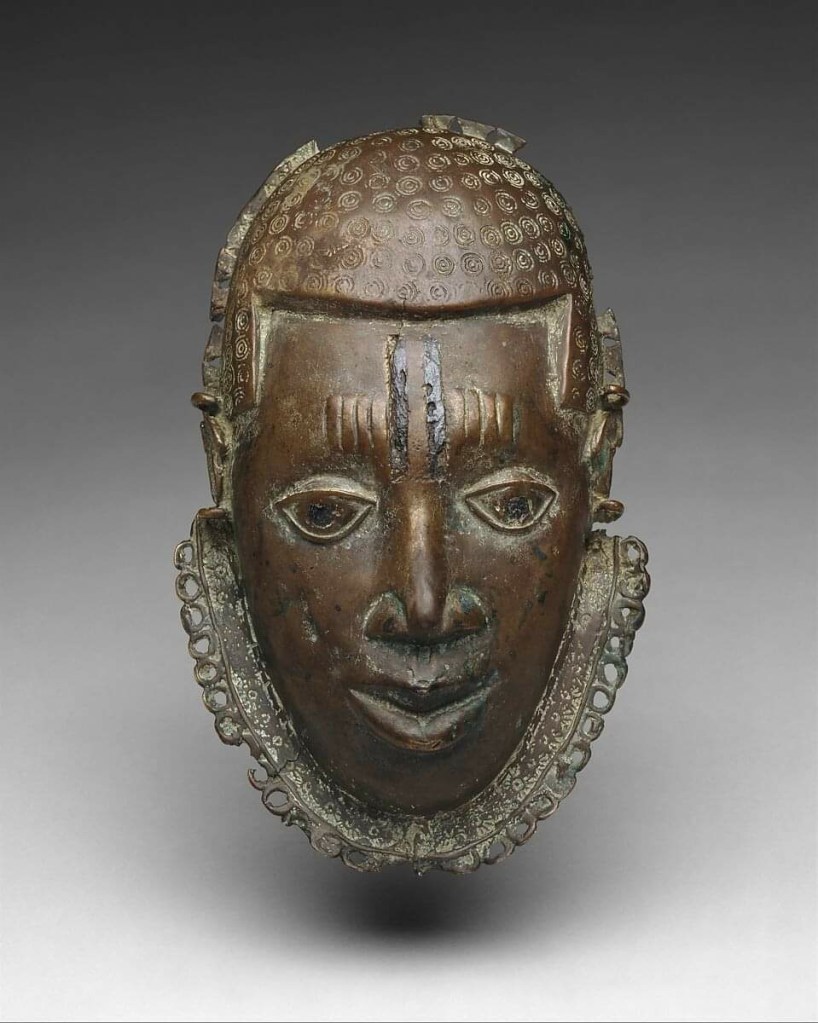
The rulers of Owo wear a number of ceremonial ensembles that are of Edo origin. One of these, called orufanran, consists of pants and a jacket sheathed in appliquéd scales of red flannel and studded with carved ivory ornaments. These pendants and masquettes mirror in their size and appearance those found at Benin—leopard, crocodile, and ram’s heads (1991.17.123), as well as the faces of human rulers, allude to the extraordinary and fearsome powers of the king. Although similar to their Edo counterparts in form and function, they differ in the material from which they were made: ivory, rather than brass, was the favored material of Owo rulers at this time. The skill of Owo’s ivory carvers was also appreciated at the court of Benin. During the seventeenth and eighteenth centuries, Benin’s rulers increasingly utilized insignia made from ivory and imported Owo’s art objects and recruited its artisans for their own royal workshops.
Source: Alexander Ives Bortolot: Department of Art History and Archaeology, Columbia University (Perspective of a foreign researcher)
The rulers of Owo wear a number of ceremonial ensembles that are of Edo origin. One of these, called orufanran, consists of pants and a jacket sheathed in appliquéd scales of red flannel and studded with carved ivory ornaments. These pendants and masquettes mirror in their size and appearance those found at Benin—leopard, crocodile, and ram’s heads (1991.17.123), as well as the faces of human rulers, allude to the extraordinary and fearsome powers of the king. Although similar to their Edo counterparts in form and function, they differ in the material from which they were made: ivory, rather than brass, was the favored material of Owo rulers at this time. The skill of Owo’s ivory carvers was also appreciated at the court of Benin. During the seventeenth and eighteenth centuries, Benin’s rulers increasingly utilized insignia made from ivory and imported Owo’s art objects and recruited its artisans for their own royal workshops.
Source: Alexander Ives Bortolot: Department of Art History and Archaeology, Columbia University (Perspective of a foreign researcher)
 Hi welcome to my website