On this day in 1990, a faction of the Nigerian Armed Forces, led by Major Gideon Orkar.
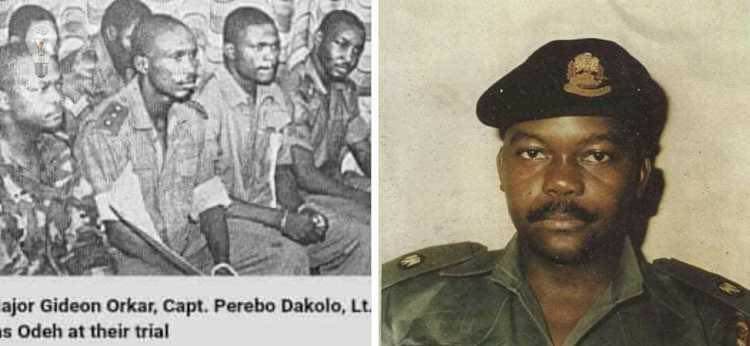
On this day in 1990, a faction of the Nigerian Armed Forces, led by Major Gideon Orkar, attempted a military coup against the government of General Ibrahim Babangida. The rebels seized the FRCN radio station and various military posts around Lagos, including the military headquarters and the presidential residence in Dodan Barracks.
In a live broadcast, Orkar announced the overthrow of Babangida and the excision of five northern states from Nigeria. However, the coup ultimately failed, and Orkar was captured. He and 41 co-conspirators were convicted of treason and executed by firing squad on July 27, 19901.
This event remains a significant moment in Nigerian history, reflecting the tensions and power struggles of that era.
The most radical point in his rambling speech was his decision to “temporarily” excise some states from the country as if they were a bunch of badly behaved children being told by an angry parent to stay out of the house until they learnt their manners.
While some Nigerians at the time found reasons to be excited by that speech, as they have been about other coups before, others deduced the reasoning and heard the voice of a radically naïve officer.
That speech alone was the switch to Orkar’s spotlight. The beginning, if you like, of his 15 minutes of fame. It was ironically also the speech that hanged him and the 68 or so other officers executed alongside him on account of their actions that day in Lagos in 1990.
At the time Orkar came on air, the coup plotters were still far from achieving their objective of overthrowing the government. Yes, they had secured the radio station from where they made the broadcast, held, for a short time, Dodan Barracks, the seat of the military government at the time, and some other locations, but they had not secured or neutralised Gen. Babangida or his Chief of Army Staff, then Lt. Gen. Sani Abacha. They had not in fact secured any loyalties or positions outside of Lagos.
In those hours of uncertainty, with Abacha, who had survived an assassination attempt that morning, trying to rally troops and assess who was loyal to Gen. Babangida or not, Orkar went on air and blew out the candle of his own revolution.
He announced that “a temporary decision to excise the following states namely, Sokoto, Borno, Katsina, Kano and Bauchi from the Federal Republic of Nigeria comes into effect immediately until (some) conditions are met.
It was, in all honesty, a speech that was Trumpish—before Donald Trump himself invented that genre of absurdity. It was chaotic, puerile and vindictive. It was also conflating where it described Gen. Babangida as a power-grabbing self-perpetuating tyrant while in the same breath accused a clique of hijacking Babangida’s government.
The conditions for the reabsorption of these temporarily excised states were also infantile. Unlike other coup plotters, like Maj. Chukwuma Nzeogwu for instance, who were careful to put the country and its unity front and centre in their speeches, Orkar, who lacked Nzeogwu’s charisma and popularity within the army, reduced his speech to projecting regional sentiments ahead of the country. There was a persistent reference to perceived injustices to the Middle Belt (where he was from) and the South and officers from those regions.
OnThisDay #TodayInHistory #History #Coup #Babangida #IBB #GideonOrkar
 Hi welcome to my website