WHITEWASHED COSPLAY VS AUTHENTIC NILE VALLEY AFRICAN HAIRSTYLES
WHITEWASHED COSPLAY VS AUTHENTIC NILE VALLEY AFRICAN HAIRSTYLES
The first image is some random movie on Netflix which depicted two Arabs with hairstyles supposedly worn by the ancient Kemetyu (Egyptians). However these wigs looks totally un-natural and ridiculous on the actors. When side by side with actual Africans who still wear the hairstyles of the ancient Kemetyu the fake is easily noticeable next to the authentic.
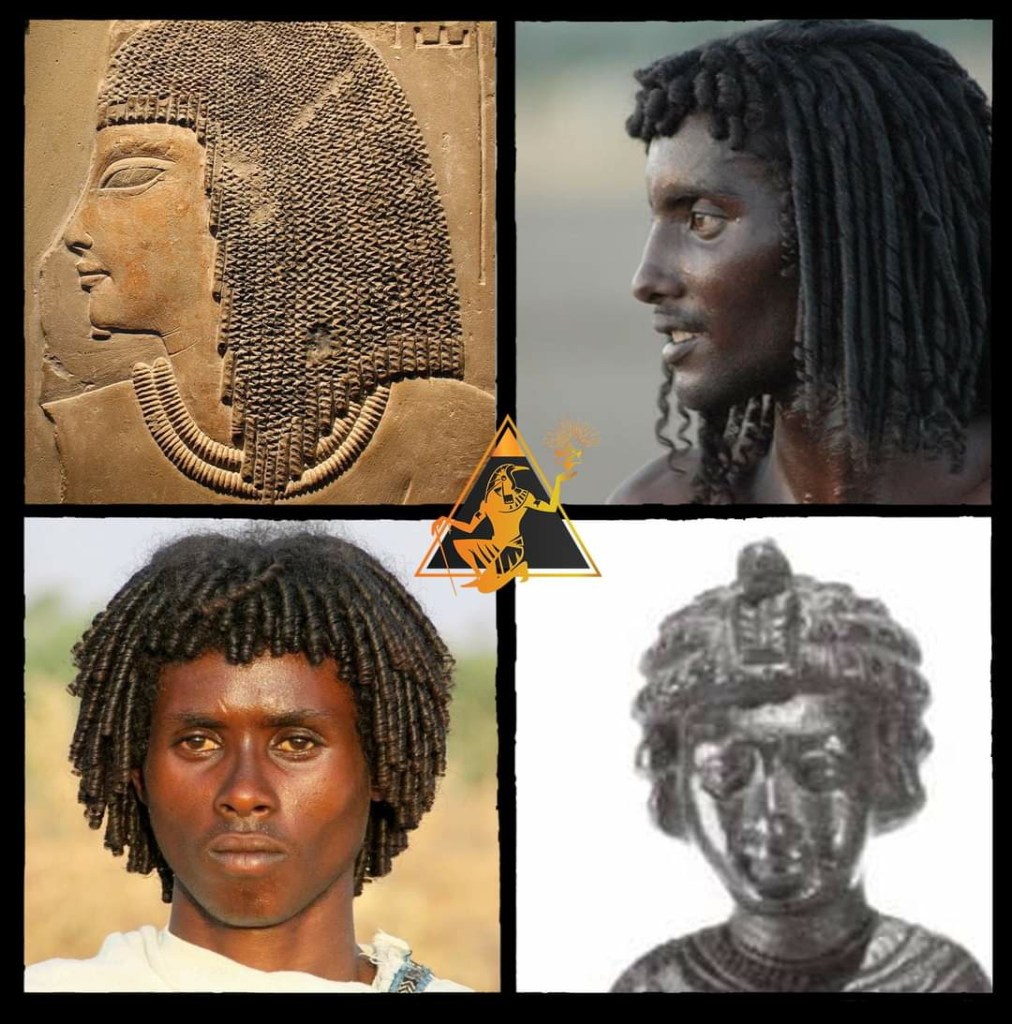
In Ancient Kemet 𓆎𓅓𓏏 hair was an embodiment of their identity and many of their crowns drew inspiration from ancient African hairstyles. Hairstyles carried religious and social significance and portrayed information about gender, age, and social status. The Kemetyu 𓆎𓅓𓏏𓏪 (km.tw, ancient Egyptians) wore elaborate braids, locs and short twists. Some even wore wigs as evidence of the 3300 year old Wig of Merit, whom was the wife of Kha (Tomb TT8). This however was rare due to the exorbitant coast to produce. Only Elites sometimes wore wigs but was even rare for them. While some have made the claim that the likes of Queen Nefertiti and Queen Ankhesenamun wore the Nubian Lappet Wig, there is no evidence such a wig existed and none have been recovered suggesting that this Nubian Lappet was not a wig and was simply a natural hairstyle.
In these images were shown the process of how Africans achieved the Nubian Lappet hairstyle or twisted loc style which is it is referred to as today. Some have claimed this to be a wig rather than his natural hair. Although Eurocentric academics claim this to be a wig, not one Nubian Lappet Wig has been discovered in over a century of excavations. Needless to say it was not a wig, and rather these elaborate boisterous hairstyles were actually their natural hair.
In a 2009 study British archeologist Geoffrey Tassie acknowledges the importance of Kemetic hair in the portrayal of social and class status stating, “hairstyles were a means of displaying status. An institutionalized cannon for hairstyles was established coinciding with the creations of administrative institutions. These codified hairstyles continued to serve as the norms for identifying members of the administration or signs of authority.” The study of ritualistic and hierarchal hairstyles in ancient Africa is called ethno-trichology.
The Kemetyu 𓆎𓅓𓏏𓏪 (ancient Egyptians) and Nehesi 𓅘𓎛𓋴 𓇋 (Nubians) had a variety of hair textures from curly to coarse that could keep its shape when certain oils and animal fats were added. They would slather butter onto their hair and scalp, protecting it from the sun which then could be twisted into locs, combed out into long flowing waves, or used to enhance curl definition. The most elaborate style was the Lappet hairstyle that consisted of layers of locs over lapping each other.
Prominent during the New Kingdom this hairstyle can be seen being worn by Nubian 𓅘𓎛𓋴 𓇋 Dignitaries on the temple walls of King Tutankhamun’s tomb (TT80). Although the layered Lappet style would fade from history, similar hairstyles are still practiced by Ethiopians and and people of African decent. Beeswax and cow fat are still used today 5,000 years later to achieve these elaborate designs specifically in Ethiopia.
Wigs were sometime worn however it was rare due to their high cost. The idea of wigs has been used by racist Egyptologist to explain away the obvious African textured hair and hairstyles seen widely throughout ancient Kemetic artwork.
- • •
In 2023, Professor Christopher Ehret reported that the physical anthropological findings from the “major burial sites of those founding locales of ancient Egypt in the fourth millennium BCE, notably El-Badari as well as Naqada, show no demographic indebtedness to the Levant”. Ehret specified that these studies revealed cranial and dental affinities with “closest parallels” to other longtime populations in the surrounding areas of Northeastern Africa “such as Nubia and the northern Horn of Africa”.
Ehret, Christopher (20 June 2023). Ancient Africa: A Global History, to 300 CE. Princeton: Princeton University Press. pp. 83–85.
“I have not spoken angrily or arrogantly. I have not cursed anyone in thought, word or deeds.” ~35th & 36th Principals of Ma’at
 Hi welcome to my website