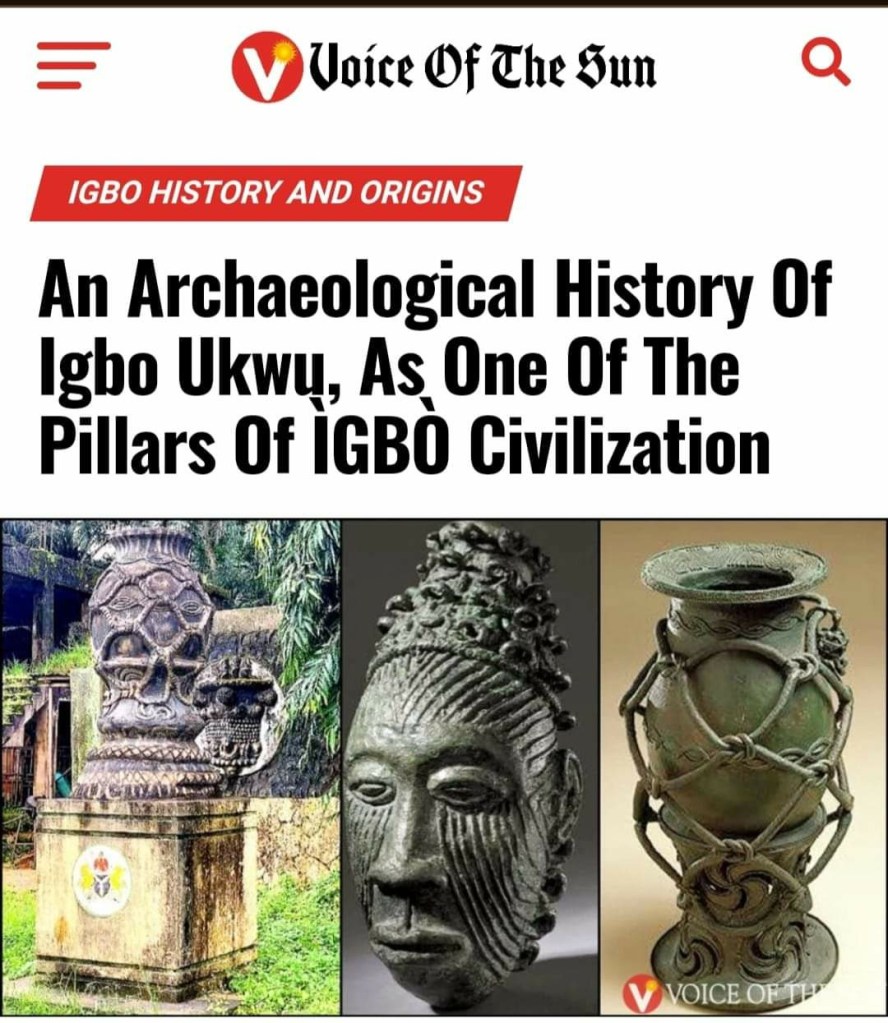
An Archaeological History Of Igbo Ukwu, As One Of The Pillars Of ÌGBÒ Civilization
An Archaeological History Of Igbo Ukwu, As One Of The Pillars Of ÌGBÒ Civilization
Ìgbò Ukwu is a prominent town in Aguata local government area of Anambra state in the southeastern part of Nigeria.
The town consists of seven villages partitioned into three main quarters namely; Obiuno, Ngo, and Ihite. Ìgbò Ukwu was formerly known as ‘Ìgbò Nkwo’ or just ‘Igbo‘; the name Igbo Ukwu translates as ‘Great Igbo’ — an ancient Igbo town that is significant for its contribution to Igbo civilization.
Ìgbò Ukwu is renowned throughout Ìgbò-land and beyond because of the ancient ceremonial bronze objects excavated from the area.
This discovery by an indigene of the town by name, Isaiah Anozie, attracted two British archeologists to probe the origin of these intricate objects. The outcome of this discovery cemented the belief that the Ìgbò Ukwu is one of the original cradles of the Igbo people.
This article will trace the origin of this prestigious town as well as its heritage and contributions to Ìgbò civilization. Ìgbò Ukwu is blessed with a great cultural heritage evident in their customs, arts, festivals, sacred sites, folklores, and indigenous technology.
Africa has for ages suffered heavy exploitation of their heritage and natural resources by the British in different forms such as; iconoclasm, artifact trafficking, and false documentation.
The great cultures of Ìgbò Ukwu were not exempted from this cruel exploitation, as some were abolished during the British colonization. Some of these extinct cultures are; Ahia mbibi ( A fattening ceremony done to prepare a bride for marriage), Okpensi (An annual festival in honor of the ancestors), Iwa ogodo ( A ceremony done to show that young men have matured).
These cultures collapsed when Ndi Ìgbò were manipulated into a sham marriage of modernity and Christianity by the missionaries and British colonial enterprise.
Connections Between Igbo Ukwu Bronzes and Igbo Ancestry Origin
Years after the British excavations had ended, an Ìgbò man, Onwuejeogwu, embarked on a different research adventure focused on identifying the origin of these excavated artifacts.
In his 1981 study, he pointed out the similarity of Ìgbò culture evident in Thurston’s discovery. He classified these trails into five sections namely; those associated with the Nri title, the Ozo title, the Ichi title, the rituals of Alusi and Mmuo, and Status and Prestige.
To support these trails, the present Nri culture functions near the spot where these artifacts were discovered. Also significant are the Ichi royal marks peculiar to ancient leaders in Ìgbò-land marked on some of the bronze objects from Thurston’s excavation.
The Ichi marks, however, did not wane with the Western civilization, so they were a great tool to prove the similarity between Ìgbò Ukwu finds and Igbo culture, as observed in studies by Equiano and John Adams.
On December 29th, 1989, the Ìgbò Ukwu museum was built to store, preserve and exhibit these artifacts. It is situated at Ngor-road, Ìgbò Ukwu along Nnewi-Ekwulobia road in Aguata, Anambra state.
This museum has since served as a tourist centre and enhanced new research on Ìgbò culture and civilization. In Ìgbò Ukwu, there’s also an ancient hut known as Obidege – designated as the Hut of the first son/settler of the Ìgbò race.
 Hi welcome to my website