
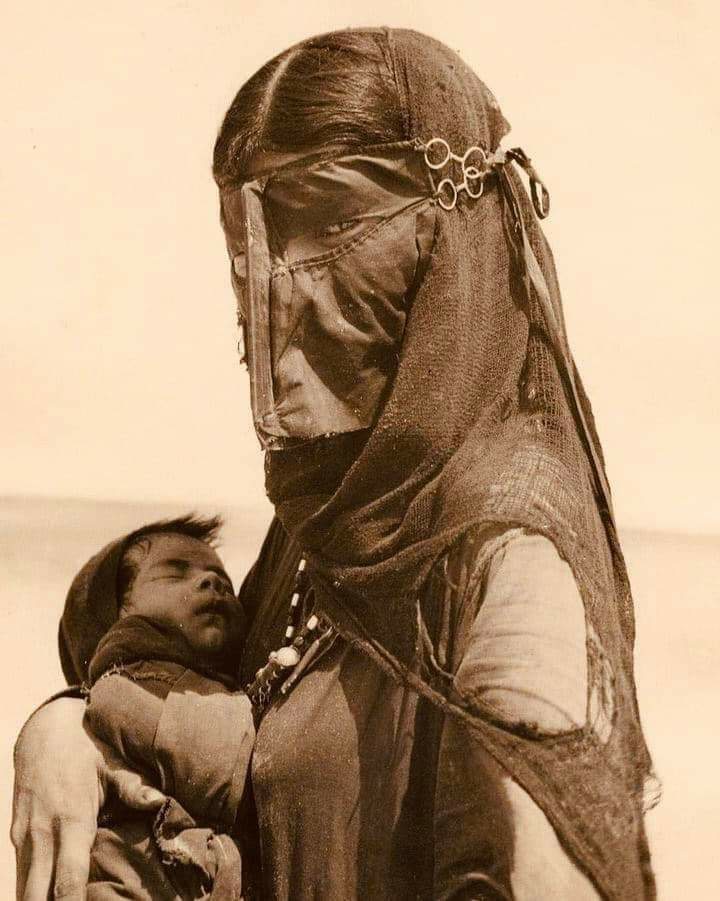
In the vast, arid expanses of Saudi Arabia in 1948, a Bedouin woman stood tall and graceful, cradling her child close to her heart.
In the vast, arid expanses of Saudi Arabia in 1948, a Bedouin woman stood tall and graceful, cradling her child close to her heart. The desert, with its endless dunes and relentless sun, was her home—a land where survival depended on both resilience and a deep connection to the earth and sky.
Her traditional clothing, made of flowing fabric that shielded her from the harsh desert elements, spoke of a culture deeply rooted in centuries-old traditions. The patterns and colors were not just decoration but a reflection of her tribe’s identity and the rich history of her people. Her face, partly covered by a veil, revealed eyes that were both fierce and nurturing, reflecting the strength required to raise a family in such a demanding environment.
The child in her arms, wide-eyed and curious, was the center of her world. Despite the challenges of desert life, she exuded a calm, protective energy, ensuring her child would grow up learning the ways of the Bedouin—an existence that balanced on the edge of modernity and ancient customs. Her lullabies, carried on the desert wind, would tell tales of their ancestors, who roamed these lands with the same dignity and grace she now embodied.
Life for the Bedouin people was one of constant movement, following the seasons and the needs of their livestock. The woman was not just a mother, but a vital part of this nomadic life—she managed the tent, prepared food, and passed down the wisdom of survival in the desert. Her knowledge of the land, from where to find water to understanding the signs of an approaching sandstorm, was crucial for her family’s well-being.
In 1948, Saudi Arabia was on the cusp of immense change. The discovery of oil had begun to transform the nation, and the traditional Bedouin way of life was slowly intersecting with the modern world. Yet, for this woman and her child, the desert remained a constant, a source of identity and sustenance in a rapidly evolving landscape.
As she stood there, her child nestled securely against her, the Bedouin woman represented the enduring spirit of her people—strong, adaptable, and deeply connected to the land that had shaped their way of life for generations. In her embrace, she held not just her child, but the future of a culture that would continue to thrive, even as the world around them changed.
 Hi welcome to my website