
Inside life:
BURKUTU (ASHA): THE NATIVE LIQUOR OF THE JUKUN PEOPLE
Inside life:
BURKUTU (ASHA): THE NATIVE LIQUOR OF THE JUKUN PEOPLE
It is called “Asha”by the Jukun-Wanu of Benue State, and “Acin” by Jukun-Wapan of Taraba State, and popularly known as BURKUTU by all the ethnic nationalities that consume it.
The origin of the name BURKUTU can not be adequately substantiated. Be that as it may, BURKUTU has been a long time native liquor brews and consumes largely by the Kwararafa People especially the Jukun-Wanu and Jukun-Wapan.
The essence of this article is not eulogize BURKUTU or encourage its excessive intake because It is alcohol base and can intoxicate anyone who takes it, but to uphold it’s importance and centrality to the Jukun culture, tradition and economy.
Prior to the advent of the foreign liquor, burkutu the native drink was and is still pivotal to the Jukun people. The importance of burkutu to the culture and tradition of the Jukun people can not be overstressed. As a matter of fact, burkutu is to Jukun culture what kolanut is to the Igbo culture of the Eastern Nigeria and koko or akamu to hausa culture of the northern Nigeria. In Igbo culture, it is believed that kolanut does not understand English language so anything that has to do with kolanut in Igbo land has to be native and cultural. Similarly, in Jukun Kingdom, burkutu does not understand English language except Jukun native dialect. So, incantation, chanting and other Jukun culturally related activities are in Jukun dialect and are not always complete without the presence of burkutu.
Apart from enhancing the smooth deliberations by the council of elders in their council meetings, burkutu also serves as the major instrument in appeasing the gods of the land in Jukun-Wanu traditional settings
Before the coming of the westernization and civilization into Jukun Kingdom, days of the week were determined by the procedures or processes involved in brewing burkutu. The process in brewing burkutu takes five to seven days before burkutu is finally ready for consumption. All the ingredients needed to brew burkutu were and are still natural, no artificial additives. No wonder the gods of the land in Jukun-Wanu Kingdom cannot be contaminated by and with artificialities. From the day the millet is soaked in the water, the days of the week begun in Jukun-Wanu calendar. From the day one when the millet is soaked to the day the burkutu is finally ready for consumption takes seven days. Among the Jukun-Wanu people, the basic ingredients for burkutu production include but not limited to; millet, guinea corn, sorghum and water. However, the procedure starts from dividing the grains into two halves by measuring it. One of the halves is soaked in some quantity of water. This is followed by extensive washing to remove the unwanted from the soaked grain. This washing is done morning and evening and is kept in a big basket to allow for ventilation and proper sprouting. All of this is done in a roomed temperature after which the washing is repeated in the second day of the soaked grains to hydrolyze the enzymes for two days.
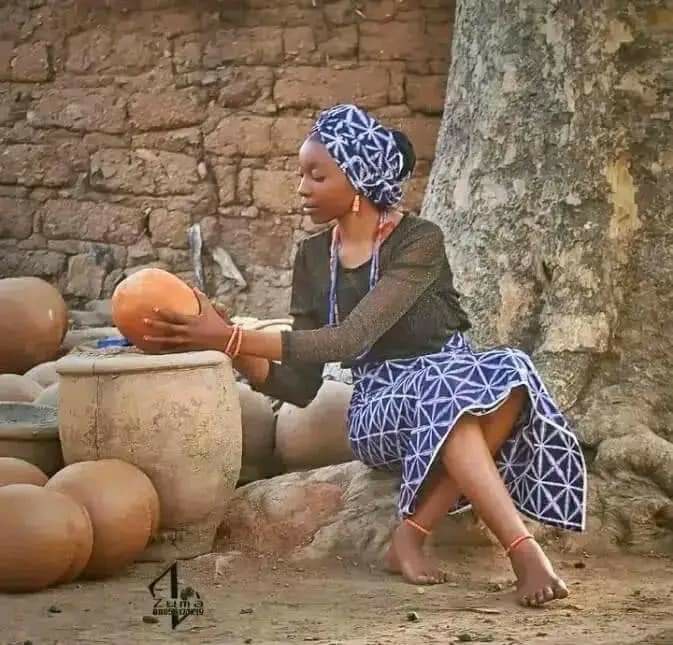
On the third and fourth day, the sprouted grains is then grinded by the traditional grinding stone. With the advancement of technology, the grinding is done with a modern sophisticated grinding machine, the grains are mashed into tiny semi-liquid form and then mashed. The mashed semi-liquid grinded grains are then mixed in a required quantity of water, the mashed semi-liquid grinded grains is then filtered using sieve. The mashed is then heated in a clay pot using firewood and fire, the boiling lingers till the liquid is thicken to the desired texture.
The boiling is normally accompanied with a continued stirring of the mash using pamfront. This is done periodically to remove the foams under an intensive heat of the fire until the mash is cooked thoroughly. It takes a period of approximately three to four hours for the mash to cook and the continues stirring up of the mash is to prevent any distilled deposit of mash from getting burnt and consequently contaminating the taste and flavor of the burkutu. The cooked mash is therefore shared among the pots to cool off naturally. The cooled mash is then filtered and this is done to obtain the chaff collected to be kept aside to feed the domestic animals.
On the fifth day, what is then known as “Afusha” in Jukun-Wanu dialect is also cooked under intensive fire heat and it is accompanied by the constant stirring all day long. As the heating continues, the liquid is thicken and this will produce what is known as “AZOR” in Jukun-Wanu dialect (wort) in English language. The essence of the second heating is to ensure more hydrolysis of the sugar in the sweet wort. The wort is allowed to cool naturally through the process of sharing in the native pot buried halfway down the ground, it is then properly covered to ferment to a desirable level of a normal taste of the burkutu.
On the third day of the process, the second half of the grains shared earlier is repeated but with the aim of a different desired result. This time, the desired product is known as “wuta-wuta” also known as “Autata”. To produce burkutu, both “AZOR” and “Wuta-wuta” is mixed together in a desired proportion. This mixing is done mostly at the late hours of the night ie 11 to 12 pm of the sixth day so that before the morning of the day seventh, the desired byproduct BURKUTU is produced with nice taste and flavor ready for consumption. Worthy of note is that a good burkutu produces a lot of bubbles on the surface from the beneath and it is mildly and looking very catchy to the sight. A good burkutu can stay for a period of 24 hours without getting depreciated in taste.
THE ECONOMIC IMPORTANCE OF BURKUTU TO THE JUKUN SOCIETY.
Burkutu is a source of income among the Jukun-Wanu women, it is also a source of livelihood among the Jukun-Wanu women. It is so because, it is sold both in rural and urban areas by the Jukun-Wanu women and by doing so, they earn their living. The proliferation of burkutu Houses in both urban and rural areas is a clear evidence that burkutu business is an employer of labour force. Many Jukun-Wanu women both old and young are employed to assist in the process of burkutu production. Many Jukun-Wanu women who take up good ventures from buruku business are doing well in it. Some are able to build their personal houses and train their children in school for a better future endeavours.
As noted earlier in this article, burkutu is used to appease the spirit of the ancestors, when the ancestors are angry, they bring calamities as punishment for its victims, sacrificial burkutu is then brewed to appease the gods and ancestors who’s spirit has been offended. It is done through prayers and making of libations in the early morning, evening or as dictated by the spirit of the gods and ancestors. When the gods are at peace, everything will flourish well in the kingdom and calamity will be averted.
Burkutu is also used for the ceremonies such as; festivals, burial, marriages, naming of new born babies, funerals oration and even installation of AKU (Chief) or titleholders (Wacha) among the Jukun people. Burkutu also plays significant role during relaxation of the peer group, it is used as a tool for mobilization of labour in the family and communal works, especially farming; it is also used for traditional cleansing rites. It is used as fine for defaulters of community laws. In fact, drinking of burkutu brings people of the same village or neighbouring communities together both old and young, men and women especially among the traditionalists. No wonder, burkutu is a unifying tool that when properly utilized by the government of the day can go along way to broker peace between the Jukun and Tiv in the ongoing communal crisis since the both ethnic groups concerned are fans of this native drink.
Today, this native drink is brewed and consumed by virtually all the ethnic nationalities in the middle belt of Nigeria and even beyond the shores of it.
Embrace westernization and civilization but not at the detriment of your culture and tradition.
One Nigeria, unity is the essence
 Hi welcome to my website