DECODING NARMER’S PALLET: THE WORLDS FIRST POLITICAL DOCUMENT
DECODING NARMER’S PALLET: THE WORLDS FIRST POLITICAL DOCUMENT
Although Narmer was not the first Pharaonic King of the Nile Valley he was the first Great Unifier who unified the two Land of Upper and Lower Kemet, known as Semi Tawi, which translates to the Union of the Two Lands. Narmers Palette is known as the world’s first political document which depicts the formation of the nation of Kemet. Narmer’s company came from the south called Ta-Shamau “Land of Reeds”, donning the hedjet, the white crown of Upper Kemet. He conquered the various African and Asiatic populations occupying the Delta and established rulership.
Symbolically the Pschent, the Double Crown of Both Lands represented dominance over the Delta and the unification of the two lands of Upper and Lower Kemet. Upper Kemet was the seat of its political power and Pharaonic Kingship developed in and around Qustul, Elephantine and Waset (Thebes).
Narmer conquered the Mediterranean population occupying the Delta and established rulership creating what is now widely known as ancient Egypt. After marching south from the city of Tjenu, and uniting the two lands, Lower Kemet would become a major hub for trade and commerce for the Southern Monarchs as the Delta was a transcontinental highway connecting Africa to the near East and Mediterranean world.
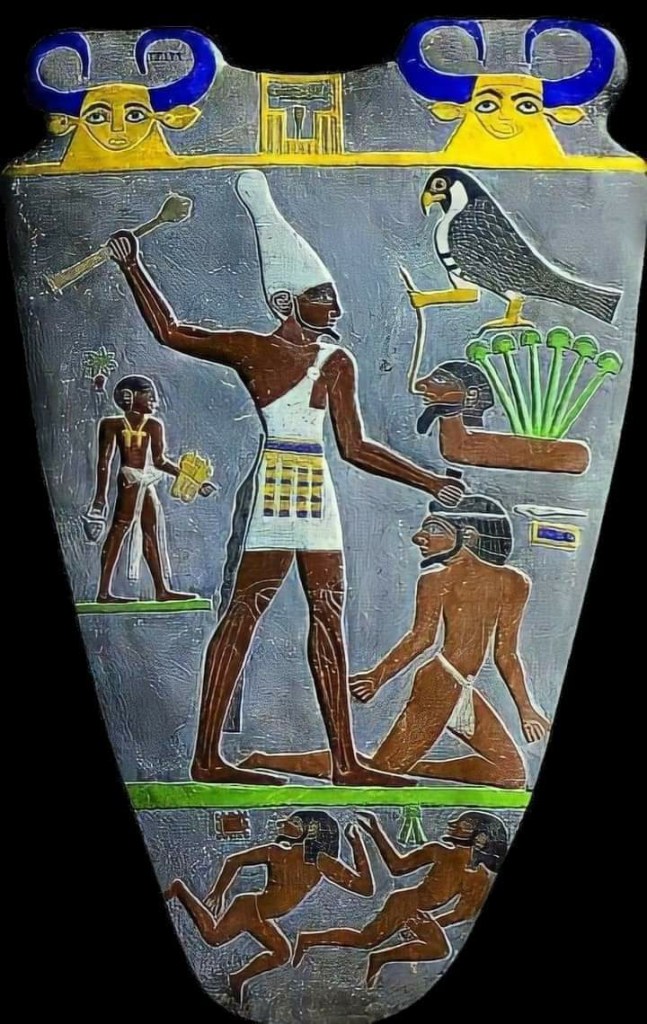
Narmer’s Pallet, dating back to around 3100 BCE, is an iconic artifact from ancient Kemet that symbolizes the unification of Upper and Lower Kemet under Pharaoh Narmer. This ceremonial palette, made of slate, is intricately carved on both sides, showcasing significant events from Narmer’s reign. On one side, the pharaoh is depicted wearing the crown of Upper Kemet, while on the opposite side, he wears the crown of Lower Kemet, visually representing the union of the two regions. The carvings illustrate Narmer in powerful poses, including smiting an enemy, which emphasizes his role as a conqueror and protector.
Additionally, the presence of symbolic creatures, such as the falcon representing Heru (Horus), signifies divine authority and the pharaoh’s connection to the gods. The palette also serves a practical purpose; it is believed to have been used for mixing cosmetics, which were vital in ancient Kemetic (Egyptian) rituals. Overall, Narmer’s Pallet not only reflects the political and social dynamics of early dynastic Kemet but also stands as a testament to the pharaoh’s power and the significance of art in conveying historical narratives. This artifact is crucial for understanding the foundations of ancient Kemetic civilization and the development of its complex iconography.
Breakdown of Narmer Pallet:
- Heru (Falcon): The falcon represents the god Horus, who was associated with kingship, the sky, and protection. In the context of Narmer’s Palette, Horus symbolizes the divine authority of the pharaoh and his role as a protector of the nation. The depiction of Horus holding a rope around a captive signifies the pharaoh’s power over his enemies and his divine right to rule.
- The Bull: The bull is shown in a dynamic posture, displaying strength and aggression. It is often interpreted as a representation of the pharaoh, symbolizing his power and authority over his enemies. The bull’s muscular form emphasizes its might, reinforcing the idea of the pharaoh as a fierce warrior.
The man beneath the bull is typically interpreted as a defeated enemy or a symbol of chaos. - Asiatic Enemy: The defeated man being tramped by the bull is depicted in a prone position, illustrating his vulnerability and defeat. He is depicted with a different hairstyle and possibly different clothing compared to the Kemetic figures. This suggests he represent a non-Kemetic or a person from a rival culture from the near east known as the Aamu which translates to “Asiatic” also known as the Hycksos, Asiatic invaders responsible for the invasions of the 1st and 2nd intermittent periods known as dark ages of Nile Valley history.
- Iconography: The scene is rich in iconographic meaning. The act of trampling suggests the pharaoh’s triumph over chaos and disorder, underscoring his role as a protector of the nation. The bull’s action symbolizes the pharaoh’s strength in maintaining control and asserting dominance.
- Serpopards: These mythical creatures, which have long necks and leopard-like bodies, are often interpreted as symbols of chaos or foreign lands. The two serpopards are depicted with intertwined necks, suggesting the unification of Upper and Lower Kemet. The men capturing the beast have round snub noses same as Narmer and large African textured Afros showing a clear African phenotype unlike the man being trampled by the bull which has a clear Asiatic Phenotype. Their presence emphasizes the pharaoh’s victory over the Asiatics of the Delta and his control over chaos and his ability to bring stability and order to his realm.
- Lotus and Papyrus Plants: The palette features the lotus, representing Upper Egypt, and the papyrus plant, symbolizing Lower Egypt. Their inclusion highlights the harmony and unity between the two regions, reinforcing Narmer’s role in unifying the kingdom.
Overall, the creatures on Narmer’s Palette serve to illustrate the themes of power, divinity, and the unification of Kemet, making it a vital artifact in understanding the early dynastic period and the symbolism of pharaonic rule.
“King of Upper Kemet…Beautiful is the Ka-Soul of Ra who appears in Waset”
Truth Restored!
 Hi welcome to my website