
COLOR AND IDENTITY IN HISTORICAL DESCRIPTIONS
COLOR AND IDENTITY IN HISTORICAL DESCRIPTIONS
Historically, people did not commonly use hair color as a primary identifier for different groups or races…
Instead, distinctions were typically made based on broader physical traits like skin complexion…
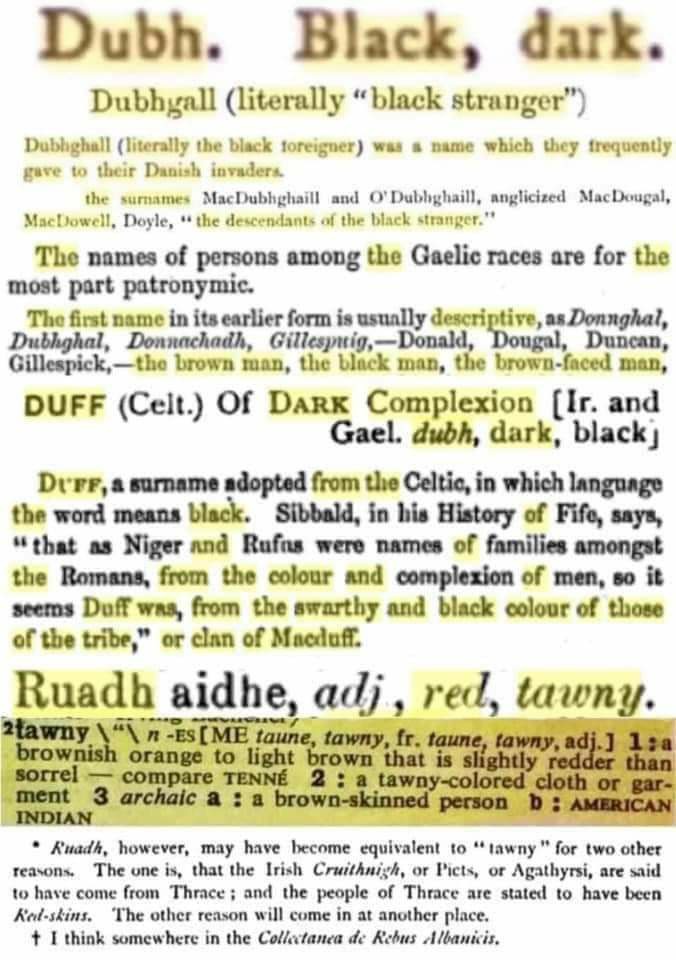
Besides the general term of Gentiles, that of Gall, the Irish word for stranger, was likewise applied to them, and two nations were distinguished as Finngaill, white Galls, and Dubhgaill, black Galls—the former being Norwegians, and the latter, Danes…
The typical Dane of today is not a black haired man; quite the reverse…
And dubh means black, without any word of hair…
These two sections of invaders were also known as Finn Gennti, and Dubh Gennti, White Gentiles and Black Gentiles; and as Fionn-Lochlinneaich, and Dubh-Lochlinneaich, White and Black “Lochlinners” or Scandinavians…
And, in “the wars of the Gaedhil and the Gaill”, the Danari are styled “black Danars,” or “black Danes.”
In none of these terms is there any hint that the colour of the hair is indicated…
But the expression used by St. Berchan in speaking of the Norwegians leaves no room for doubt…
He calls them “the Gentiles of pure colour.”
The Danes, then, were not “of pure colour.”
They were dubh, or black.
There can be no question about it…
The designation given by the common people of one race to another is almost invariably founded upon some physical feature, and the most natural distinction is that of colour where the races differ in complexion…
The invading whites styled the “Indians” of America “Red-skins,” and these again called their conquerors “Pale-faces.”
A native Australian is a “black-fellow” to the modern Briton…
Other “Blacks” are roughly spoken of either under that title or, under its other form, as “Negroes.”
Therefore, when the white races of Britain styled the Danes “Black heathen,” they simply made use of the most natural term that could occur to them…
William Forbes Skene includes the terms ban and finn (white), ciar and dubh (black), dearg and ruadh (red), liath (grey), glas (green [also grey]), gorm (blue), breac or brit (speckled), among “the names of the primary colors which enter into the composition both of names, persons, and places,”
To these may be added donn, brown—which word is indeed no other than dun and tawny; and also buidhe, yellow…
Of these terms it has been shown that green and blue, so often interchangeable with black and brown, relate to the woad stained, dark skinned races…
It is obviously absurd to suppose that the distinguishing agnomens green, blue, and speckled have to do with hair…
Why, then, should the other?
One who knows Gaelic intimately, both as a spoken and as a written language, translates ruadh or red as tawny…
It is not so very long ago that “an American” meant “a red Indian” or “a red man”
⁷Did native Americans or “Indians” have red hair or red (tawny) skin???
 Hi welcome to my website