
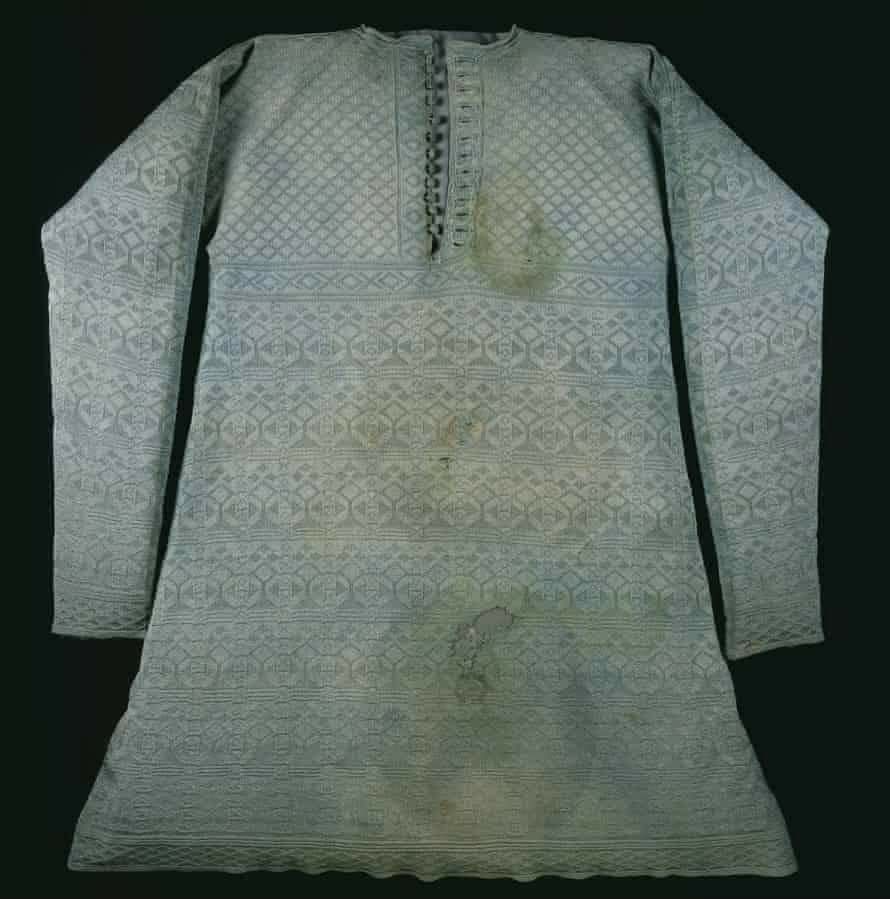
CHARLES I by Anthony Van Dyck c. 1635 & the silk vest worn by him when he was beheaded, in 1649
CHARLES I by Anthony Van Dyck c. 1635 & the silk vest worn by him when he was beheaded, in 1649
This is the detail of a painting now titled by museum curators at the Royal Museums of Fine Arts of Belgium as “Four Studies of a Head of a Moor” by Sir Anthony van Dyck c. 1635…
See it here:—https://artsandculture.google.com/asset/four-studies-of-a-head-of-a-moor-peter-paul-rubens/LgE6l73zlShsKQ?hl=en
In 1632, Van Dyck became the main court painter for Charles I of England…
He is best known for his portraits of the aristocracy, most notably Charles I…
For a long time “experts” were divided on whether to ascribe this painting to Rubens or to Van Dyck…
Investigations into another painting titled “Charles I in Three Positions”, by Van Dyck shows a caricature of the king from three viewpoints:—left full profile, face on, and right three-quarter profile—The clothing varies across each portrait—each portrait has a different coloured costume…
See it here: https://en.m.wikipedia.org/wiki/Charles_I_in_Three_Positions
As with the “Four Studies of a Head of a Moor”, it’s shown from three viewpoints—left three-quarter profile, left profile, and right profile—the clothing varies across each portrait—each portrait has a different colored costume…
Charles II is described verbatim by his contemporaries in first hand historical accounts as a tall black man…
“Charles the second was, in the popular language of the day, a tall black man”
SOURCE;
(Norman Chevers, ‘An Enquiry into the circumstances of the Death of King Charles the Second’; 1861)
Colonel George Gounter, helped Charles II to escape from England after the battle of Worcester…
“Colonel Gounter mentions that, shortly after the King had left Brighton, “soldiers came into the town to search for a tall black man, six feet two inches high,” meaning the King”
SOURCES;
(Henry Cary, ‘Memorials Of The Great Civil War In England From 1646 To 1652 ; Edited From Original Letters In The Bodleian Library Volume 2’; 1842)
(George Gounter, ‘The Last Act in the Miraculous Story of King Charles the Second’s Escape Out of the Reach of His Tyrannical Enemies … Now First Published from the Original MS’; 1846)
(“A Narrative of The Adventures of Charles the Second after The Battle of Worcester”; 1859)
His sons and grandson, are also described verbatim in first hand historical accounts as tall black men, and as having “black complexions”…
COMPLEXION = the natural color, texture, and appearance of a person’s SKIN especially of the FACE.
DUKE OF NORTHUMBERLAND— “a tall, black man, like his father the King”
DUKE OF GRAFTON— “grandson to King Charles II; a tall black man”
CHARLES LENNOX, DUKE OF RICHMOND— “black complexion, much like King Charles”
DUKE OF ST. ALBANS—“son to King Charles the Second, he is of a black complexion”
SOURCE;
(Memoirs of the Secret Services of John Macky, Esq., During the Reigns of King William, Queen Anne, and King George I. Including, Also, the True Secret History of the Rise, Promotions, & of the English and Scots Nobility, Officers, Civil, Military, Naval, and Other Persons of Distinction, from the Revolution, in Their Respective Characters at Large; 1733)
The royal Stewart line was founded by Robert III…
Robert III—born John Stewart—was King of Scotland from 1390 to his death in 1406…
He was the eldest son of Robert II…
“They Lineally descended of Sir John Stewart, (commonly called the Black Stewart, from his Complexion) Son to King Robert the II …”
SOURCE;
(George Crawford, “A Genealogical History of the Royal and Illustrious Family of the Stewarts”; 1710)
“From his dark complexion, he was known as The Black Stewart”
SOURCE;
(John MacArthur, “The Antiquities of Arran”; 1873)
 Hi welcome to my website