
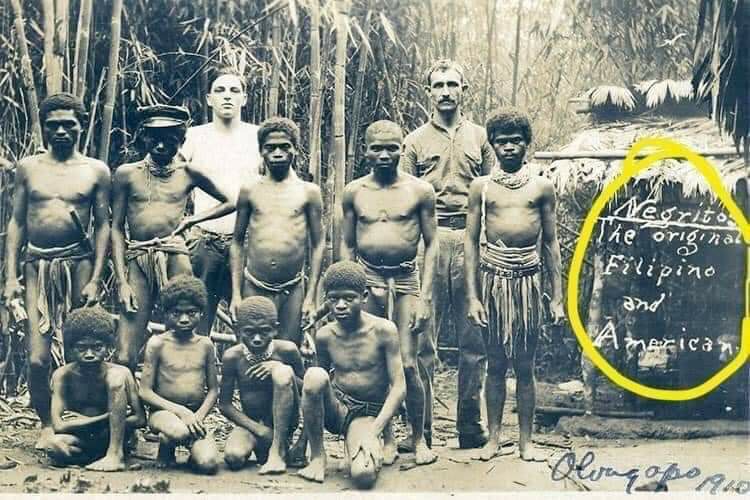
THE ORIGINAL FILIPINO & AMERICAN—Olongapo, Philippines, 1910
THE ORIGINAL FILIPINO & AMERICAN—Olongapo, Philippines, 1910
(Photo courtesy of the U.S. Marine Corps Archive)
Somebody in the U.S. Marine Corps circa 1910 acknowledged the “Negrito” as the original American… (see photo below)
The term Negrito refers to several diverse ethnic groups who inhabit Southeast Asia and the Andaman Islands…
Haplogroup Q is the predominant Y-DNA haplogroup among modern Native Americans…
Haplogroup P is the direct paternal ancestor of haplogroup Q…
Haplogroup P is primarily found in indigenous populations of Melanesia, Southeast Asia, and parts of Oceania…
Haplogroup P is found today in parts of Southeast Asia, Melanesia, and Oceania, which means that these regions retain populations with the ancient haplogroup from which Q (Native Americans’ Y-DNA) descended…
The fact that Haplogroup P individuals are found today in these regions indicates a shared ancient lineage…
As individuals carrying Haplogroup P migrated north, some of their descendants became the Haplogroup Q individuals who would eventually populate the Americas…
Haplogroup P is found at its highest rate among members of the Aeta, a people indigenous to Luzon who formed from various ancient groups, such as Oceanians and Austronesian peoples…
Aeta is a collective term for several indigenous peoples who live in various parts of Luzon island in the Philippines…
They are included in the wider Negrito grouping of the Philippines and the rest of Southeast Asia, with whom they share common physical characteristics such as: dark skin tones; short statures; frizzy to curly hair…
They are thought to be among the earliest inhabitants of the Philippines—preceding the Austronesian migrations…
 Hi welcome to my website