SHEM & THE CHARACTER OF THE GREAT PYRAMID:
SHEM & THE CHARACTER OF THE GREAT PYRAMID:
Many are curious about how the ancient Egyptians managed to construct the pyramids using intricate mathematical calculations…
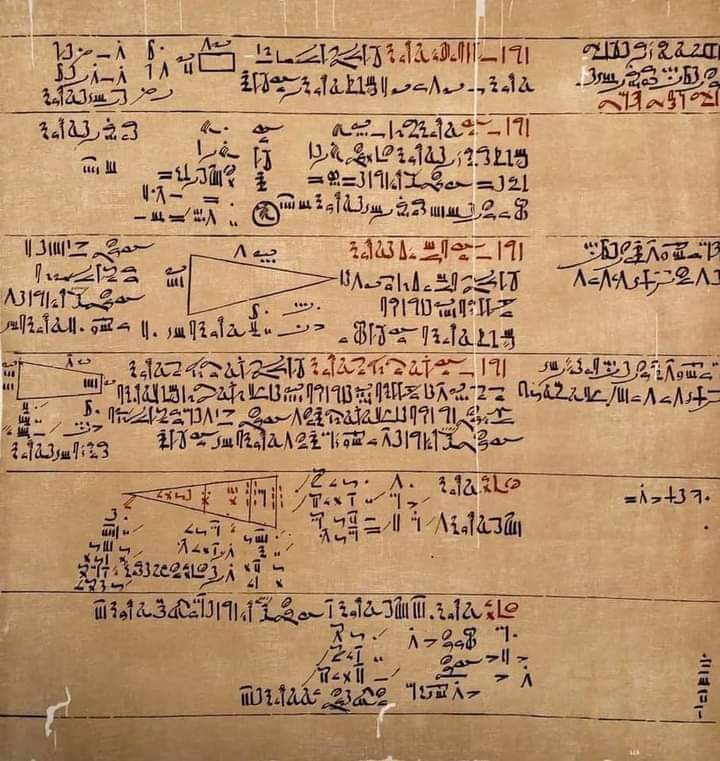
The Papyrus of Ahmose, also known as the Mathematical Rhind, is the oldest known manuscript featuring algebra and trigonometry…
Its origins trace back roughly 3500 years ago…
This manuscript reveals that the Egyptians were proficient in employing first-order equations and had various methods to solve them…
They were also well-versed in quadratic equations, adept at solving them, and familiar with numerical and geometric sequences…
For instance, they were capable of handling equations like:
X2 + y2 = 100
Y = 3/4 x, where x = 8, y = 6
This equation serves as the foundation of the Pythagorean theorem, a2 = b2 + c2
Pythagoras developed his mathematical theories after a visit to Egypt, where he learned from Egyptian priests…
Remarkably, the Egyptians had mastered algebra, trigonometry, and geometry approximately 2,000 years before Pythagoras was born, and even around 3,000 years prior to the birth of al-Khwarizmi…
We may here briefly recapitulate the evidence in proof of the Shepherd kings being the Pyramid builders, Suphis I and Suphis II…
Cheops is a corruption by the Greeks of the Egyptian name Shufu or Khufu…
There is a feature in the names of Suphis I and Suphis II which tends to further identify them with the Shepherd kings…
Shufu, or Shuphu, the Egyptian form of their names, means “much hair,” a characteristic which distinguishes them in a radical manner from the Egyptians proper, who carefully shaved…
Similarly Eratosthenes calls Suphis, “Saophis Comastes,” which is the Greek for “longhaired.”
This was a distinguishing characteristic of the Semitic Patriarchs and Shepherd kings, and Shepherds were always represented by the Egyptians with ragged locks and unshaven…
If Suphis was “Set the powerful,” nicknamed “Salatis,” then the admission of Manetho, that “he was arrogant to the gods,” is as much as we could expect…
But the priests, his predecessors, who were consulted by Herodotus, were more communicative; “Cheops,” i.e., Suphis, they said, ”plunged into every kind of wickedness. For that, having shut up the temples, he first of all forbade them to offer sacrifices, and afterwards he ordered all the Egyptians to work for himself”
Is not the above an exact parallel of the acts of the Shepherd kings, who are described as “demolishing the temples of the gods,” and reducing the inhabitants to slavery?
Cheops, says Herodotus, was succeeded by his brother Chephren (i.e., Suphis II.), who followed the same practices as his predecessor, both in other respects and in building a Pyramid, and that during their two reigns, amounting to 106 years, “the Egyptians suffered all kinds of calamities, and for this length of time the temples were closed and never opened.”
In other words, all idolatry was suppressed during that period…
Moreover, as it was only Suphis I. and Suphis II. {i.e., Cheops and Chefren), who suppressed idolatry, they would be the only two kings besides Apepi to whom the hated name of “Shepherd” would be applied…
The hatred also of the idolaters to the memory of the Shepherds is implied by the statement in Genesis xlvi. 34, that “every shepherd is an abomination {i.e., an object of religious hatred) to the Egyptians”; showing that the Shepherd Set, who overthrew Tammuz or Nimrod, and the idolatry established by him, was regarded with precisely the same religious hatred as was Set, the enemy and overthrower of Osiris…
“Shepherds were an abomination to the Egyptians” (Gen. xlvi. 34).”
This, of course, would be the consequence of the destruction of the heathen temples and gods by the Shepherd kings, and the word “abomination” implies that the hatred, which would otherwise have been unmeaning, was of a religious nature…
Speaking of Cheops and Chephren, Herodotus says, “From the hatred they bear them the Egyptians are not very willing to mention their names.”
Thus there is the same hatred evinced towards the Pyramid builders as to the Shepherd kings, and as to Set or Typhon…
There are the same accusations of cruelty and oppression…
There is the same overthrow of idolatry in both cases; and the period of the commencement of their rule in Egypt would appear to synchronise exactly…
Again, like the Shepherds, the Pyramid kings are said to have been “men of a different race.”
But there is no mention of them being foreign conquerors, and this exactly accords with the story of Set or Typhon…
Manetho, speaking of the Shepherd kings, says that after they had destroyed the temples they chose one of their number (i.e., Saites or Set), to be king, who, it is clear, was the Shepherd prince Shem, the righteous king of Salem, who, with his flocks and herds and followers, went to Egypt to warn the people against the wickedness and idolatry of their tyrant conqueror…
Pls check comment section 👏👇
 Hi welcome to my website
The Pharaohs, the Mysterious Civilization. An interesting post, well done. Good luck and have a good day
LikeLiked by 2 people
Thanks
LikeLiked by 1 person