
THE SEMITIC NEGRO (“Afroasiatic”; “Hamito-Semitic”)
THE SEMITIC NEGRO (“Afroasiatic”; “Hamito-Semitic”)
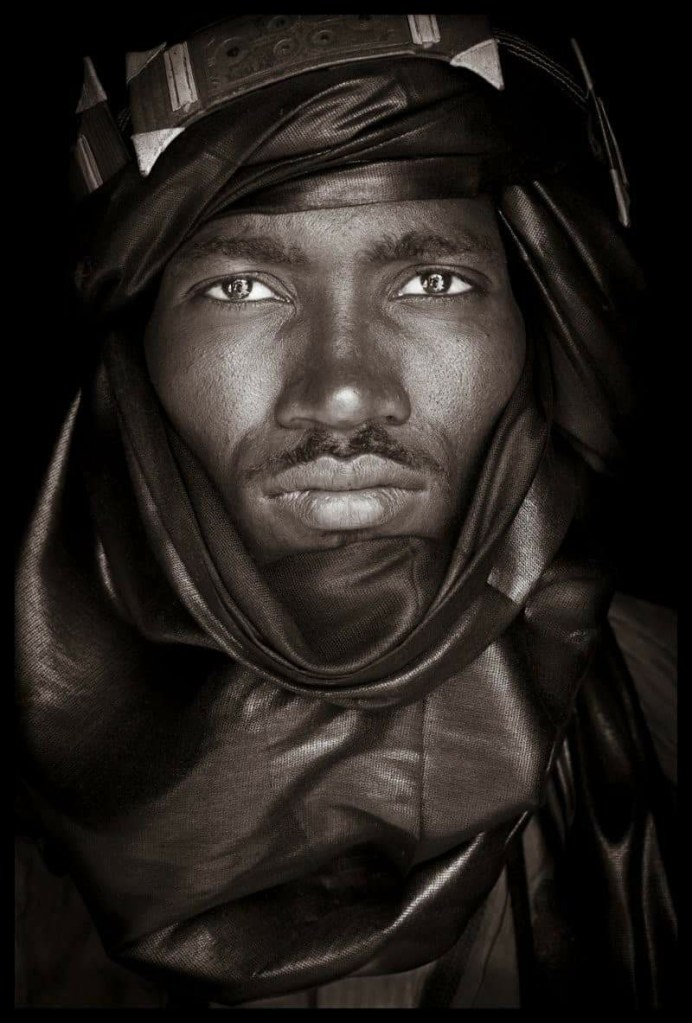
From about 2000 BC, Berber (Tuareg / Tamashek) and Chadic (Hausa) languages spread westward from the Nile valley across the Sahara into the Sahel…
“A large portion of the brown and black tribes of Northern Africa, as has been shown, belong to the same family as that which first originated commerce, which invented the alphabet, produced the sublime Hebrew poetry and Arabian science…
The Semitic negro can certainly never be considered by the worshippers under a Semitic religion as inferior in blood to themselves…
Still another group of peoples, both brown and black—many fully black—are descendants of that family which erected the ancient empires on the Euphrates, and which, unknown centuries ago, built the pyramid-tombs on the Nile, and founded the gloomy art, the artificial civilization, and the science of Egypt…”
SOURCE;
(Charles Loring Brace, ‘The Races of the old world’; 1863)
“Arabia was the cradle-land of the Semites, while North Africa was that of the Hamito-Semitic [Afroasiatic] race, the Semites in prehistoric times separated from their kinsmen and migrated to Arabia”
SOURCE;
(The Jewish Encyclopedia, A Descriptive Record of the History, Religion, Literature, and Customs of the Jewish People from the Earliest Times to the Present Day · Volume 11; 1901)
The genographic project confirms humans migrated out of Africa through Arabia, and that the area near and around Lake Chad or Bornou, “The Land of Noah”, was the cradle-land of the Hamito-Semitic (Afroasiatic) race, not North Africa…
SOURCE;
(https://phys.org/news/2011-11-genographic-humans-migrated-africa-arabia.amp)
Haber et al. (2016) confirms that these Semites or Eurasians migrated back into Africa and were more closely related to [and resembled] populations in the central Sahel; northern Cameroon, northern Nigeria, Chad and Niger…
SOURCE;
(https://www.sciencedirect.com/science/article/pii/S0002929716304487)
In other words, people who were most closely related to (and resembled) the Hausa, Fulani and Tuareg lived in Europe and Asia prior to migrating back to Africa and settling near and around Lake Chad…
“It is now established that the population map of the neolithic Sahara was perceptibly different from the situation following the climatic change, and there are plausible indications of a sedentary majority black population…
The first millennium of the Christian era may have been characterized by the continued existence of black peasant communities as well as entrenched cores among Libeyco-Berber and then Berber nomads…
Pressure from these latter set off a gradual southward movement, i.e. to the habitat which the black peoples have largely retained…”
SOURCE;
(UNESCO, General History of Africa Volume 3; 1988)
In other words, the population in the Sahara, during the Neolithic (10,000 B.C. – 2200 B.C.) was a so called black population…
Even in the first millennium of the Christian era (1 A.D. – 1000 A.D) the population there was still black…
This black population in the Christian era were Punic people or Carthaginians, descendants of the Canaanites and Israelites, who were supplanted by the Romans, Germanic tribes, and Arabs, and pushed southward into so called sub Saharan Africa…
 Hi welcome to my website