
MIGRATION AND STATE-BUILDING IN WEST AFRICA (Kanem’s King List)
MIGRATION AND STATE-BUILDING IN WEST AFRICA (Kanem’s King List)
With respect to early literacy in Kanem, it should be noted that the original name of the chronicle preserved in Kanuri—which likewise designates king lists in various other kingdoms of the Central Sudan—is girgam…
Derived from the Sumero-Akkadian term girginakku (“box for tablets”, “library”)
The history of Kanem-Bornu has received relatively little attention for a number of decades, but recent archaeological research in West Africa has renewed interest in the topic…
The unexpectedly early date of the emergence of proto-urban settlements south of Lake Chad in the middle of the first millennium B.C. (500 B.C.) is particularly striking…
In recent years the historical archaeology of West Africa has been significantly advanced by the findings of German researchers from Frankfurt…
On the western and southern fringes of the firgi clay plains of Lake Chad, archaeologists discovered proto-urban settlements dating from about 500 B.C.
How can one explain the emergence of proto-urban sites connected with important technical and agricultural innovations around 500 B.C. in the Lake Chad basin???
In the Western Sudan the emergence of the city of Jenne-Jeno along the eastern arm of the Inner Niger Delta in the third century B.C. (300 B.C.) has given rise to the idea that the Ghana Empire, supposedly the oldest state in West Africa, was founded at the same period…
If we assume a connection between urbanism and state-building, the foundation of Kanem in the region of Lake Chad (the early nucleus of the Kanem-Bornu Empire) may likewise have been much earlier than hitherto supposed…
Insufficient source criticism and strict reliance on the prevailing local paradigm of African history have contributed to concealing the Near Eastern origin of the state-building people of Kanem up until now…
The onomastic analysis of Central Sudanic king lists allows us to infer that Near Eastern people reached sub-Saharan West Africa claiming descent or at least connections with Babylonian, Elamite, Assyrian, Urartean, Amorite, Aramaean, and Israelite kings…
Apparently, substantial numbers of the migrants to Africa belonged to those ethnic groups referred to by specific royal names in a similar way in both dynastic lists…
As shown by different records, they departed from Syria-Palestine at the time of the last Assyrian king at the end of the 7th century B.C. (600 B.C)
According to linguistic evidence, speakers familiar with Semitic languages of the ancient Near East seem to have migrated to the region of Lake Chad and introduced important innovations such as the state, the notion of urban settlements, and horse riding…
From the archaeological record of the region of Lake Chad, it appears that urban settlements and a number of technical innovations including iron working emerged in the region towards the middle of the first millennium B.C.
The combination of these different types of evidence confirms the message of the documentary testimonies that refugees from the collapsing Assyrian Empire reached the Central Sudan towards 600 B.C. and contributed significantly to the sudden rise of social complexity…
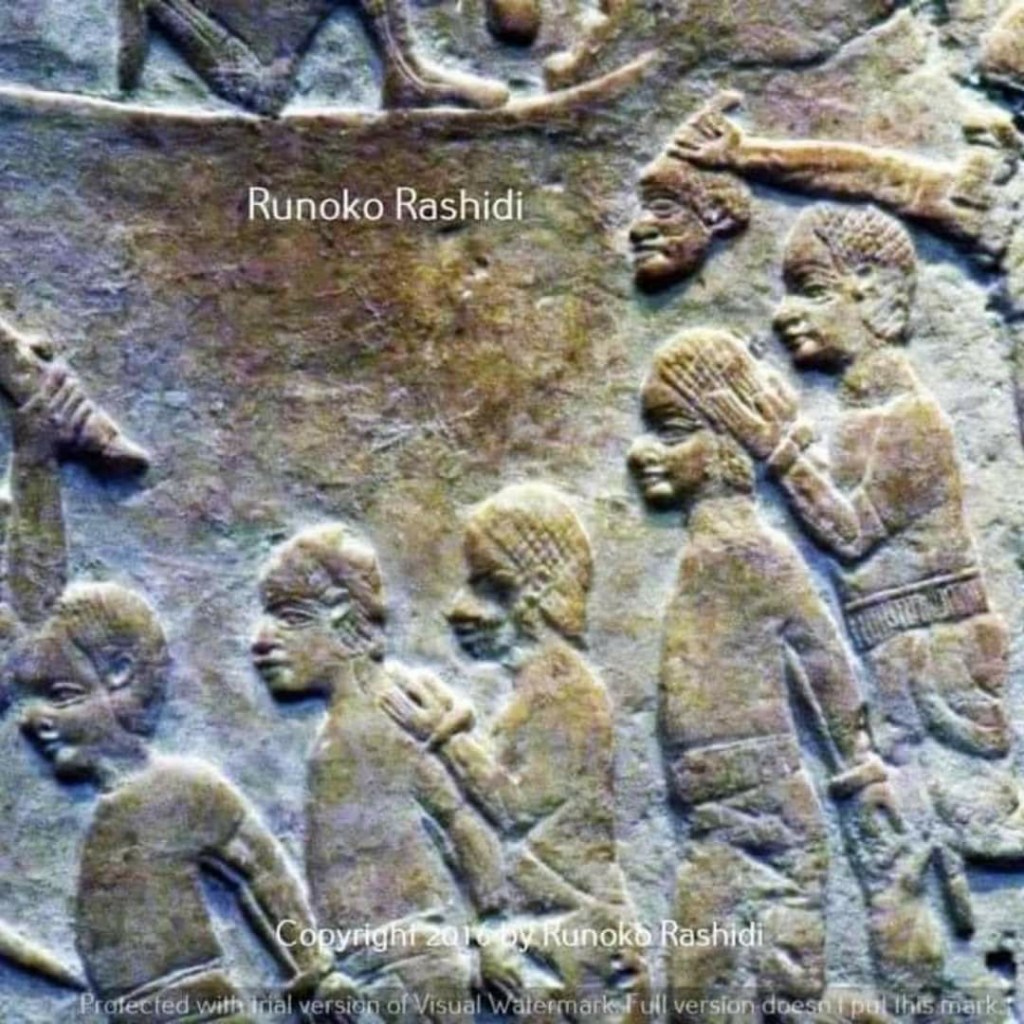
After the defeat of the Egypto-Assyrian forces at Carchemish in Syria in 605 B.C. numerous deportees followed the fleeing Egypto-Assyrian troops to the Nile valley, before eventually continuing their migration to so called sub-Saharan Africa…
From recent historical research it appears that a number of West African polities were founded by refugees from the collapsed Assyrian empire c. 600 BC…
Members of the German culture historical school were convinced that states in West Africa originated in pre-Roman times as a result of Near Eastern or Mediterranean influences…
They noted surprising similarities between the institutions of surviving traditional states all over Africa and therefore believed in a vast movement of diffusion…
The remarkable parallelism between the dynastic records of Kanem-Bornu and Kebbi concerning the first imperial period of Mesopotamian history, as reflected in the girgam in the first section and in the Kebbi list in the second section, appears to provide important evidence for the significance of ancient Near Eastern history for the state builders of the Central Sudan…
The Kebbi king list likewise has a section where specific royal names refer to different ethnic communities: Kassites, Urartians, Hittites, Babylonians and Elamites…
However, by placing this section at the beginning of the entire list, the author of the Kebbi list apparently emphasizes the primordial importance of members of these groups for the building of a new state in Africa…
Seen in conjunction, both records indicate that members of various ethnic groups, whose ancestors were deported by the Assyrian authorities from the eastern and northern provinces of their empire to SyriaPalestine, seem to have left their new homes in large numbers—perhaps more than one hundred thousand—after the collapse of Assyria, and settled in sub-Saharan Africa…
If the preceding onomastic analysis is correct, the cogently arranged incorporation of important ancient Near Eastern royal names in historically significant sections reflects a clear idea of ancient Near Eastern history…
According to this analysis, the authors of both lists appear to have been members of immigrant groups which reached the region of Lake Chad and settled there shortly after the collapse of Assyria in 609 B.C.
Apart from sound knowledge of ancient Near Eastern history, they must have had several ancient written king lists at their disposal…
Combining the knowledge of Mesopotamian list science and the Hebrew concept of onomastic scholarship, such as is expressed in the Table of Nations (Gen 10), they apparently took account of the new situation in Africa to compose highly original list records of their countries of origins…
The analysis of the Kebbi king list in particular shows that the author of the list must have had written documents available to him…
Therefore it would appear that scholars travelling on foot, in horse-drawn chariots, or riding on horses or camels had brought such texts with them on their migration to the Central Sudan, covering a distance of about 4000 km.
The survival of ancient and valid documentary evidence in Bornu and Kebbi concerning ancient Near Eastern history can hardly be explained otherwise…
 Hi welcome to my website