The Etruscan League.
The Etruscan League.
According to some ancient authors (Livy, Dionysius of Halicarnassus, Servius and others) Etruria proper was divided into twelve cities or populi (duodecim populi), the so-called dodecapolis or Etruscan league. However, no document provides us with the complete list of the twelve cities. It is believed, but there is not full agreement among scholars, that the main centers of southern Etruria – maritime and inland Etruria such as Caere, Tarquinia, Vulci, Veio, Roselle, Vetulonia, Volsinii, Chiusi, Perugia, Cortona, Arezzo would have been part of it. . It may be that over time there may also have been changes (following, for example, the decline or defeat of some cities) and that other peoples have taken over such as Populonia, Fiesole, Volterra, Pisa, etc …
The sources refer to the dodecapolis already with regard to the archaic period in which the Etruscan centers would have been governed by kings (monarchical period), although in the opinion of some scholars it is to be considered more probable (in this sense Giovannangelo Camporeale) that the Etruscan league originated in a more recent period, linked to the formation of the real cities.
With particular reference to the period relating to the final phase of the clash with Rome, the ancient authors evoke meetings (Councils) of the twelve populi held at the Fanum Voltumnae (the sanctuary of Voltumna) with annual periodicity (coinciding with religious feasts).
From the sources emerge news regarding the modalities of the meetings. The meetings were also attended by people belonging to the working classes who, however, did not have the right to vote. On the occasion of the councils, games were also held presided over by a federal priest elected by the assembly. Sometimes ad hoc meetings were organized in extraordinary situations. Foreigners could also participate in the councils and sometimes the meetings were requested by foreigners. The place of meeting, at least between 434 and 389 BC, was the Fanum Voltumnae (in this sense Livy). The meetings had mainly religious connotations, but also commercial and political ones.
Scholars debate whether the Etruscan League had only religious, cultic value or whether it was a central body with deliberative power on matters of general interest. There is obviously no shortage of intermediate and more nuanced positions. The well-known events of the history of the Etruscans, the interactions with other Italic and non-Italic peoples, as well as the relations between the same centers of Etruria, would lean towards an organization based on the strong autonomy and independence (fragmentarism) of the various city-states at least as regards the most relevant issues such as political ones (in this sense also Massimo Pallottino). The foundation of the Etruscan league would thus have been the cultural and religious unity of the Etruscans.
In the subsequent Roman imperial phase, probably by the Etruscan emperor Claudius, the Etruscan league was in some way “restored” and enlarged from twelve to fifteen populi (see for example the formula praetor Etruriae XV populorum).
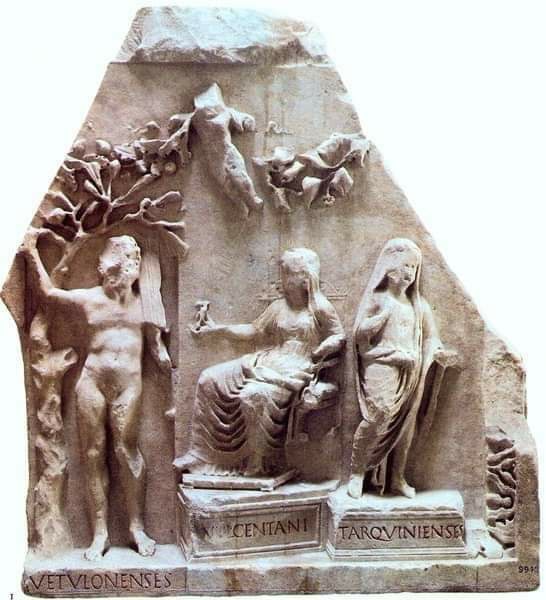
In the mid-1800s in the Roman theater of Cerveteri was found the so-called. throne of Claudius, a fragmentary marble bas-relief (preserved in Rome in the Gregorian Etruscan Museum), which probably depicted the XV personified populi, and which today allows us to admire only three populi, namely the Vetulonenses, the Vulcentani and the Tarquinienses.
For the sake of completeness, it should be noted that the sources also refer to two other dodecapolis, one for the Po Valley Etruria (Livy, Plutarch) and the other relating to Campanian Etruria (Strabone).
For further information on the Etruscan league cf. The Etruscan League From the Dodecapolis to the Quindecim Populi Proceedings of the study day Chiusi, 9 October 1999, International Publishing and Printing Institutes 20001, with writings by Dominique Briquel and Giovannangelo Camporeale (Library of Etruscan Studies).
Below is an image of Claudio’s throne cd.
 Hi welcome to my website