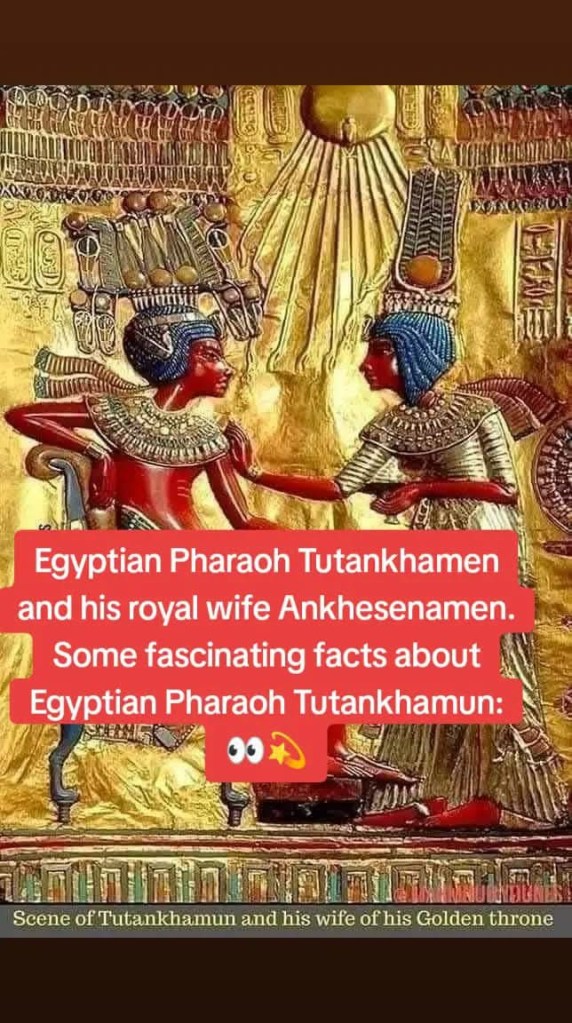
Egyptian Pharaoh Tutankhamen and his royal wife Ankhesenamen.
Some fascinating facts about Egyptian Pharaoh Tutankhamun:
A) Early Life and Reign:
Egyptian Pharaoh Tutankhamen and his royal wife Ankhesenamen.
Some fascinating facts about Egyptian Pharaoh Tutankhamun:
A) Early Life and Reign:
- Born around 1341 BCE: Tutankhamun was the 12th pharaoh of the New Kingdom period.
- Son of Akhenaten: Tutankhamun’s father, Akhenaten, introduced monotheistic worship of Aten.
- Became pharaoh at 9-10 years old*: Tutankhamun ascended to the throne after Akhenaten’s death.
B) Restoration of Ancient Traditions:
- Abandoned Akhenaten’s reforms: Tutankhamun reinstated the traditional Egyptian pantheon and restored the capital to Memphis.
- Rebuilt temples and restored priestly power: Tutankhamun sought to revive Egypt’s traditional spiritual practices.
C) Personal Life and Death:
- Married his half-sister, Ankhesenamun: This was a common practice among ancient Egyptian royalty.
- Died around 1323 BCE: Tutankhamun’s death at 18-19 years old remains a mystery, with theories including malaria, a bone disorder, or even murder.
- Buried in the Valley of the Kings: Tutankhamun’s tomb, KV62, is one of the most famous archaeological discoveries in history.
D) Discovery and Legacy:
- Tomb discovered by Howard Carter in 1922: The tomb’s treasures and remarkably preserved mummy captivated the world.
- Sparkling golden mask: The iconic golden funerary mask is one of the most recognizable objects in history.
- Continued fascination and research: Tutankhamun’s life, reign, and legacy remain the subject of ongoing study and public interest.
Ankhesenamen was the queen of ancient Egypt (reigned 1332–22 bce), who shared the throne with the young king Tutankhamen. Ankhesenamen was the third daughter of Akhenaton and Nefertiti, the couple who introduced the religious and cultural innovations of the Amarna period. She was probably married to her father toward the end of his reign, and the marriage seems to have produced one daughter, Ankhesenpaaton-tasherit (“Ankhesenpaaton the Younger”).
Photo:
King Tutankhamun and Queen Ankhesenamen, detail from the back of the throne of Tutankhamun; in the Egyptian Museum, Cairo.
 Hi welcome to my website