Mossi history :
Mossi history :
The Mossi are a Gur ethnic group native to modern Burkina Faso, primarily the Volta River basin. The Mossi are the largest ethnic group in Burkina Faso, constituting 52% of the population or about 11.1 million people. The other 48% of Burkina Faso’s population is composed of more than 60 ethnic groups, mainly the Gurunsi, Senufo, Lobi, Bobo, Bissa and Fulani. The Mossi speak the Mòoré language.
The Mossi people originated in Burkina Faso, although significant numbers of Mossi live in neighboring countries, including Benin, Côte d’Ivoire, Ghana, Mali, and Togo. In 2022, the estimated population of Burkina Faso was 20M+, over 11M of which are Mossi. Another 2 million Mossi live in Côte d’Ivoire.
ORIGINS :
According to oral tradition, the Mossi come from the marriage of a Mamprusi/Dagomba princess, Yennenga, and a Mandé hunter.
Yennenga was a warrior princess, daughter of a king, Naa Gbewaa, of present-day northern Ghana. Gbewaa’s tomb is located in Pusiga in the Upper East Region of Ghana. The story has it that while exploring her kingdom on horseback, she lost her way and was rescued by Rialé, a solitary Mandé hunter. They got married and gave birth to a son, Ouedraogo, who is recognised as the father of Mossi people.
MOSSI EMPIRE:
Main article: Mossi Empire
Though Mossi records exist, primarily written using the Ajami script, the Mossi people’s history has largely been kept by oral tradition. This means it is impossible to assign precise origin dates.Nevertheless, historians assign the beginning of their existence as a state to the 11th century.The Mossi were able to conquer a vast amounts of territory thanks to their mastering of the horse, created a prosperous empire, and kept peace in the region until the Mossi Kingdoms were conquered by the French. The expansion of the Mossi empire was stopped in the 19th century with the initiation of intensive colonisation by the French.
COLONIAL ERA:
French rule affected Mossi society and weakened the power of the Mossi emperor, the Mogho Naaba. Despite colonization, the Mogho Naaba was given some authority over the Mossi during the French colonial period. He is consulted today for crucial decisions, especially those affecting the destiny of society. Two great events have affected the status of the Mogho Naaba during colonization:
During the initial phase of the French invasion, he retired to the Mamprusi kingdom with which the Mossi have always kept brotherly relations.
In 1896, the Mogho Naaba accepted the French protectorate.
The Mossi and several other peoples played a significant role in France’s military during World War II. They constituted part of the corps in the military troops of French West Africa, known in French as the Tirailleurs Sénégalais.
LANGUAGE AND CULTURAL VALUES :
Group identity and values within the Mossi and contrasted against other ethnic groups are tied first and foremost to language.
MOSSI LANGUAGE:
The Mossi speak the Mooré language, of the Western Oti-Volta group of languages, northwestern sub-group. It is spoken in Burkina Faso, Ghana, and Ivory Coast. This language group is part of a larger grouping, Gur languages belonging to the Niger–Congo family. In the language there are a few dialects based mainly on region. For example, there is a dialect spoken in Yatenga (Ouahigouya), another distinct dialect in the northern region, a third in the southeast in Koupela, different from a fourth dialect in the same region called Tenkodogo. Despite these regional differences, the dialects are mutually intelligible.
CULTURAL VALUES:
According to the explanations of Marie Tapsoba, the former Cultural Counsellor at Burkina Embassy in Senegal and Mossi herself, Mossi culture can be divided into four main values characteristic of the ethnic group.
ATTITUDE TOWARDS ANCESTORS :
Ancestors are believed to have reached a better world from which they can influence life on earth. They can help or punish their descendants depending on their behavior. Ancestors are also the judges that have the power to allow a descendant to enter the “pantheon of the ancestors”. If an ancestor chooses to deny entrance, the soul of the disavowed one is condemned to run at random for all eternity. Because of these beliefs, Mossi swear by their ancestors or by the land; when they do so (which only occurs in extreme situations), it is more than symbolic — it is a call to imminent justice.
LAND :
Land is related to the ancestors, being a path by which one can access the ancestors. Even today, this notion gives a unique value to land in Mossi thought. Land is considered to be much more than simple dust and has a spiritual dimension to it. A Mossi’s life depends on his/her land, and it is essential for the family settlement.
FAMILY :
Family is an essential cultural element of the Mossi, who hold collectivism in high regard.Individualism does not exist in traditional Mossi culture: one’s actions and behaviors are always taken to be characteristics of one’s family. They must always ask an elder in order to do something. As a result, all are expected to act in their family’s name; thus, the family is the smallest entity in the Mossi society. Heritage is patrilineal, passed down from a father to his sons. However, when a man has no sons, women can inherit from their husbands and even from their father.
HIERARCHY :
Hierarchy is a fundamental concept for the Mossi and pervasive in their culture.The family is organised like a kingdom with its king — the husband and father, his advisor — the wife, and the people — the children. Aunts and uncles play a role by helping in the education and raising of children.
TRADITIONAL AND CULTURAL HOLIDAYS :
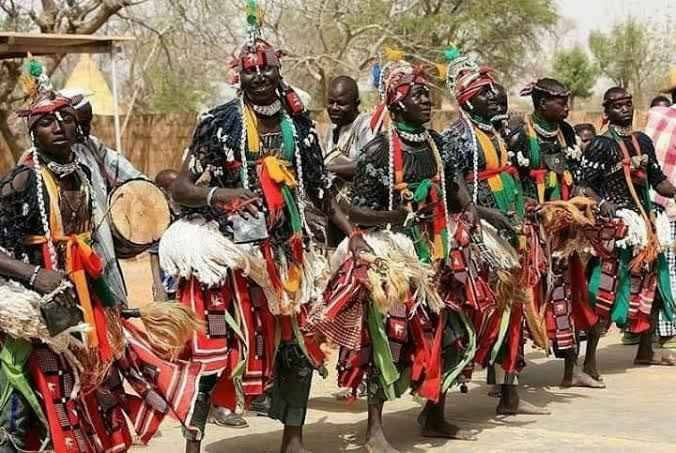
Ceremonies and celebrations pace the life of Mossi people, with each celebration having its particulars. Through them the community expresses joy or suffering, or simply fulfills duties to the memory of the ancestors.
MOGHO NAABA COURT :
The Friday Mogho Naaba court ceremony derives from an event when the Moro Naba’s sister fled north to the land of Yadega, the kingdom called Yatenga. As she fled north, she carried all of the amulets of power, or nam, with her. The Moro Naba had to decide whether to follow her and retrieve his sacred power objects or to remain behind to rule over his people. Three times he left his palace to mount a white horse, and three times he returned to the palace. In the end he did not pursue his sister, and to this day the kings of Yatenga claim that they hold the power of Mossi rule.
The political segment of Mossi society, the Nakomse (sing. Nakoambga), use art to validate their rule. Bridles, saddles, stirrups and other objects associated with the horse are very important. In addition, Mossi chiefs use carved wooden figures to represent their royal ancestors. These figures are displayed each year at royal festivals called na possum, when the heads of each household in the community reaffirm their allegiance and loyalty to the chief.
MOSSI MASKS:
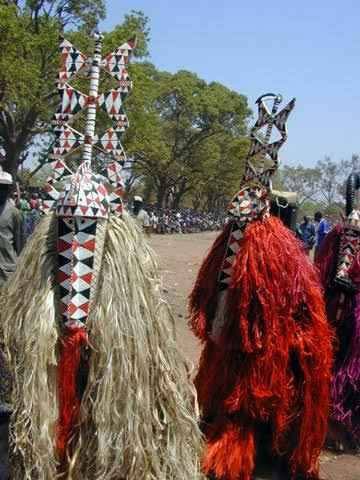
The Nyonyose (the ancient farmers and spiritual segment of Mossi society) use masks in their religious observances and rituals. The Nakomse (chief class) do not use masks. Masks in initiations and funerals is typical of all the Voltaic or Gur-speaking peoples, including the Nyonyose, Lela, Winiama, Nouna, Bwaba, and Dogon. Masks appear at burials to observe on behalf of the ancestors that proper procedures are carried out. They appear at funeral or memorial services held at regular intervals over the few years after an elder has died. Masks attend to honor the deceased and to verify that the spirit of the deceased merits admission into the world of ancestors. Without a proper funeral, the spirit remains near the home and causes trouble for his/her descendants.
Masks are carved of the wood of the Ceiba pentandra, the faux kapokier. They are carved in three major styles that correspond to the styles of the ancient people who were conquered in 1500 by the invading Nakomse and integrated into a new Mossi society:
In the north masks are vertical planks with a round concave or convex face.[13]
In the southwest masks represent animals such as antelope, bush buffalo, and strange creatures, and are painted red, white and black.
In the east, around Boulsa,[14] masks have tall posts above the face to which fiber is attached.
Female masks have two pairs of round mirrors for eyes; small masks, representing Yali (“the child”) have two vertical horns. All Nyonyose masks are worn with thick costumes made of the fiber of the wild hemp, Hibiscus cannabinus. In the old days only the northern Nyonyose in Yatenga and Kaya, and the eastern people around Boulsa allowed their masks to be photographed. The people in the southwest forbade photography because it did not conform to the yaaba soore, the path of the ancestors.
Mask characters include Balinga, the Fulani woman; katre, the hyena; nyaka, the small antelope; Wan pelega, the large antelope, and many others. Masks from all three areas appear at annual public festivals such as International Art & Craft Fair (Salon international de l’Artisanat de Ouagadougou or SIAO), Week of the Culture, and the Atypical Nights of Koudougou (Les Nuits Atypiques de Koudougou). Each Nyonyose family has its own mask, and they are charged with protecting the masks to this day. Masks are very sacred and are a link to the spirits of ancestors and of nature.
IN SUMMARY :
The Mossi people are an ethnic group native to West Africa, primarily residing in Burkina Faso, as well as in parts of Mali and Ghana. They are one of the largest ethnic groups in Burkina Faso, making up around 50% of the country’s population.
The Mossi people have a rich cultural heritage, with a strong tradition of storytelling, music, and art. They are known for their skilled craftsmanship, particularly in woodcarving, leatherwork, and textiles. The Mossi are also renowned for their vibrant festivals and celebrations, such as the Festival of the Masks, which showcases their elaborate masks and traditional dances.
Historically, the Mossi people were organized into powerful kingdoms, with the Mossi Empire being one of the most influential empires in West Africa during the pre-colonial period. The empire was founded in the 13th century and was known for its military prowess, administrative efficiency, and trade networks.
Today, the Mossi people continue to play an important role in the cultural, economic, and political life of Burkina Faso and the wider region. They are known for their warm hospitality, strong sense of community, and resilience in the face of challenges.
 Hi welcome to my website