
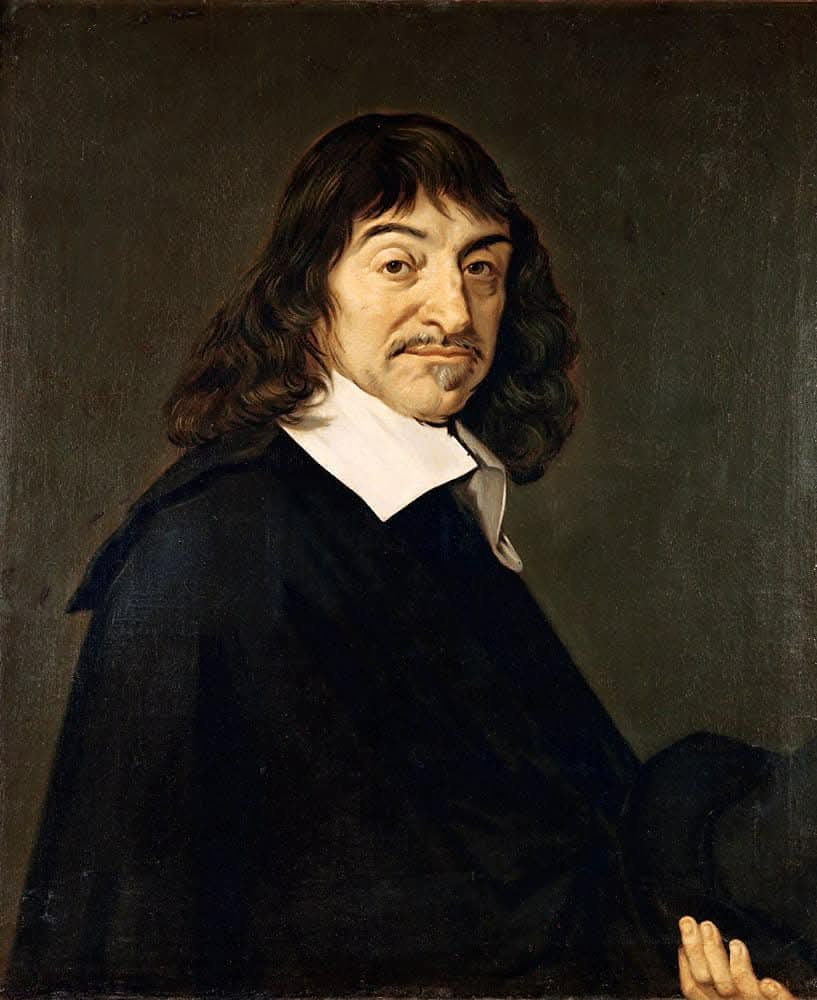
Death of philosopher René Descartes, 11 February 1650, 375 years ago today.
Death of philosopher René Descartes, 11 February 1650, 375 years ago today. He is famous for saying “I think, therefore I am,” which is usually translated from Latin as “cogito, ergo sum.” But what does this statement mean? Bertrand Russell explains:
“I think, therefore I am“ says rather more than is strictly certain. Descartes imagined a deceitful and powerful demon, who presented unreal things to his senses in a perpetual phantasmagoria; it might be very improbable that such a demon existed, but still it was possible, and therefore doubt concerning things perceived by the senses was possible. But doubt concerning his own existence was not possible, for if he did not exist, no demon could deceive him. If he doubted, he must exist; if he had any experiences whatever, he must exist. Thus his own existence was an absolute certainty to him. Some care is needed in using Descartes’ argument. It might seem as though we are quite sure of being the same person to-day as we were yesterday, and this is no doubt true in some sense. But the real Self is as hard to arrive at as the real table, and does not seem to have that absolute, convincing certainty that belongs to particular experiences.
Descartes invented a method which may still be used with profit—the method of systematic doubt. He determined that he would believe nothing which he did not see quite clearly and distinctly to be true. Whatever he could bring himself to doubt, he would doubt, until he saw reason for not doubting it. By applying this method he gradually became convinced that the only existence of which he could be quite certain was his own. “I think, therefore I am,“ he said (Cogito, ergo sum); and on the basis of this certainty he set to work to build up again the world of knowledge which his doubt had laid in ruins. By inventing the method of doubt, and by showing that subjective things are the most certain, Descartes performed a great service to philosophy, and one which makes him still useful to all students of the subject.“
— Bertrand Russell, The Problems of Philosophy(1912), Ch. II: The Existence of Matter, pp. 27-8
━━━
René Descartes (31 March 1596 – 11 February 1650) was a French philosopher, mathematician and writer who spent most of his life in the Dutch Republic. Descartes has often been dubbed the father of modern Western philosophy, the thinker whose approaches has profoundly changed the course of Western philosophy and set the basis for modernity. His Meditations on First Philosophy (1641) continues to be a standard text at most university philosophy departments.
”Descartes may have made a lot of mistakes, but he was right about this: you cannot doubt the existence of your own consciousness. That’s the first feature of consciousness, it’s real and irreducible. You cannot get rid of it by showing that it’s an illusion in a way that you can with other standard illusions.”
— American philosopher John Searle, Our Shared Consciousness, TED.com (May 2013)
Image: Portrait of René Descartes after Frans Hals (1648).
 Hi welcome to my website