
THE INVASION OF ESANLAND BY THE FULANI AND NUPE IN 1800.
THE INVASION OF ESANLAND BY THE FULANI AND NUPE IN 1800.
Before 1824, the dynasty that ruled the Nupe Kingdom was Tsoede Royal Dynasty. Unfortunately, there was a crisis between the Nupe princes as a member of the Tsoede royal family, and it’s emerged after the death of Abdullahi Tinkanko in 1783. The two principal rivals, Jimada and Majia, could not resolve their differences without inviting foreigners, e.g., The Fulani under Mallam Dendo.
These Fulani leaders who were invited, neither helped to settle the quarrel nor found a solution to the civil wars that ensued. Rather, they manipulated the situation to take over power from the two Nupe princes in 1824. This was how Dendo established a Fulani dynasty that assumed leadership in the area from 1824.
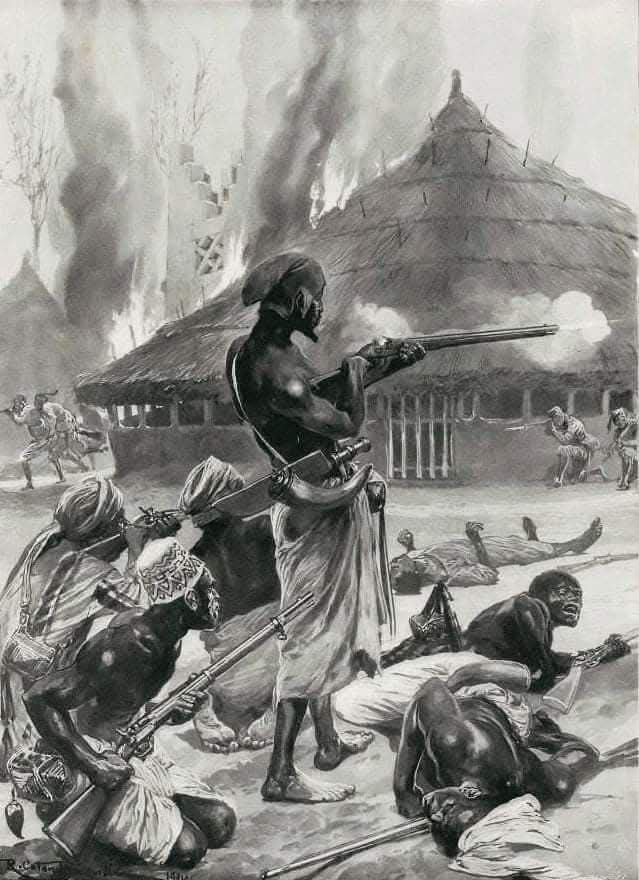
In 1860, Bida under the leadership of the Fulani adopted a violent external policy. An aggressive expansionist policy aimed at the establishment and maintenance of Nupe’s control over several lands and raiding of slaves, particularly Etsako, Owan, Akoko Edo, and other Afemai communities in Northern Edo State. Their primary goal was to conquer and annex, Edo North, Esanland, down to the seacoast of the Niger Delta for their economic and political benefits.
The army under the leadership of Fulani Princes Umaru Majidi and Maliki supervised the invasion and conquest of Edo North in 1860. They were successful in their mission because of some internal collaborators who assisted the Nupe/Fulani to ensure their victory over the entire Etsako or Afemai country, due to the necessity of keeping their new titles and position of IZENI or consuls, during this period.
When they were able to establish a leadership structure in Edo North. In 1881, they invaded Ewu. Ewu was the first place the Fulani attacked in Esanland and this is due to its proximity to Agbede in Esako. Which is about 10 kilometers at Ujagbe, which was then part of Ewu. In 1882, they attacked Idoa, Ukhun, and Uzea looking for slaves. At this time, it was imperative there is a need for (Akugbe) unity in Esanland to be able to defeat the (Egbalukpon) the name Esan called Fulani.
Thus, all the kingdoms in Esanland drafted an army through their war captain Okakulo. The military defense alliance was named AKOTA. They were armed with modern weapons, firearms, long barrel guns, Utagbo, Blacksmiths, archers, and juju priests. The AKOTA was positioned across strategic locations in Esanland, including Ehor. The first encounter between the Akota, allied forces, and Fulani/Nupe troops lasted for more than three years. (1894-1897). It was coded Egbalukpon Nell war, meaning ‘the war of the robed ones’, because the Nupe and their collaborators robed even in war with horses.
This is how the Fulani were defeated and pushed back to Agbede in Esakoland. Some Nupe soldiers were taken as prisoners of war, whom their descendants still live in Esan till date.
The invasion is not without consequence. The implication is the little Islamic footage you see in Ewu today and some northern Esan Kingdoms mentioned above. Finally, one or two traditional rulers in Esanland converted to Islam over time, not through conquest but voluntarily. For instance, in 1921, the king of Agbede, Akhigbe Momodu converted the Ojie Eromosele of Irrua, to Islam by offering his daughter; princess Ebaaje in marriage.
ANCESTOR: In all of this , we nor see Benin inside oh… And they will claim to be founders of those lands.
Reference
Esan Native Laws and Customs; with Ethnographic Studies of the Esan People. Dr Christopher Okojie 1960.
The Impact of Nupe Invasion on Etsako Society, 1860 – 1897. A Sociopolitical and Cultural Analysis. Hakeem Billy Harunah 1990.
Courtesy: ESAN HISTORY
 Hi welcome to my website