
The Last Embrace”
“The Last Embrace”
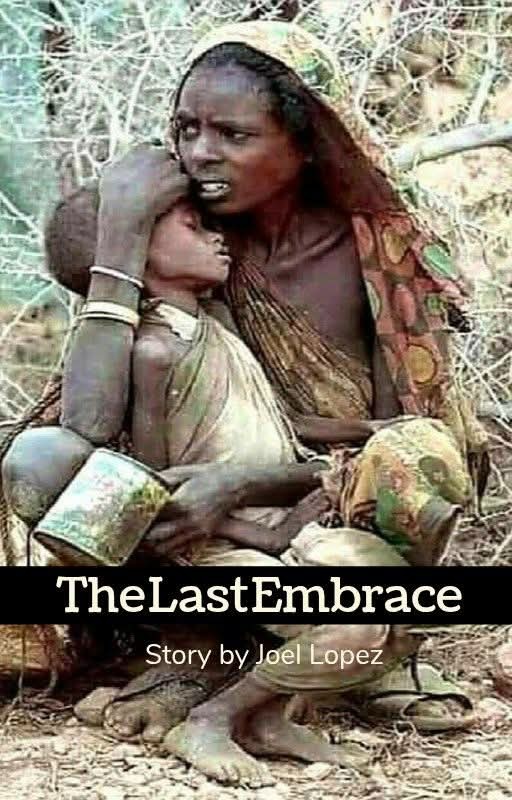
The sun in the arid lands of Kofari did not just shine—it punished. It bore down on the cracked earth with a merciless glare, turning dust into blades and air into fire. The trees, once proud and life-giving, now stood as skeletal reminders of what once was. And beneath one of those dying branches sat a woman, her arms wrapped tightly around her son, as though her embrace could shield him from a hunger that had long outgrown silence.
Her name was Luma. His, Beko.
There was a time, not long ago, when they laughed under the stars—when meals were modest but full, when her son’s face was round with joy and not hollowed by want. But the rains stopped coming. The crops failed. One by one, the animals perished. Then the neighbors left. And all that remained was the wind, the dust, and hunger.
It came slowly at first, like a thief testing doors. A skipped breakfast. A halved portion of supper. Then it came boldly, stealing full days, gnawing through bones and spirit alike. Luma stopped eating long before Beko did, tucking what little she found into his trembling hands. He didn’t know, at first. He was too young. But one day he noticed the way she swayed when she stood up, the way her cheeks sunk before his.
“Eat, Mama,” he had whispered, pressing a dry piece of root into her mouth. “You need to stay strong.”
She only kissed his forehead and said, “I’m strong because of you.”
They searched for food daily. Roots. Leaves. Insects. Anything. Luma would walk for hours with Beko tied to her back, his limbs now so light they barely weighed more than the shawl that held him. They came back with nothing more often than not. And yet, every night, she told him a story—one where they were in a village where the rivers were sweet, and pots never emptied, and no child ever cried from hunger.
One such night, Beko laid his head on her chest, and she felt how cold his skin had become. She held him tighter, as though her arms could become the meal his body needed.
“Will we eat tomorrow, Mama?” he murmured.
“Yes,” she lied. “Tomorrow, there will be rice. And honey.”
Beko nodded, satisfied with hope. He always believed her.
But morning came with no miracle. The only thing that stirred was the wind, tossing dust into their eyes. Beko’s body was limp now. He hadn’t spoken in hours. Luma held him close, her hands shaking not just from weakness, but from fear—fear that hunger would take him before the world remembered he existed.
She screamed, but no one heard. She begged the sky, but the sky was silent.
In her heart, she prayed: God, take my breath if it gives him another.
She held him until his breathing became too slow. Her lips pressed against his forehead, and in her silence, she gave him the only thing she still had—her love. Unyielding. Unmoving. Unspoken.
When aid workers finally found them days later, Luma was still sitting there, arms around her boy, her eyes glazed in pain, but her hold unbroken. Beko was gone. And so was a piece of her soul.
In that moment, the world may have seen a mother who had lost. But they didn’t see the fierceness of a woman who gave everything—her strength, her food, her hope—so her child could dream one more time.
Because when the stomach screams, love whispers louder.
And sometimes, that whisper is the last thing that keeps a child alive.
The rescue workers gently uncurled Luma’s arms from around Beko’s tiny, lifeless body. At first, she resisted, her arms tightening, her voice hoarse with a whisper that repeated his name over and over, like a lullaby caught between grief and denial.
“Beko… Beko… my sun… my little fire… wake up now, Mama found water…”
But there was no more waking.
She had always imagined the worst thing in the world would be to die from hunger. But now she knew the truth: the worst thing was to survive it while the child you starved to feed did not.
They laid Beko down on a sheet, his fragile ribs still outlined against his thin skin, as if even in death, his body told the story of what he’d endured. The workers wept silently, not just for the boy, but for the mother—this mother who had carried him, fed him with her soul, and lost everything in the battle against a hunger that the world ignored until it was too late.
They gave Luma food, water, medicine. But she didn’t want any of it.
“What use is bread when the one I saved it for is no longer here to eat it?” she murmured. “What use is strength now that my reason is gone?”
The aid station tried to comfort her. But nothing fills the silence a child leaves behind. It echoes in places no one else can hear.
Days passed. She wouldn’t speak. Wouldn’t move. Just sat in a corner, clutching the tiny shirt Beko wore the day before he stopped waking. The nurses said grief needed time. But Luma wasn’t grieving in days. She was grieving in breaths. In heartbeats. In memories that replayed too loudly.
One evening, a nurse placed a notebook and pencil beside her bed. She said gently, “When you’re ready… tell his story. Let the world know he was here.”
It took her a week to lift the pencil. But when she did, it was as though the floodgates of sorrow burst through ink. Page after page, she wrote—not just of pain, but of the love that stitched every hungry night together. She wrote about Beko’s laughter, the way he danced barefoot in the dust when the rain finally fell that one rare time. How he whispered dreams of becoming a farmer one day, “so no one would ever be hungry again.”
That story made its way beyond Kofari. People read it. Some wept. Some raged. Others moved—moved to act, to feed, to care.
And while nothing could ever return what Luma had lost, the world began to remember her boy. Donations flowed to villages like hers. Aid grew faster. Children who once walked alone now had meals waiting.
And in a quiet corner of a dusty village, Luma planted a tree—Beko’s tree, she called it. Underneath it, she buried the little shirt and whispered, “Grow tall, my son, where hunger cannot reach you.”
The wind carried her voice like a prayer, and the leaves rustled in reply.
Because even in loss, love remains.
Even in hunger, a mother’s heart still feeds the world.
 Hi welcome to my website