Africa’s Ancient Dawn: Exploring the Continent’s Oldest Civilizations and Their Innovations
Africa’s Ancient Dawn: Exploring the Continent’s Oldest Civilizations and Their Innovations
Africa, the cradle of humanity, is home to some of the world’s most ancient and influential civilizations. Millennia before the rise of European empires, sophisticated societies flourished across the continent, leaving behind legacies of remarkable innovation and complex social structures.
Among the oldest known of these are Ancient Egypt, the various cultures of Nubia (including the Kingdom of Kerma), the enigmatic Nok civilization, and the Kingdom of D’mt.
Perhaps the most renowned ancient African civilization is Ancient Egypt, which emerged in the fertile Nile Valley of Northeastern Africa (modern-day Egypt) around 3100 BCE with the unification of Upper and Lower Egypt.
Spanning several millennia, Egyptian civilization is synonymous with monumental architecture, a complex religious system, and significant intellectual achievements.
The Egyptians developed a sophisticated hieroglyphic writing system, which allowed for record-keeping, literature, and the codification of laws. Their advancements in mathematics were profound, enabling them to construct the awe-inspiring pyramids and temples, calculate land areas, and develop a remarkably accurate solar calendar of 365 days.
Egyptian medicine was also advanced for its time, with evidence of surgical procedures, bone setting, and a wide pharmacopoeia. Agriculture thrived due to their mastery of irrigation techniques, harnessing the predictable flooding of the Nile to cultivate staple crops like wheat and barley. They were also skilled in metallurgy, particularly in working with copper and later bronze.
South of Egypt, along the Nile River in what is present-day Sudan, lay the region of Nubia. Nubia was home to a series of interconnected cultures and kingdoms that predate or were contemporaneous with dynastic Egypt.
One of the earliest identifiable was the Ta Seti culture, which existed in northern Nubia potentially as early as 4000 BCE, suggesting the emergence of complex societies here at a very early date. Later, the powerful Kingdom of Kerma rose to prominence between 2500 and 1500 BCE. Located near the Third Cataract of the Nile, Kerma was a major urban center and a formidable rival to Egypt.
The Kerma civilization was known for its distinctive material culture, including fine pottery and impressive mudbrick architecture, such as the Western Deffufa, a massive religious structure.
They had a complex social hierarchy, a thriving economy based on agriculture, cattle herding, and extensive trade networks that connected Egypt with sub-Saharan Africa, dealing in commodities like gold, ivory, and exotic animals. Evidence suggests advanced craftsmanship in metalworking and other industries.
In West Africa, specifically in what is now central Nigeria, the Nok civilization flourished from around 1000 BCE to 300 CE. The Nok are particularly celebrated for their remarkable terracotta sculptures, which are among the oldest known in sub-Saharan Africa.
These lifelike figures, depicting humans and animals, showcase a high level of artistic skill and provide valuable insights into the physical appearance, customs, and beliefs of the Nok people. Beyond their artistic achievements, the Nok were also pioneers in iron smelting technology in West Africa. The development of iron tools had a transformative impact on agriculture and likely contributed to population growth and the expansion of settled communities.
Their societal structure and political organization are not as well understood as those of Egypt or Nubia due to a lack of written records, but the sophistication of their art and metallurgy points to a well-organized society.
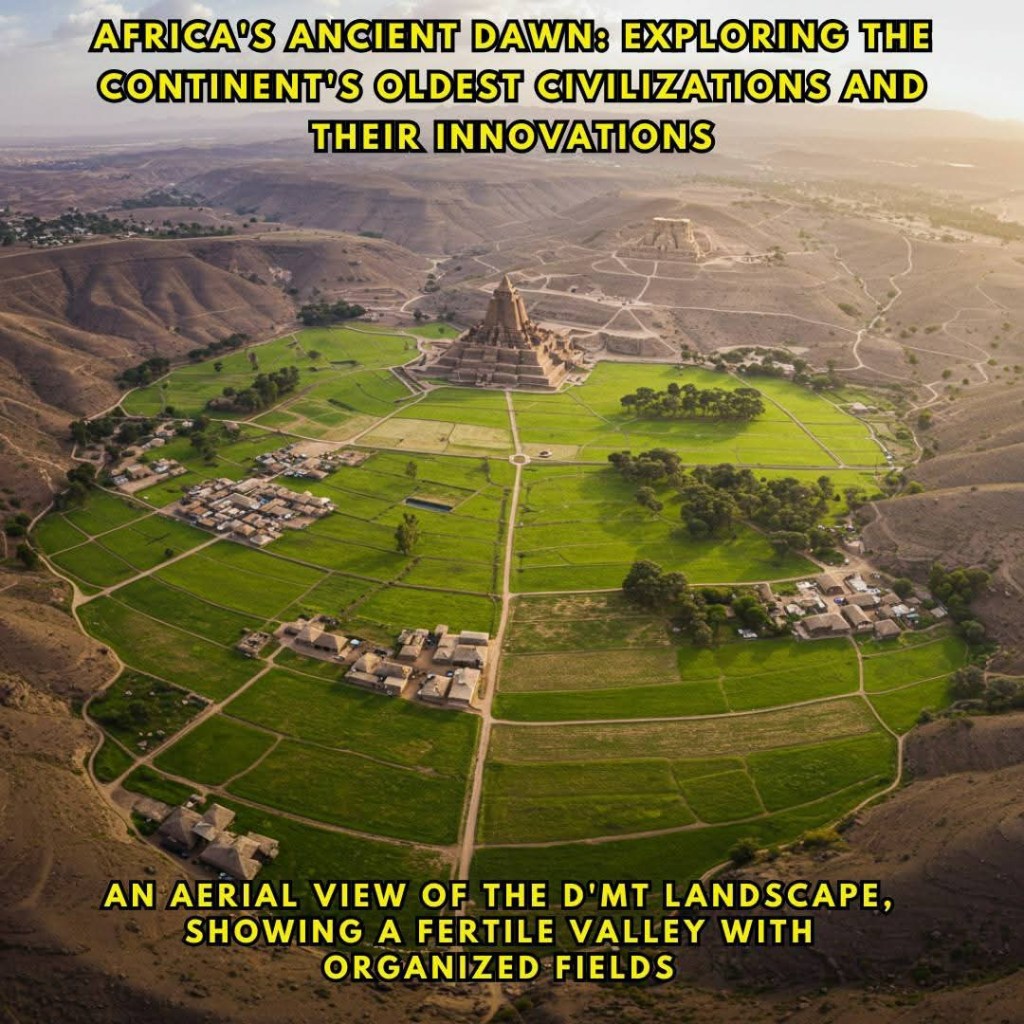
Moving to the Horn of Africa, in the northern part of modern-day Ethiopia and Eritrea, the Kingdom of D’mt (pronounced “Da’amat”) emerged around the 10th century BCE. D’mt is considered a precursor to the later powerful Aksumite Kingdom.
Evidence suggests that D’mt had a centralized government and engaged in large-scale building projects, including temples and irrigation systems. Their economy was based on agriculture, utilizing plows and cultivating crops like millet.
They also possessed knowledge of iron working. While there is evidence of South Arabian influence, particularly in inscriptions and religious practices, the D’mt civilization is increasingly recognized as an indigenous African development with its own distinct characteristics.
These ancient African civilizations, though separated by vast distances and diverse environments, demonstrate the continent’s long history of complex societies, technological innovation, and rich cultural expression.
From the monumental achievements of Egypt and the trading prowess of Kerma to the artistic legacy of the Nok and the agricultural innovations of D’mt, these early civilizations laid foundational stones for the development of later African kingdoms and empires, shaping the course of human history in profound ways.
Please comment and share 🙏🙏🙏
africanculture #africanhistory #african #africa #ancientegypt #ancienthistory #AncientCivilizations
 Hi welcome to my website