ECHOES OF EMPIRE: THE GREAT CIVILIZATIONS OF ANCIENT WEST AFRICA
ECHOES OF EMPIRE: THE GREAT CIVILIZATIONS OF ANCIENT WEST AFRICA
Before the thunder of European colonialism rolled across the African continent, long before the ink of Western historians branded Africa a “dark continent”, the lands of West Africa rang with gold, wisdom, and kingdoms whose splendor rivaled any civilization on Earth. From the megalithic settlements of the Sahara’s southern edge to the opulent courts of Mali and Ghana, West Africa thrived as a nexus of wealth, governance, and culture that not only captivated foreign visitors but birthed oral traditions still echoing today.
Long before Islam swept through the Sahel, pre-Islamic West African civilizations were thriving. One of the earliest known is the culture of Dhar Tichitt in present-day Mauritania, flourishing between 2000 BCE and 500 BCE. Archaeologists have uncovered stone-built towns, granaries, and evidence of millet-based agriculture—clear indicators of urbanized life. The Tichitt-Walata complex reveals a society with social stratification and regional trade, predating the Ghana Empire by over a thousand years.
Further south, the Nok civilization of modern-day Nigeria emerged as early as 1500 BCE. Known for its advanced iron smelting and expressive terracotta sculptures, the Nok left behind artifacts that attest to a highly artistic and technologically adept society. Despite the absence of a known writing system, the sophistication of their metallurgy places them among the earliest iron-working cultures in sub-Saharan Africa.
In the Niger River valley, the ancient city of Jenne-Jeno, founded around 250 BCE, was one of the oldest urban centers in West Africa. Excavations reveal long-distance trade networks, specialized craft industries, and complex urban planning. Rather than being centralized like later empires, Jenne-Jeno operated as a city-state with decentralized governance, flourishing for centuries as a commercial and spiritual hub. These early civilizations laid the foundation for the great empires that followed: Ghana, Mali, Songhai—and the mighty Ashanti Empire.
The Gold Kings of Ghana
One of the earliest great civilizations of West Africa recognized by external chroniclers was the Ghana Empire (not to be confused with modern Ghana), centered in what is now southeastern Mauritania and western Mali. Arabic geographers and merchants spoke of its astonishing wealth long before setting foot there. In the 9th century, the Muslim scholar al-Yaqubi noted:
“The kingdom of Ghana is the land of gold… Their king is the richest and most powerful in the land. In his territory are mines of gold.”
The Ghanaian kings were not only fabulously wealthy—they were masterful rulers of a multi-ethnic empire supported by a strong military and complex taxation systems. The 11th-century geographer al-Bakri described the capital, Koumbi Saleh, as a dual city: one part for the king and his traditional animist followers, and another for Muslims, complete with mosques and scholars. He wrote:
“The king adorns himself like a woman, wearing necklaces and bracelets, and when he gives audience to his people he sits in a domed pavilion… around him stand ten pages holding shields and swords decorated with gold.”
These accounts explode the myth of a primitive precolonial Africa. They speak of regal ceremony, religious coexistence, administrative complexity, and dazzling displays of wealth.
Mali: The Empire That Stunned the World
Following Ghana’s decline came the thunderous rise of the Mali Empire in the 13th century, founded by the legendary Sundiata Keita, whose story is immortalized in the Epic of Sundiata. Under his leadership, Mali expanded across the Sahel, controlling major trade routes and cities like Timbuktu, Djenne, and Gao. The Moroccan scholar Ibn Battuta, who visited Mali in the 14th century, marveled:
“Among their good qualities is the small amount of injustice among them… and their concern for learning. Their memorization of the Qur’an is astonishing.”
Even seasoned Muslim travelers, familiar with the urban sophistication of North Africa and the Middle East, were stunned by Mali’s legal systems, social order, and reverence for scholarship. Timbuktu, in particular, emerged as a beacon of intellectual life. Most famously, Mansa Musa, in 1324, made a pilgrimage to Mecca with a caravan so lavish it reportedly destabilized regional economies with the sheer volume of gold distributed. The 14th-century scholar al-Umari wrote:
“This man spread a flood of generosity… He left no person of office without a gift. His humility in the face of his wealth was astonishing.”
Ashanti: Warrior-Priests of the Golden Throne
As the Mali and Songhai empires waned, the forest regions of West Africa gave rise to a new powerhouse: the Ashanti Empire. Founded around the late 17th century in modern-day Ghana by Osei Tutu, the Ashanti Kingdom quickly rose through military strength, gold wealth, and political unity.
Osei Tutu, guided by his spiritual advisor Okomfo Anokye, unified rival clans under the divine symbol of the Golden Stool (Sika Dwa Kofi)—a sacred object believed to house the soul of the Ashanti nation. No one, not even the king, was allowed to sit on it.
The Ashanti developed a highly organized bureaucracy centered in Kumasi, their capital. They maintained a strong standing army, utilizing advanced battle tactics and firearms obtained through trade. The Ashanti economy was rooted in gold—so much so that the region was known to Europeans as the Gold Coast. Their wealth funded elaborate architecture, courtly pageantry, and a sophisticated judiciary system.
The Ashanti, developed a remarkably sophisticated cosmology that rivaled the metaphysical systems of any ancient civilization. Their worldview wasn’t just spiritual, it was a deeply structured philosophy in which the universe, society, and the self were all interconnected. Concepts like kra (soul), sunsum (spirit), and honam (body) reflected a layered understanding of human nature as a microcosm of the divine. Their belief in a trinitarian creator, Nyame, Nyankopon, and Odomankoma—reveals a nuanced theology of creation, order, and continuity. Time was cyclical, ancestors remained spiritually active, and political power was tied to sacred symbols like the Golden Stool, which embodied the soul of the nation. This wasn’t mythology for mythology’s sake, it was an intricate, living cosmology that shaped governance, ethics, and identity.
When the British sought to assert colonial dominance in the late 19th century, they demanded possession of the Golden Stool. This blasphemous request ignited the War of the Golden Stool in 1900, where the Ashanti, under the leadership of Yaa Asantewaa, a warrior queen and regent, fiercely resisted. Though eventually subdued by British forces, the Ashanti never surrendered the Golden Stool. The Ashanti legacy lives on. Their art, especially Adinkra symbols and Kente cloth, remains globally recognized, and the Asantehene (King of Ashanti) continues as a cultural authority in modern Ghana.
The Griot’s Testimony
But we must not let outsiders speak alone for West Africa. The griots—oral historians and bards—preserved accounts of empire from within, rooted in memory, lineage, and ceremony. The Epic of Sundiata is more than folklore; it is a constitutional record. According to griot tradition, Sundiata established the Kouroukan Fouga, a charter outlining laws of governance, justice, and social conduct centuries before Magna Carta.
One famous line from the epic declares:
“The world is old, but the future springs from the past.”
These griots recited genealogies, dynastic records, and assemblies of nobles, articulating codes of conduct and governance. They are living libraries.
“We do not invent the past; we are its guardians. We are the memory of mankind.”
Memory as Resistance
The legacy of ancient West African civilizations is more than a counter-narrative—it is a proud affirmation of Africa’s central place in world history. From the golden courts of Ghana to the libraries of Timbuktu, from the sacred stool of the Ashanti to the stones of Tichitt, West Africa was and remains a cradle of culture, law, and human achievement.
Let the griots speak. Let the golden echoes ring.
“We are the memory of mankind.”
Artwork by Malcolm Quartey: https://malcolmquartey.artstation.com
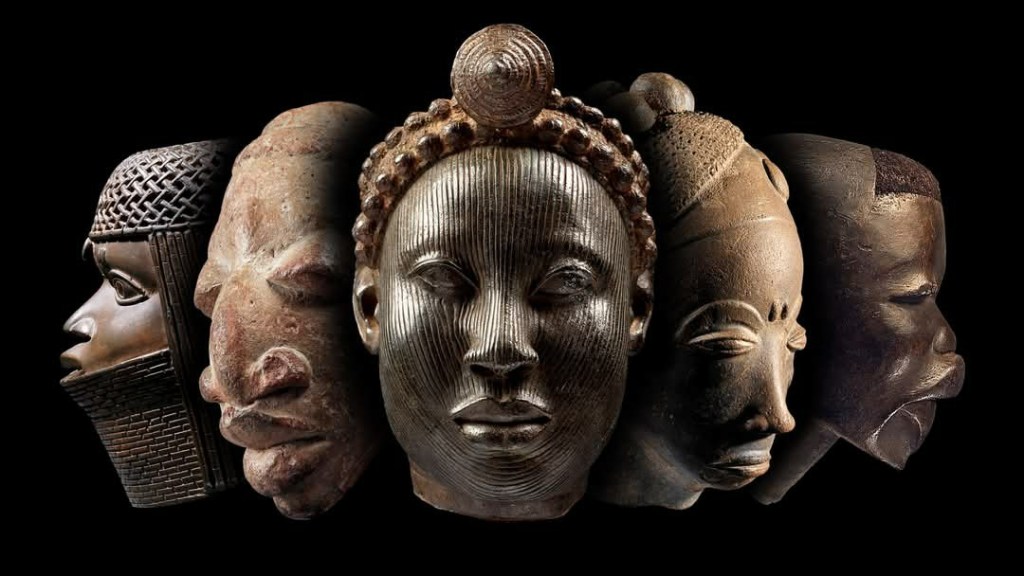
left to right:
- Benin Bronze, commemorative head (uhunmwun elao), Edo, Nigeria, 17th century.
- Mahen Yafe, commemorative head, Sapi Peoples, Sierra Leone, 15th to 17th century.
- Wunmonije head, copper alloy head from the Wunmonije compound, Ife, Nigeria, c. 14th century.
- Nsodie, Akan memorial head, Ghana, 17th century.
-Makonde ritual helmet mask, Mozambique, 19th century.
Visit our official website for Merch:
https://www.knowthyselfinstitute.com/shop
Follow our Youtube Channel:
https://www.youtube.com/@knowthyselfinstitute
“I have not spoken angrily or arrogantly. I have not cursed anyone in thought, word or deeds.” ~ 35th & 36th Principals of Ma’at
 Hi welcome to my website