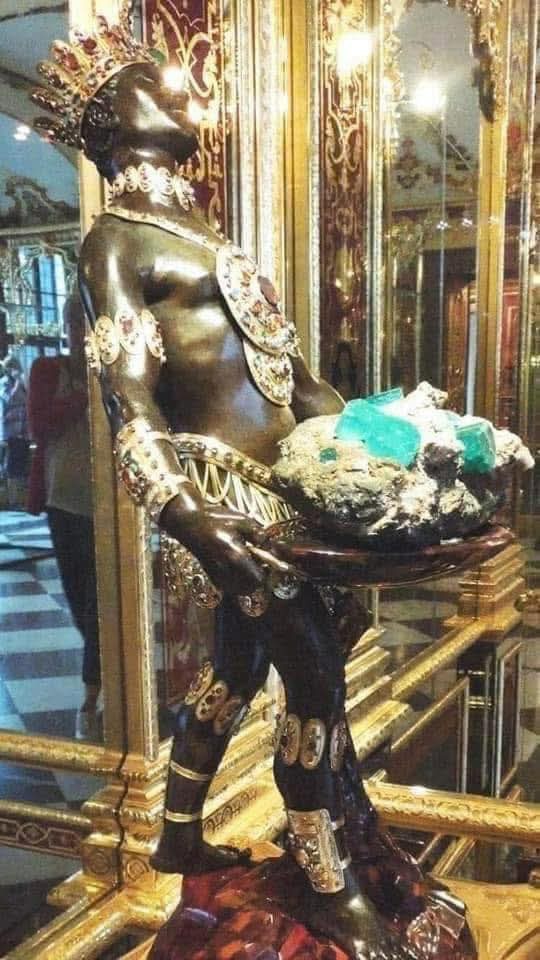
In 1586, a piece containing 16 emerald crystals, some of them very large—the finest stones from limousin bedrock—was gifted to Elector August by Emperor Rudolf II…
In 1586, a piece containing 16 emerald crystals, some of them very large—the finest stones from limousin bedrock—was gifted to Elector August by Emperor Rudolf II…
The dark green gemstones came from the Chivor-Somondoco emerald mine in Colombia…
Elector August valued the piece so highly that shortly before his death in 1586, he ordered the “emerald cluster” to be kept at his princely house as an eternal memorial…
Nearly a century and a half later, when Augustus the Strong began expanding the Green Vault into a treasure museum, he commissioned a magnificent statue from his court sculptor Balthasar Permoser to hold the emerald cluster—though today it retains only four large and five small emeralds…
This statue is commonly referred to by its historical term as a “Moor.”
The powerful, casually and proudly striding young man—carrying a tortoiseshell tray on which the emerald cluster rests—has the physiognomy of an African…
Yet due to the clothing and jewelry created by Johann Melchior Dinglinger, he is also clearly identifiable as an indigenous inhabitant of the Mississippi Delta in the Americas, as depicted in a 16th-century copper engraving from a travel report…
His ethnologically accurate body tattoos identify him as a Native American, as do his precious necklaces and bracelets, chest ornaments, feather crown, loincloth, and footwear…
SOURCE;
(https://www.kunstbuch-shop.de/Der-Traum-des-Koenigs-Die-Schaetze-des-Gruenen-Gewoelbes/9783954985821)
“The Moor is represented as a muscular youth in swaggering stride; he is carved from pearwood, and lacquered a deep brown. His broadly smiling face
with its wide, blunt nose and full lips is clearly meant to be that of a Negro; but his curly hair is when seen from the front almost entirely hidden by a jeweled
gold “feather” crown of a type generally associated with romantic images of American Indians”
SOURCE;
The statue’s tattoos and feather crown were taken from contemporary illustrations of travel accounts, and the figure is supposed to represent an American Indian…
Indeed, almost every detail of the adornments of the statue has a common source, a series of engravings of the New World by Théodore de Bry (1528-98)
Among de Bry’s illustrations to René de Laudon-nière’s report about the abortive French settlement in Florida in 1564, we find the exact model for the figure’s tattoos in those of the “powerful king called Satouriona”
The statue’s characteristic pectorals of two overlapping discs, his armlets and knee bands composed of oval discs, his belt with skirtlike fringes of oval pendants hanging from straps, we see on braves in the opposing army, that of Olata Outina, “considered the king of kings”
Olata Outina, also spelled Olatoa Utina, was a Timucua chief in what is now northern Florida during the early 17th century…
The Timucua were a Native American people who lived in Northeast and North Central Florida and southeast Georgia…
They were the largest indigenous group in that area and consisted of about 35 chiefdoms, many leading thousands of people…
 Hi welcome to my website