
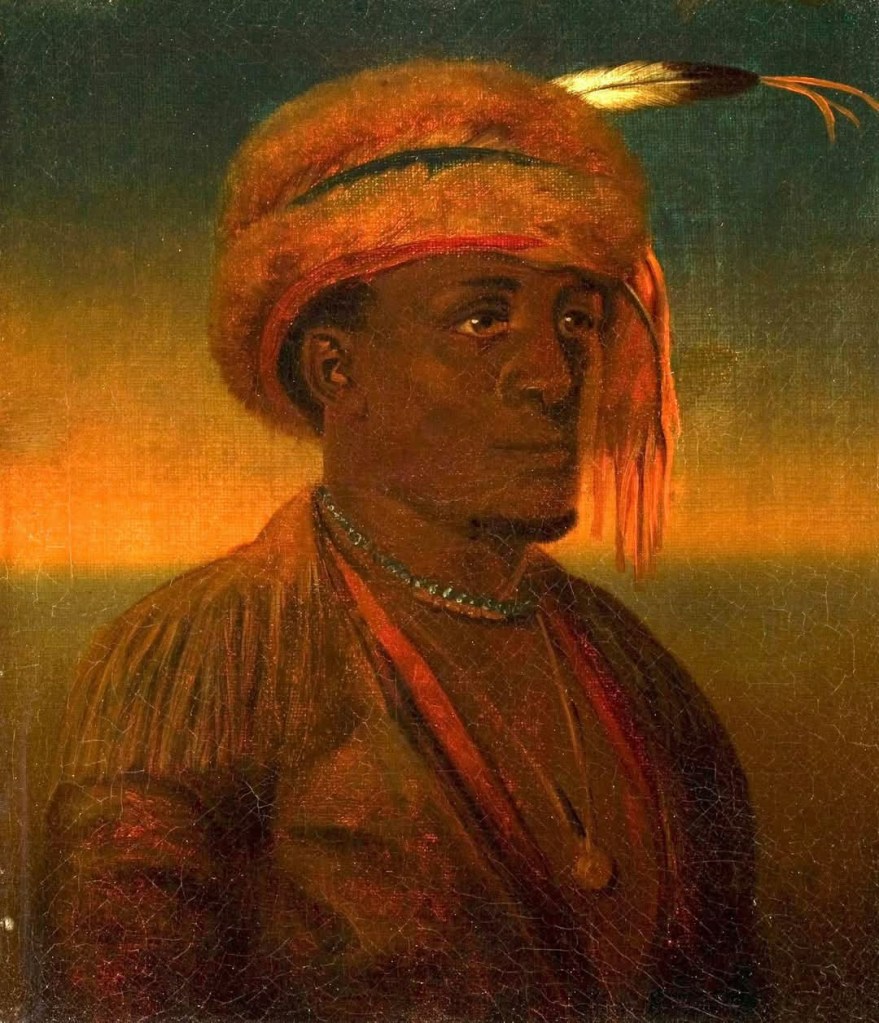
THE REAL CHIEF BILLY BOWLEGS (Seminole Chief) by Karl Ferdinand Wimar c. 1858…
THE REAL CHIEF BILLY BOWLEGS (Seminole Chief) by Karl Ferdinand Wimar c. 1858…
This portrait is now titled “Portrait of a Native American (half-breed)”
By the mid 1800s, there was significant intermixing between Native Americans and people of African descent, especially in the Southeast (i.e, Seminole, Creek, and Cherokee nations)
Given the time period and documented interactions between Native and African communities, it’s plausible that the term ‘half-breed’ in this context could refer to a person of mixed Native American and African descent…
Please note the turban seen in the portrait is a well documented feature of Seminole attire…
Seminole men, especially leaders and warriors, were known to wear turbans…
These turban style headdresses were distinct from the feathered war bonnets of Plains tribes, highlighting a regional and cultural difference…
This portrait was painted by Karl Ferdinand Wimar c. 1858…
Karl Ferdinand Wimar was a German-American painter that immigrated from Germany to St. Louis in 1843…
St. Louis was considered the “Gateway to the West” because it played a crucial role in westward expansion during the 19th century…
During the 19th century, many Native American groups, including those forcibly removed from the Southeast, passed through or resettled near St. Louis before continuing to Indian Territory (present-day Oklahoma)
The Seminoles were among the Native American groups forcibly removed from the Southeast, though their path to Indian Territory (present-day Oklahoma)
During the Third Seminole War (1855–1858), Chief Billy Bowlegs and his followers resisted U.S. military efforts to remove them from Florida…
However, after continued pressure and destruction of their settlements, Bowlegs and his band surrendered in 1858. They were then forcibly relocated to Indian Territory…
After surrendering, Billy Bowlegs and his people were transported by steamboat from Tampa, Florida, to New Orleans and then up the Mississippi River toward Indian Territory…
St. Louis, being a major transportation hub on the Mississippi, was a logical stopping or processing point along this journey…
It is possible that Wimar, who was based in St. Louis, encountered Bowlegs during this period, either as he passed through or as word of his relocation spread…
This would explain how Wimar, who never traveled to Florida, came to paint the portrait of a prominent Seminole leader…
“Another great chieftain was Micanopah, described as part negro and very dark, Billy Bowlegs his nephew, was also part negro”
SOURCE;
(‘Opportunity’ Volumes 12-13; 1934)
Micanopy or Micanopah was the uncle of Wild Cat and Billy Bowlegs:—
Micanopy = “part negro” and “very dark”
Billy Bowlegs = “part negro” (Portrait of a half breed)
Wild Cat = “Black Seminole”
 Hi welcome to my website