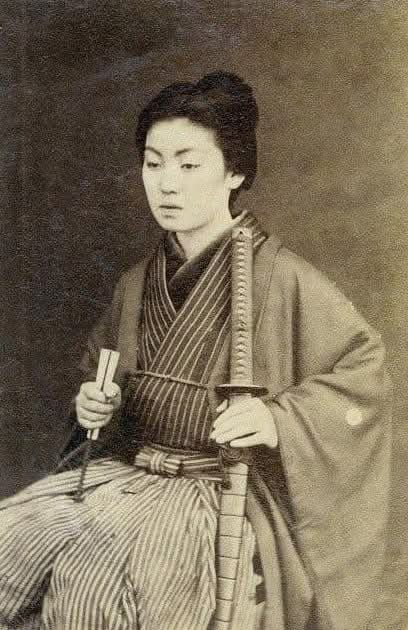
Nakano Takeko, a renowned Japanese warrior from the Aizu domain,
Nakano Takeko, a renowned Japanese warrior from the Aizu domain, is remembered for her extraordinary courage and skill in battle during the late 19th century. Born in Edo (modern-day Tokyo) in April 1847, Takeko was the eldest daughter of Nakano Heinai, a samurai and official of Aizu, and Nakano Kōko, the daughter of a samurai. Growing up in privilege, she was trained in calligraphy, literature, and martial arts, eventually receiving certification in the Itto-ryu school of swordsmanship. Her prowess in martial arts led her to teach naginata (a pole weapon used by female warriors) to the wife of a local lord, and she was later adopted by her master, Akaoka Daisuke, who brought her to Aizu. There, Takeko continued her martial arts training and began to educate younger students, including her own sister, while immersing herself in the stories of legendary women warriors.
Takeko’s life took a decisive turn during the Boshin War, a civil conflict between the Tokugawa shogunate and those supporting the restoration of the imperial rule under Emperor Meiji. In 1868, Takeko fought valiantly in the Battle of Aizu, where she commanded a unit of female warriors. Despite being outnumbered by imperial forces, the women of Aizu, under Takeko’s leadership, fought fiercely with naginatas, demonstrating remarkable determination. Due to the reluctance of Aizu officials to officially engage women in battle, the women fought independently, earning the name “Female Army” from the men who were forced to accept their participation. During the battle, Takeko fought until she was fatally wounded, killing several enemy soldiers before her death.
Before passing away on October 10, 1868, Takeko asked her sister to decapitate her to prevent the enemy from desecrating her body. She was buried under a pine tree at the Hokai-ji Temple in Fukushima, where her body, along with her naginata, rests today. Takeko’s legacy is celebrated each year during the Aizu Autumn Festival, where historical reenactments honor her life and the role of women warriors. Her story has become an enduring symbol of bravery and determination, with an estimated 172 samurai killed by her in battle.
Credit goes to the respective owner
 Hi welcome to my website