
Key Context and Scientific Insights:
Key Context and Scientific Insights:
Out of Africa Theory
Modern humans (Homo sapiens) originated in Africa roughly 200,000–300,000 years ago. Around 60,000–80,000 years ago, humans began migrating out of Africa, eventually populating every continent. So yes, early humans who first migrated were of African origin and had dark skin.
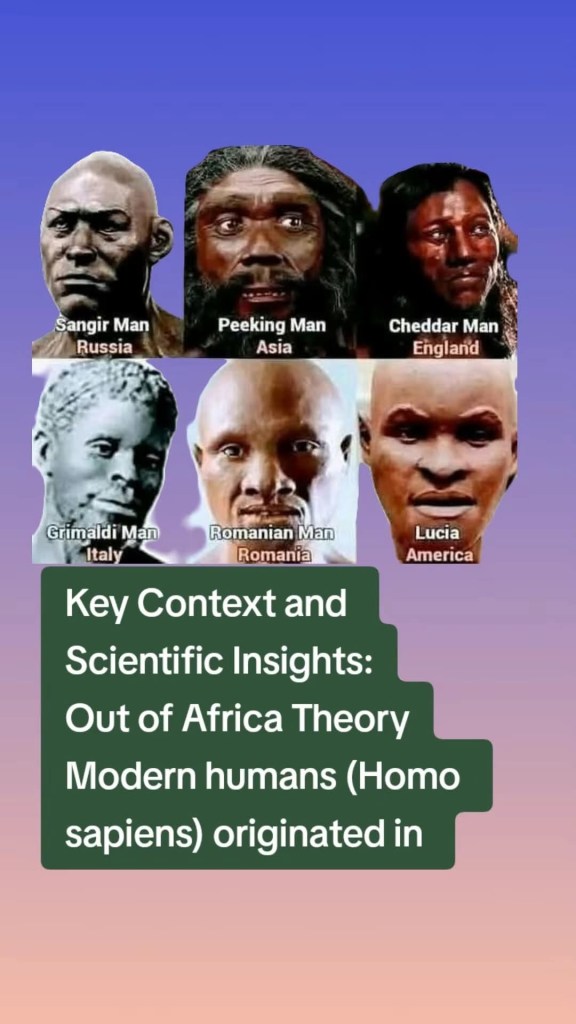
Cheddar Man (England)
Cheddar Man lived about 10,000 years ago. DNA analysis suggests he had dark skin, blue eyes, and curly hair. This supports the claim that early Britons did not look like today’s population.
Lucia (Brazil)
Lucia is one of the oldest known human skeletons in the Americas (about 11,500 years old). Some researchers suggest her features resemble those of modern Indigenous Australians or Africans, raising questions about early migration routes.
Grimaldi Man (Italy)
These remains, dated to 20,000–30,000 years ago, are associated with early European populations. Some early anthropologists noted African-like traits, though these assessments are debated today.
“Romanian Man” and “Sangir Man”
These may refer to Upper Paleolithic European remains. Reconstructions often vary widely based on interpretation and available data. There’s no widely accepted figure named “Sangir Man” in academic literature.
Peeking (Peking) Man (China)
Refers to Homo erectus fossils found in China (~700,000 years ago). They predate Homo sapiens and are part of the broader human evolutionary tree, not modern humans.
Conclusion:
While it’s scientifically accurate that all modern humans originated from Africa and that early migrations populated the world with people of African descent, some of the figures in the image are either misrepresented or based on outdated interpretations. The visual reconstructions should be viewed with caution, as they often reflect modern biases or incomplete data.
 Hi welcome to my website