
THE AFRO-ASIATIC ROOTS OF THE ORIGINAL HEBREW ISRAELITES
THE AFRO-ASIATIC ROOTS OF THE ORIGINAL HEBREW ISRAELITES
The early Levantine region, home to the ancient Israelites and other early Semitic groups, was not an isolated outpost but rather an extension of Africa’s rich Afro-Asiatic world, deeply influenced by African linguistic, cultural, and biological developments. As historian Christopher Ehret notes, genetic evidence identifies the Horn of Africa as the source of the “M35/215” Y-chromosome lineage, a key genetic marker that migrated northward into Egypt and the Levant. This genetic flow illustrates a clear biological continuity and connection between populations in Northeast Africa and those who settled the Levant (Ehret, 2023).
This biological and genetic proximity firmly situated the early Israelites within the Afro-Asiatic sphere. Contrary to narratives that depict early Hebrews as Semitic outliers with lighter skin or European features, evidence points to their origins in a region genetically, culturally, and geographically tied to Northeast Africa. The languages spoken by these groups—including Hebrew, ancient Egyptian, Cushitic, and Berber—belong to the Afro-Asiatic family, reflecting shared roots that stretch across the northeastern African continent and into the Near East.
Moreover, the Levant was a cultural and genetic crossroads, inhabited by a mosaic of groups including early Semitic peoples, Egyptians, Nubians, Cushites, and later waves of migrants from Anatolia and Mesopotamia. This melting pot created a hotspot for cultural fusion and biological overlap, where ideas, traditions, and genes were exchanged and blended over millennia. Thus, the early Levant was not merely a Middle Eastern frontier but a dynamic region shaped by African ancestry and Afro-Asiatic heritage. It was a nexus where Africa’s profound influence converged with neighboring populations, giving rise to the unique but interconnected cultures and peoples—including the Hebrews—whose legacy continues to resonate today.
The historical identity of the original Hebrews has long been obscured by Eurocentric scholarship and colonial interpretations of religious texts. However, mounting archaeological, anthropological, and biblical evidence strongly suggests that the ancient Israelites were a dark-skinned, Afro-Asiatic people, closely related to ancient Nubians and Egyptians, and therefore aligned with what modern society often classifies as “Black.” The question of the original Hebrews’ appearance, specifically their skin color and hair type has generated both scholarly inquiry and cultural debate. Based on genetic, archaeological, and anthropological evidence, the earliest Hebrews (early Israelites and Judeans) were a dark-skinned Afro-Asiatic people who did not carry the alleles responsible for white skin, but instead had the ancestral alleles associated with high melanin production, resulting in brown to black skin and curly to tightly coiled hair.
Genetic Make-Up of Early Hebrew Israelites:
Modern European populations tend to carry derived mutations in genes such as, SLC24A5 (A111T), SLC45A2 (L374F) and TYR and OCA2 (depigmentation variants). These mutations reduce melanin production, resulting in light or white skin. However, ancient DNA samples from Bronze and Iron Age Canaanite and Israelite sites, including Lachish, Megiddo, and other parts of ancient Israel, do not carry these mutations. Instead, the ancient Israelites retained the ancestral (G) variants of these genes, common in sub-Saharan African, Nile Valley, and early Near Eastern populations, indicating dark-brown to black skin.
Source: Haber et al., Cell, 2020; Lazaridis et al., Nature, 2016.
The pigmentation profile of the original Hebrews aligns strongly with that of ancient African and Afro-Asiatic populations, based on genetic markers that govern melanin production. Genetic studies reveal that the early Israelites carried ancestral versions of key pigmentation genes, which are associated with dark skin rather than the depigmented alleles common among modern European populations. One of the most significant genes influencing skin pigmentation is SLC24A5. The ancestral form of this gene, the G allele, is responsible for maintaining high levels of melanin in the skin and is prevalent among populations indigenous to Africa and the Near East. Similarly, the SLC45A2 gene, which also plays a role in pigmentation, appears in its ancestral G form among early Semitic peoples. This version does not contribute to the reduction of melanin and is nearly absent in light-skinned European groups.
Another critical gene, MC1R, regulates the type of melanin produced by the body. In its ancestral state, which was common among early Afro-Asiatic populations—MC1R promotes the production of eumelanin, the darker form of melanin responsible for brown to black skin tones. Finally, the OCA2 gene, which influences both skin and eye color, also existed in its ancestral form among early Hebrews, supporting darker pigmentation across both traits. These pigmentation alleles are ubiquitous among ancient African populations such as the Nubians, Egyptians, and Cushites, as well as among early Semitic groups of the Levant. Given the geographic and genetic proximity between these groups and the Israelites, the presence of these dark-skin alleles in the Hebrew population strongly suggests that the original Hebrews had highly melanated skin, consistent with their environment and ancestral heritage.
While ancient DNA doesn’t always preserve hair phenotype alleles well, anthropological and skeletal studies suggest that early Hebrews, like their Nubian, Egyptian, and Cushitic neighbors, likely had curly to tightly coiled hair textures. Traits linked to African or African-adjacent populations such as: EDAR variants (hair thickness, curliness), High sebaceous gland activity (common in tropical populations), and Broad nasal apertures and cranial morphology associated with hot climates.
Anthropological Ties to Nubia and Egypt:
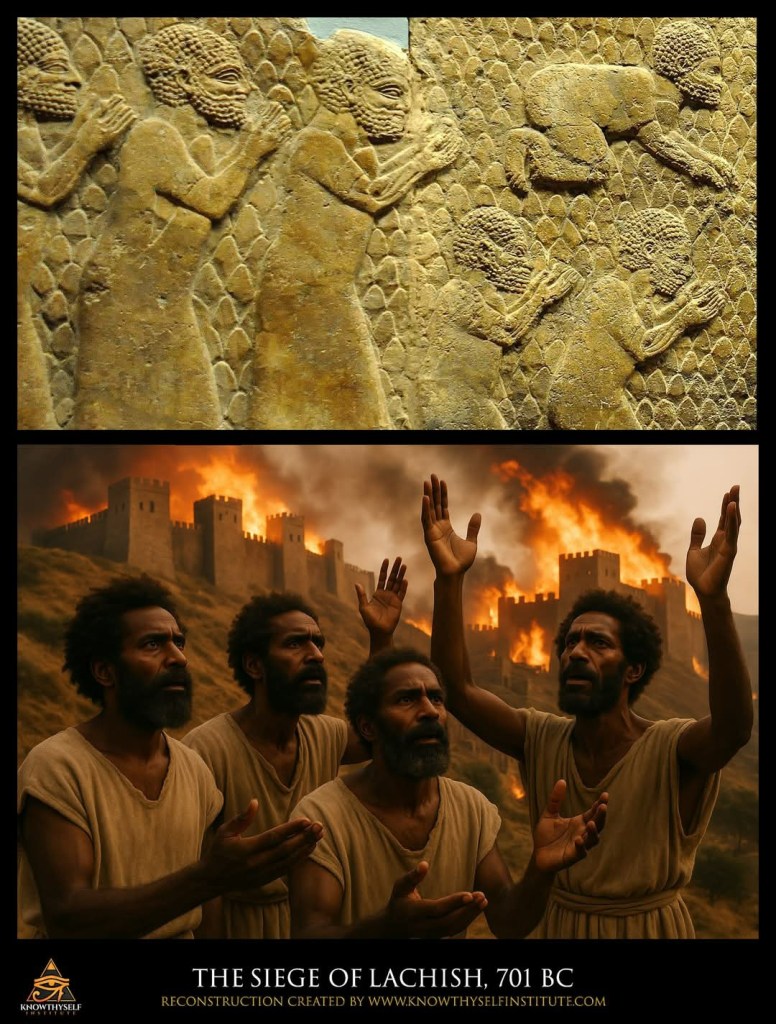
Recent bio-anthropological studies have challenged traditional notions of the ancient Israelites as ethnically distinct from African populations. In a 2020 craniometric study, biological anthropologist Leigh Godde compared skeletal remains from several ancient populations, including the Naqada and Badarian Egyptians, A-Group Nubians, and Bronze Age Israelites from Lachish (Palestine). Godde found that:
“The two pre-dynastic [Egyptian] series had strongest affinities [with Nubians], followed by closeness between the Naqada and the Nubian series… the Lachish sample placed more closely to Naqada than Badari” (Godde, 2020).
- An Examination of Nubian and Egyptian Biological Distance (Godde, 2020)
This biological proximity places early Israelites firmly within the Afro-Asiatic sphere. Rather than being a Semitic outlier with lighter skin or European features, the Israelites emerged from a region that was genetically, culturally, and geographically tied to Northeast Africa.
Biblical Testimony: The Black Identity of Israelite Figures
The Hebrew Bible itself contains numerous clues about the skin color and ethnic affiliations of ancient Israelites. For instance:
- Moses is mistaken for an Egyptian (Exodus 2:19), and at the time, Egyptians were depicted in art and text as dark-skinned Africans with wooly hair.
- Moses marries a Cushite woman (Numbers 12:1); Cush was the ancient name for Nubia, a region in present-day Sudan.
- In Song of Songs 1:5, a woman declares: “I am Black and beautiful, O daughters of Jerusalem, like the tents of Kedar.”
These verses not only affirm the presence of dark skin among the Hebrews but normalize it as part of their divine narrative and cultural fabric.
Afro-Asiatic Roots of the Hebrew Language:
The Hebrew language is a member of the Afro-Asiatic language family, which encompasses a wide range of languages including ancient Egyptian, Berber, Amharic, Cushitic, Chadic, and other East African and Semitic tongues. The Israelites trace their origins to Ur of the Chaldees in southern Mesopotamia but spent centuries in Egypt—a land that served as both a literal and symbolic “womb” for their national identity. Their migration patterns, trade routes, and intermarriages further embedded them within African and Afro-Arabian cultural and genetic contexts. This deep Afro-Asiatic heritage highlights a shared ancestral and linguistic matrix between early Semitic peoples and African populations, underscoring the interconnectedness of the Hebrew language’s preservation across northeastern Africa and the ancient Near East.
Moses, the foundational prophet and lawgiver of the Hebrew tradition, was raised in Egypt and married a Cushite woman (Numbers 12:1), connecting him directly to the African branch of the Afro-Asiatic world. Cush, often identified with Nubia in modern-day Sudan, was a civilization inhabited by dark-skinned people with significant political and spiritual influence in antiquity.
The Levites, charged with preserving and teaching the Torah, emerged from an Egyptian context. Archaeological and cranial studies (Godde, 2020) suggest strong biological and cultural ties between Egyptians, Nubians, and early Semitic populations in Canaan, implying that the early Hebrews were likely part of a dark-skinned Afro-Asiatic population.
The New Testament account of the Ethiopian eunuch (Acts 8:27–39), who was reading Hebrew scripture from the Book of Isaiah, further demonstrates that African Afro-Asiatic peoples were deeply engaged with the Hebrew religious tradition. This tradition continued through the Beta Israel (Ethiopian Jews), who preserved Torah scrolls, Hebrew prayers, and priestly customs for centuries in East Africa, independent of rabbinic Judaism.
These connections make it clear that the Afro-Asiatic world—especially its African branches—played a central role in the transmission and preservation of the Hebrew language and its sacred texts. Many of these historical actors would be considered Black or African by today’s standards, challenging modern assumptions about the ethnocultural identity of early Hebrews.
Modern Implications and Erasure:
Modern depictions of Jews, especially from medieval Europe onward, have shifted the image of ancient Hebrews into a European framework. However, this reflects later diaspora influences and political rebranding, not the ethnic realities of early biblical figures. The term “Jew” itself originates from the tribe of Judah, a southern Israelite group whose members were taken into Babylonian exile in the 6th century BCE and returned under Persian rule. By this point, centuries of cultural contact had already diversified their appearance. Yet, the original Israelites—the ones of the Exodus, the Judges, and early monarchy—remained Afro-Asiatic people of likely dark brown to black skin.
To ask whether the original Jews were Black is not simply a question of color, but one of truth, identity, and reclamation. All available evidence—from skeletal remains and scriptural references to language and geography—points to a Hebrew people who were deeply connected to Africa, and who shared cultural, biological, and linguistic heritage with the Nubians and Egyptians. In today’s terms, many of them would be considered “Black.” Acknowledging this is not revisionism—it is historical restoration.
References:
- Ehret, Christopher (20 June 2023). Ancient Africa: A Global History, to 300 CE. Princeton University Press. pp. 97, 167:
- Haber et al., Cell, 2020; Lazaridis et al., Nature, 2016.
- Godde, Leigh. An Examination of Nubian and Egyptian Biological Distance: Support for Biological Diffusion or In Situ Development? Academia.edu, 2020.
- The Bible (Exodus 2:19, Numbers 12:1, Song of Songs 1:5)
- Keita, S. O. Y. (1993). Studies of ancient crania from northern Africa: Supporting evidence for early regional continuity in North Africa. American Journal of Physical Anthropology.
- Diop, Cheikh Anta. The African Origin of Civilization: Myth or Reality. (1974)
Visit our Official Website:
https://www.knowthyselfinstitute.com
“I have not spoken angrily or arrogantly. I have not cursed anyone in thought, word or deeds.” ~ 35th & 36th Principles of Ma’a
 Hi welcome to my website