SHARED ICONOGRAPHY AND CULTURAL PARALLELS IN ANCIENT EGYPT AND MESOPOTAMIA
SHARED ICONOGRAPHY AND CULTURAL PARALLELS IN ANCIENT EGYPT AND MESOPOTAMIA
The ancient civilizations of Egypt and Mesopotamia shared striking symbolic and visual motifs, none more iconic than the winged sun disk and composite guardian figures such as sphinxes and lamassu. But beneath the surface of shared iconography lies a deeper layer: a common ethnolinguistic consciousness centered around blackness, not in a radicalized modern sense, but as a marker of ancestral identity, divinity, and legitimacy. From Egypt’s “Black Land” (Kemet) to Sumer’s designation as the land of the “Black-headed people,” we are not simply looking at surface-level artistic similarities. We are witnessing the echoes of a shared cultural memory, expressed through symbolic language and ritual tradition.
Winged Sun Disk: Egypt’s Intellectual Property
The winged sun disk originates in Kemet (ancient Egypt) as early as the Old Kingdom (~2500 BCE). Known as Behdety, it was associated with Heru (Horus) of Edfu, the solar falcon deity, and symbolized divine protection, royal legitimacy, and the triumph of cosmic order. The myth encoded in the Temple of Edfu describes Heru transforming into a winged sun disk to defeat the “Isfet” — the forces of chaos.
By contrast, in Mesopotamia, the winged disk appears much later, beginning around the 14th century BCE under Mitanni influence and expanding during the Neo-Assyrian period (9th–7th century BCE). There, the disk is often associated with Shamash or Assur, and occasionally features a deity within the disk. Though adapted into a new context, the timing reveals clear Egypt-to-Mesopotamia influence. The transmission likely moved through diplomatic and trade networks across the Levant, where Egyptian religion and symbolism heavily impacted neighboring cultures. Egypt wasn’t just a cultural powerhouse, it was the source code of sacred imagery and arcane knowledge.
Heru-em-Akhet:
The monument known today as the ‘Great Sphinx of Giza’ was not called that by the ancient Kemetians. The name ‘sphinx’ comes from the Greeks, who associated the figure with their own mythological creature, a lion-bodied being with a riddling female head. However, the original name for this statue in the Kemetic language was Heru-em-Akhet, meaning ‘Heru on the Horizon.’ This name reflects its connection to the solar deity Heru and its alignment with the rising sun on the Giza Plateau, emphasizing its spiritual and astronomical significance within the Kemetian worldview.
Heru-em-Akhet:
- Heru: the falcon-headed solar deity, protector of kings and divine authority.
- em: in or within
- Akhet: the horizon, symbolizing rebirth, resurrection, and the cyclical journey of the sun.
This isn’t just a cool nickname, it is a cosmological statement. Heru-em-Akhet represents the sun rising at dawn in the form of Horus, emerging out of the underworld and ready to strike down chaos. Its positioning on the Giza Plateau faces directly east, perfectly aligned with the solar cycle. The timeframe and supposed builder of both the Sphinx and the Great Pyramid structure is a fallacy. Both are pre-diluvian structures built prior to the cataclysm of the Younger Dryas around 9-11,000 years ago. Heru-em-Akhet translates to “Heru on the horizon”. Heru is facing Leo rising 14,500 years ago at the beginning of the age of Leo. The depiction of Heru, son of the Virgin Mother (Asset/ Issis) as a man with the body of a lion lets us know that Heru welcomes the age of Leo.
Robert Bauval, along with his co-author Thomas Brophy, discusses the theory that the original head of the Sphinx may have been that of a lion rather than a human. In their work Black Genesis, they explore the possibility that the Sphinx was originally carved to depict a lion, which they argue symbolizes strength, guardianship, and a connection to the celestial realm. Bauval suggests that the Sphinx’s current human head may have been altered or re-carved at a later date, possibly during the time of Khafre, the pharaoh traditionally associated with the monument. They propose that this transformation reflects a shift in cultural and religious significance, as the lion was a powerful symbol in ancient Egyptian mythology, particularly associated with the sun god and kingship.
“The hypothesis that the Sphinx was originally a lion-headed figure aligns with the ancient Egyptian understanding of the lion as a potent symbol of protection and divine authority.”
— Black Genesis: The Prehistoric Origins of Ancient Egypt, Robert Bauval and Thomas Brophy
The monumental winged guardian figures we associate with the Persian Achaemenid palaces, such as those at Persepolis and Susa, are often mistakenly thought to be purely Persian inventions. In reality, they are heavily inspired by earlier Assyrian prototypes, particularly the lamassu: towering hybrid beings with the body of a bull or lion, eagle’s wings, and a human head, placed at palace gateways as symbols of divine protection and kingly authority.
The Assyrians (c. 900–600 BCE) were the first to render these figures in massive architectural form, integrating them into the gates of cities like Nineveh and Nimrud, a name linked in later tradition to Nimrod, the mighty hunter and empire-builder described in the Book of Genesis as “Nimrod the Son of Cush.” This lineage hints at a deeper African connection underlying Mesopotamian kingship and iconography, one that predates the Assyrian empire and connects to the ancient Nile Valley civilization of Kush, with its own traditions of divine kingship, monumental architecture, and solar iconography.
Like the Kushite pharaohs who ruled both Nubia and Egypt during the 25th Dynasty, Nimrod embodies the archetype of the Black sovereign whose authority spans worlds, earthly and divine, African and Afro-Asiatic. The fusion of animism, divine kingship, and architectural grandeur seen in both the lamassu and earlier Nile Valley figures like Heru-em-Akhet (the Great Sphinx) suggests not just parallel development, but a shared cultural memory rooted in the sacred power of the Black kings as mediator between heaven and earth.
These lamassu were not mere decoration; they were statements of total sovereignty, blending physical might with divine wisdom to reflect the ruler’s cosmic mandate. And when the Achaemenid Persians rose to power (c. 550 BCE), they absorbed and reimagined this visual language. At sites like the Palace of Darius, we again see winged human-animal hybrids, not as direct copies, but as imperial adaptations that reassert Persian kingship as the rightful heir to Assyrian, Babylonian, and perhaps even Kushite grandeur.
The iconography isn’t the only parallel. The self-naming of these civilizations reveals an even deeper convergence. Kemet and the Sumerians, indigenously known as the “Black-Headed People” (𒊕𒈪𒊕𒈾 / sag-gi-ga), shared an ethnolinguistic consciousness rooted in a worldview that linked blackness to sacred identity, kingship, and divine order — not simply as a physical trait, but as a cultural and cosmic marker of legitimacy.
The Sumerians referred to themselves as the “Black-Headed Ones” — a term found repeatedly in their own cuneiform tablets. In Sumerian:
- sag = head
- gi = black
- ga = plural/possessive
This wasn’t a name given by outsiders, but a proud self-designation preserved in temple hymns, royal inscriptions, and legal codes. Likewise, Kemet (𓆎𓅓𓏏𓊖) — often mistranslated as “the Black Land” — more accurately refers to “the Black People” or “Black Nation” when analyzed linguistically:
- km (𓆎𓅓) = black
- -t (𓏏) = feminine/collective suffix
- 𓊖 = determinative indicating “place” or “nation”
Supporting this is the ethnonym kmtjw (Kemetyu), meaning ‘the people of Kemet,’ which can be more precisely translated as ‘the Black people.’ Found in numerous Old and Middle Kingdom inscriptions, this term was used to distinguish the native inhabitants of the Nile Valley from foreigners. It affirms that km referred not to soil or silt, but to people and nationhood — specifically, Black people as a political, cultural, and spiritual identity.
“The Egyptians clearly called themselves Black, using the term ‘km.t’, and no reference to soil or silt was involved. The determinative in the word is the sign for people, not land.”
— Cheikh Anta Diop, Civilization or Barbarism
This parallel in self-identification between Sumer and Kemet suggests more than linguistic coincidence, it reveals a deeper cultural convergence, where blackness symbolized ancestry, sacred authority, and sovereign legitimacy. Both civilizations emerged from distinct yet resonant worldviews that encoded blackness as divine, not just in physical appearance, but in language, kingship, and cosmic order. Linguist Giovanni Semerano traced the root khem/kham across Semitic and Afro-Asiatic languages to mean ‘burned’ or ‘black,’ a theme also echoed in Akkadian (qamu) and Biblical Hebrew (Ham). The Hamites, descendants of Noah’s son Ham, were traditionally seen as the ancestors of African peoples — ‘those with burnt faces.’ Whether treated as mythology or memory, these linguistic patterns speak to a deep Afro-Asiatic legacy linking blackness with divine origin.
The biblical figure Nimrod, the great-grandson of Noah through Kush (Ham’s son), was said to have established many of the first great cities in Mesopotamia, including Babel, Erech (Uruk), Akkad, and Nineveh. His lineage through Kush, whose name also means ‘black’ in multiple traditions, places him at a symbolic crossroads between Nile Valley and Mesopotamian civilization. Nimrod becomes not just a mythic founder of empires, but a cultural link, a Kushite root embedded in the foundation of Sumerian and Assyrian greatness.
In this context, the shared use of terms like ‘Black-Headed People’ in Sumer and ‘Kemetyu’ (‘Black People’) in Kemet reflects more than physical descriptors. It signals a worldview in which blackness was divine, foundational, and inseparable from civilization itself. This structure is echoed in the wider Nile Valley and beyond. “Sudan” derives from Arabic Bilad al-Sudan, or “land of the Blacks.” “Ethiopia” comes from the Greek Aithiops, “burnt face.” These names reflect a consistent pattern of identifying African civilizations by their dark-skinned inhabitants, not just their geography. In Sumer, we see a nearly identical ethnonym: the people called themselves “sag-gi-ga”, meaning “the Black-headed people.” This wasn’t an insult or imposed label—it was a term of cultural self-identity. Just like Kemet, Sumer marked itself through complexion as a signifier of origin and belonging.
Symbols and Sacred Memory:
This is bigger than art history. The winged sun disk, Heru-em-Akhet, and the “Black-headed” ethnonyms aren’t just cross-cultural similarities. They reflect a shared sacred language, one that encoded spiritual power, ancestral knowledge, and divine authority through blackness, solar symbolism, and animal-human synthesis.
Kemet was not merely an influence, it was a point of origin, mythologically and symbolically. Civilizations such as Sumer and Assyria did not imitate Kemet so much as engage in a broader Afro-Asiatic cosmological dialogue that Kemet helped define. References like Heru-em-Akhet gazing toward the horizon, or the Sumerians calling themselves ‘the Black-Headed People,’ are not isolated linguistic quirks or artistic motifs. They reflect a shared cultural memory, a worldview in which divinity was recognized within the human form and encoded in language, architecture, and ritual. These expressions reveal not just aesthetic continuity, but a profound metaphysical understanding that spanned regions and epochs.
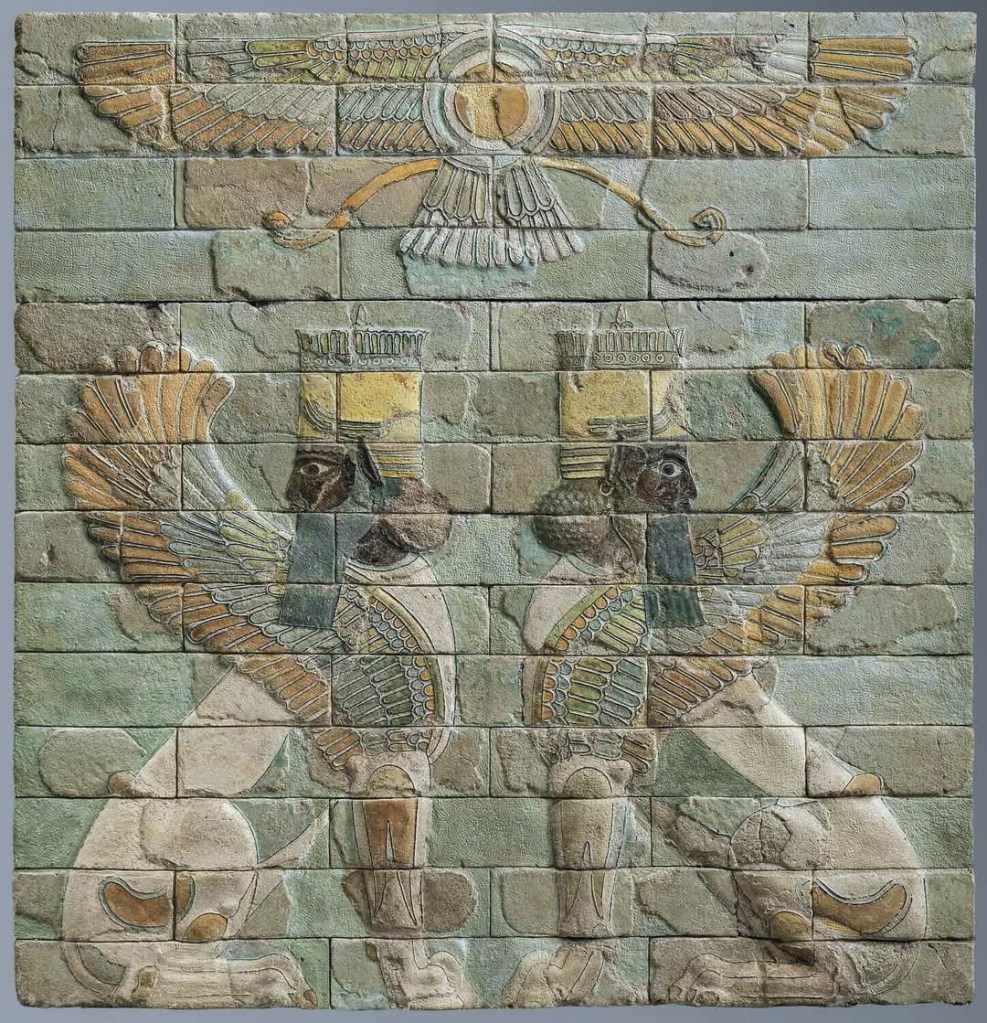
Image: Persian Sphinxes. Palace of Darius the Elamite, Susa, Persian Empire. C. 500 BC. Glazed brick sphinxes in one of the friezes of the palace. The relief shows a pair of winged lions with bearded human heads. The winged disc of Ahura-Mazda hovers above them.
DARIUS AND THE ELAMITE LEGACY: https://www.knowthyselfinstitute.com/post/darius-and-the-elamite-legacy-tracing-the-roots-of-imperial-persia
“I have not spoken angrily or arrogantly. I have not cursed anyone in thought, word or deeds.” ~35th & 36th Principals of Ma’at
 Hi welcome to my website