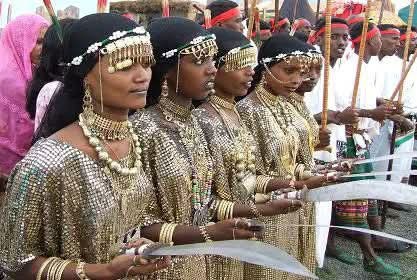
The Afar People
The Afar People
Relations between the Afar and the Abyssinians go back to when the ancient Aksumites controlled the port of Adulis, which was home to the ‘Adolla tribe of coastal Afar and a seaport for trade with South Arabia, India, and the Byzantine and Roman empires.
Ethiopia’s Middle Ages history included numerous civil wars between the Muslim Emirate of Adal and the Christian empires in the highlands, which were both made up of numerous different ethnic groups and ruled by Muslims.
From the second half of the 16th century on, the Adal Emirate’s power decreased and fell apart. A number of factors contributed to this, including the expansion of political power in Christian empires, the Oromo expansionists’ invasion of Afarland, and Turkish imperialist control over islands off the Red Sea Coast.
Even though neighboring highlanders tried more than once to get involved in Afar affairs, traditional authorities (‘Amoytas, Derders, Redantus, Momins, and Makabantus) were leaders and representatives of their people, who were mostly semi-independent. The Afar have fought off many attempts by neighboring highlanders, especially the Amhara and Tigre, to take over large parts of their land.
If you look at the history of Tigray from when it was ruled by Sehul Mika’el in the 18th century to when it is ruled by the TPLF in the 21st century, you can see that the Afar and Tigre have been rivals for a long time because of their fierce competition for economic resources and social and political power.
In the same way, Menilek’s failed attack on the Sultanate of Awsa under Mohammed Hanfare (Illelta) at ‘Arado in 1895 showed that the Afar were very resistant to outside interference.
The Afar people had their own political system that was based on their traditions. It had clear geographical boundaries. They were in charge of all trade and made caravans carrying goods from and to the Red Sea cross the Afarland and pay tax (Adou 1993: 43). Kassa Mercha of Tigray, who would become Emperor Yohannes IV, rebelled against Emperor Tewodros in the 1860s.
While he was in exile, he lived in Kala Ab’ala (northern Afar land), where the Herto leader Yakumi Sere’ Ali gave him his word that he would be safe from any threat from the highlands. In the same way, the Awsean Sultan Yayyo Mohammed helped Lej Eyasu get away from the Shoan leaders in 1916. The claim that the Afar were independent in their areas could be strongly backed up by these events.
In 1898, when Mohammed Hanfare’s family was fighting for power, it was the first time in Awsean history that the Afar asked Shoan leaders to help them with their own problems. After that, in 1944, Emperor Haile Sellasie took part in removing, choosing, and putting in place Awsean sultans.
When Ethiopia switched to a modern way of running things after the Second World War, the Afarlands were split up into different governorates-general. In the long run, this harmed the traditional Afar way of doing things.
After the federation between Eritrea and Ethiopia ended in 1961, Afarland in Eritrea became the fifth part of the Afarland, replacing the four governorates-general of Hararge, Shoa, Wallo, and Tigray.
 Hi welcome to my website