The Kingdom of Kush – Egypt’s Black Pharaohs
The Kingdom of Kush – Egypt’s Black Pharaohs
Introduction
When most people think of ancient Egypt, they imagine pyramids, hieroglyphics, and pharaohs with the regal crowns of Upper and Lower Egypt. But fewer know that for nearly a century, Egypt was ruled by Black African pharaohs from Nubia — the Kingdom of Kush in what is today northern Sudan.
These rulers were no mere invaders; they saw themselves as restorers of Egypt’s ancient traditions, protectors of Amun, and legitimate kings of the Two Lands. Their reign — the 25th Dynasty — is one of the most fascinating periods in ancient Nile Valley history, symbolizing both African imperial power and cultural renaissance.
The Land of Kush: Geography and Origins
Kush lay south of Egypt along the Nile, centered at Napata (near modern Karima, Sudan) and later Meroë. It was a rich, well-watered region of savannah, hills, and desert, controlling key trade routes to central Africa.
Kush had a long, complex relationship with Egypt. For centuries, it was both trading partner and rival. Egypt often coveted Kush’s gold, ebony, ivory, and exotic animals. During the Middle Kingdom and New Kingdom (c. 2000–1070 BCE), Egypt at times conquered and garrisoned Nubia. But even under Egyptian rule, local elites absorbed Egyptian language, art, and religion — while maintaining strong African cultural traditions.
Kush’s Independence and Rise to Power
After Egypt’s New Kingdom collapsed (c. 1070 BCE), Egypt fell into disunity and decline. The “Third Intermediate Period” saw fragmented rule, with Libyan warlords, local dynasties, and priestly factions competing for power.
Meanwhile, Kush regained independence. The kingdom became highly Egyptianized, with kings adopting pharaonic titles, hieroglyphic inscriptions, and worship of Egyptian gods — especially Amun, whose cult center at Jebel Barkal became a major Kushite holy site.
By the 9th–8th centuries BCE, Kush was united and powerful under kings like Alara and Kashta. They saw themselves not as foreign invaders, but as legitimate heirs of Egyptian civilization, guardians of its traditions at a time when Egypt itself was fractured and weakened.
The Conquest of Egypt: The 25th Dynasty
Around 750 BCE, King Kashta pushed north into Upper Egypt. He took Thebes — Egypt’s religious capital — without major battle, securing the allegiance of its powerful priesthood of Amun.
His son Piye (also spelled Piankhi) went further. Around 728 BCE, Piye launched a campaign that brought all of Egypt under Kushite control. His famous Victory Stela describes this conquest: he defeated the fragmented delta princes who had ignored Amun’s authority, entered Memphis, and demanded the submission of local rulers.
Piye did not rule from Egypt but returned to Napata, leaving local vassals in place. Still, he established the Kushite dynasty over Egypt — Egypt’s 25th Dynasty.
Major Pharaohs of the 25th Dynasty
Piye (Pankhi)
The founder of the dynasty in Egypt. Pious, devout to Amun, portrayed as a restorer of maat (cosmic order) and Egyptian tradition.
Shabaka
Piye’s brother or son. He consolidated Kushite rule, defeating rival claimants in Lower Egypt. Famous for commissioning the Shabaka Stone, which preserved ancient theological texts. Moved the capital to Memphis to better control the north.
Shebitku and Taharqa
Taharqa is the most famous Kushite pharaoh. His reign (c. 690–664 BCE) was a high point of prosperity and monumental building. He restored temples, built colossal statues, and commissioned great works in both Egypt and Nubia.
Taharqa even confronted the Assyrian Empire. At first he helped defend Judah against Assyria (Biblical accounts mention “Tirhakah king of Ethiopia” in 2 Kings 19:9), but eventually Assyrian invasions forced him to retreat.
Tanutamun
The last pharaoh of the dynasty in Egypt. He tried to retake Egypt after Assyrian occupation, briefly recapturing Memphis before being driven out. He fled south, and the 25th Dynasty ended in Egypt.
Kushite Legacy in Egypt
The 25th Dynasty was a time of cultural renaissance in Egypt:
Temple Restoration: The Kushites restored or rebuilt many temples, especially for Amun. They repaired neglected sanctuaries and commissioned grand pylons, statues, and obelisks.
Religious Revival: They revived traditional priesthoods and cult practices. They emphasized the role of Amun as Egypt’s chief god — a theological move that also legitimized their own power.
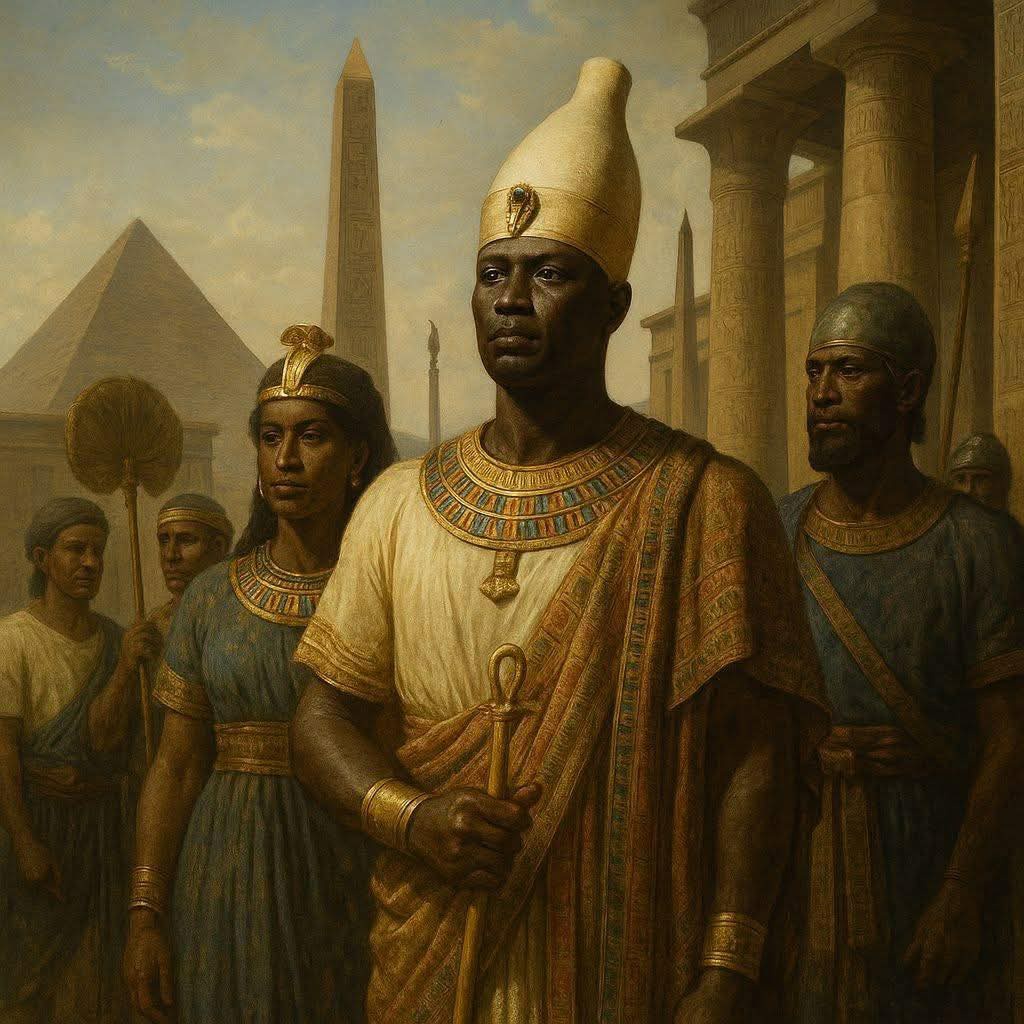
Art and Iconography: Kushite kings adopted classic pharaonic art styles but with their own distinct features. Statues show their African facial features, short hair, and the Kushite “cap crown” or double uraeus.
After the 25th Dynasty
Although Assyria expelled them from Egypt in the 7th century BCE, the Kushite kings returned to Nubia and established a powerful kingdom centered at Meroë. For centuries, Meroitic Kush flourished, developing its own writing system (the Meroitic script), building hundreds of pyramids (more than Egypt!), and maintaining extensive trade networks.
Kush remained one of the great African civilizations until its decline around the 4th century CE.
Black Pharaohs and African History
The Kushite pharaohs challenge old stereotypes about ancient Egypt as somehow “not African.” They show:
Deep African Connections: Egypt and Nubia were part of the same Nile Valley civilization, with shared religious, artistic, and political traditions.
Black African Leadership: The 25th Dynasty was led by unmistakably Black African kings who embraced both their own heritage and Egypt’s legacy.
Restoration, Not Destruction: Far from being brutal conquerors, the Kushites saw themselves as saving Egypt’s culture and religion from decline.
Their story is a powerful testament to the complexity and richness of African history. It is also a reminder that African states once ruled empires stretching from the heart of Sudan to the Mediterranean Sea.
Conclusion
The Kingdom of Kush and its Black Pharaohs deserve a central place in any telling of Africa’s past. They were warriors, priests, statesmen, and builders — heirs of Egypt and creators of their own powerful civilization.
Their legacy remains in the ruins of temples at Jebel Barkal, in the pyramids of Meroë, in the inscriptions they left behind, and in the very idea that Africa’s history is one of greatness, resilience, and cultural creativity.
africanhistory #history #civilization #africa #sudan #egypt
 Hi welcome to my website