
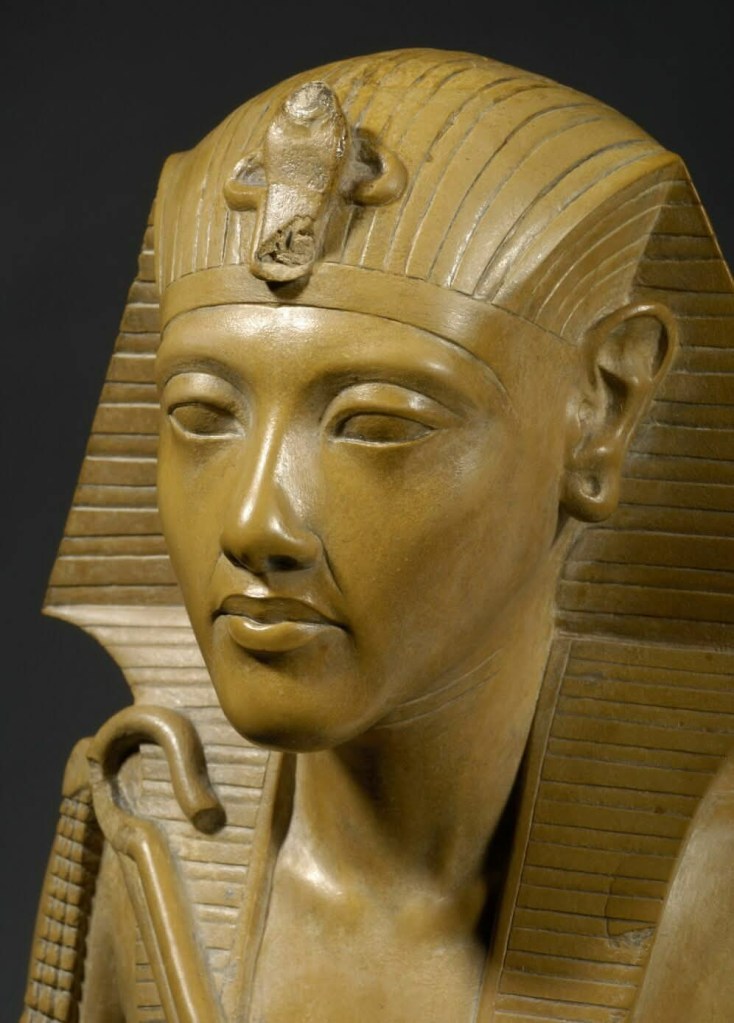
Detail of a yellow limestone sculpture possibly depicting King Amenhotep IV (later Akhenaten)
Detail of a yellow limestone sculpture possibly depicting King Amenhotep IV (later Akhenaten) who reigned circa 1353-1336 BCE during the 18th Dynasty. The uninscribed statue likely dates to early in Amenhotep IV’s reign, before the revolutionary changes he instituted for the depiction of human body in sculpture and wall relief (i.e., what we refer to now as the Amarna style).
“Akhnaton: The thought of that senseless cruelty does not fill you with horror?
Horemheb: You do not understand the necessities of war.
Akhnaton: It is you I do not understand! Your glance is kind. You are simple and unassuming. There is no cruelty in you. And yet — [broodingly] — I am afraid of you.
Horemheb: Afraid of me? My lord!
Akhnaton: We are so far from each other — you and I.
Horemheb: You are a great Prince and I am only one of a thousand soldiers.
Akhnaton: That was not my meaning. We speak a different language, you and I. And yet — and yet — there is a bond between us.
Horemheb: You are too gracious, Highness.
Akhnaton: Between your strength — and my weakness — between your simple direct mind — and my conflicting visions. To accept, as you do — I wish I could. [Pause.] You shall be my friend, Horemheb.
Horemheb: My lord, I am yours utterly.
Akhnaton: When I come to my kingdom, you shall help me rule.
Horemheb: [with enthusiasm] I will make you the greatest King that ever lived.
Akhnaton: And what can I be that is greater than those who have gone before me?
Horemheb: A wider Empire still — an Empire that stretches beyond the land of the Two Rivers.
Akhnaton: More lands, more subject peoples, bigger palaces, still greater temples to Amon, thousands of beautiful women where my father had hundreds? No, Horemheb, listen to my dream. A kingdom where men dwell in peace and brotherhood, foreign countries given back to rule themselves, fewer priests, fewer sacrifices. Instead of many women — one woman. A woman so beautiful that after thousands of years men shall speak of her beauty… [A pause. Very softly] That is my dream…”
― Christie, Agatha, Akhnaton (A Play in Three Acts), Bantam Books, New York, USA, 1996.
A reimagining of a conversation between Akhenaten — before he ascended the throne — and Horemheb, whose military career seems to have started under Akhenaten’s father and continued until he took the throne as the last monarch of the 18th Dynasty.
This piece (N 831) is now in the Musée du Louvre (Louvre Museum), Paris, France.
 Hi welcome to my website