
The Anglo-Aro War (1901–1902): A Pivotal Conflict in British Colonial Expansion into Eastern Nigeria.
The Anglo-Aro War (1901–1902): A Pivotal Conflict in British Colonial Expansion into Eastern Nigeria.
The Aro Confederacy was a powerful political, economic, and religious force in present-day Eastern Nigeria, established since the mid-17th century. This network of Aro communities (a subgroup of the Igbo people) and their allies extended its influence across southeastern Nigeria and beyond, including parts of present-day Cameroon and Equatorial Guinea. The Aro dominated regional trade networks, particularly through their control of slave trading operations and the revered Ibini Ukpabi oracle (known as “Long Juju” by British colonists). Their religious authority, economic power, and sophisticated political organization made them the primary obstacle to British colonial penetration into the Nigerian hinterland during the late 19th century .
By the last decades of the 19th century, the British were increasingly determined to consolidate control over what would become Nigeria. The Royal Niger Company, under Sir George Goldie, had established British commercial interests in the region, but the Aro Confederacy’s dominance hindered complete colonial domination. The British cited multiple justifications for confrontation, including the abolition of slavery, suppression of “barbaric” religious practices, and the introduction of “legitimate trade” and Western civilization. However, many historians argue that these moral arguments primarily served as a convenient pretext for what was essentially an imperial land and resource grab .
Causes of the Conflict: Complex Factors Behind the War
1 Economic Factors
-Slave trade vs. legitimate trade: The Aro Confederacy had built much of its wealth and power on the transatlantic slave trade and subsequent internal slave trading. Even as slave exports declined due to British abolition efforts, the Aros shifted to internal slavery and maintained their economic dominance through other commodities like palm oil. The British sought to replace these systems with their own concept of “legitimate trade” that would benefit colonial interests .
-Control of trade routes: The Aro controlled key regional trade routes and markets, limiting British access to the interior’s resources. Sir Ralph Moor, the British High Commissioner of the Nigerian Coast Protectorate, explicitly stated that one war aim was “to open up the country of the entire Aro to civilization” and “to introduce a currency in lieu of slaves, brass rods” .
2 Religious and Cultural Factors
- The Ibini Ukpabi oracle: The Aro’s religious influence through their oracle at Arochukwu was perceived as a major threat to British colonial and missionary efforts. The British claimed the oracle’s priests used “superstition and fraud” to maintain Aro dominance and facilitate slave trading .
-Resistance to Christianity: British missionaries sought to convert local populations to Christianity, which directly challenged the religious authority of the Aro and their oracle. The Aro rightly perceived Christianity as a tool of colonial disruption that would undermine their cultural and religious influence .
3 Political and Strategic Factors
-Sovereignty and control: The Aro Confederacy represented an independent African power structure that had successfully resisted European domination well into the colonial period. Their network of 19 kingdoms, with Arochukwu as the capital, maintained effective control over the region without British interference .
-British imperial expansion: The war occurred during the Scramble for Africa, when European powers were racing to claim African territories. The defeat of the Aro would open vast territories to British colonization and resource extraction.
3 Military Campaigns: The Aro Expedition and Key Battles
1 Preparation and Forces
British military planning for the invasion began as early as September 1899 under the direction of Sir Ralph Moor and the Royal Niger Company. However, due to insufficient manpower, the expedition was delayed until November 1901 . The British finally assembled a force consisting of:
- 87 British officers
- 1,550 soldiers (mostly African troops)
- 2,100 carriers
The Aro Confederacy, by contrast, fielded at least 7,500 fighters, though they were significantly disadvantaged by their lack of modern weaponry. The Aro relied primarily on traditional weapons alongside some firearms, but nothing matching the British Maxim guns and artillery .
2 Major Engagements
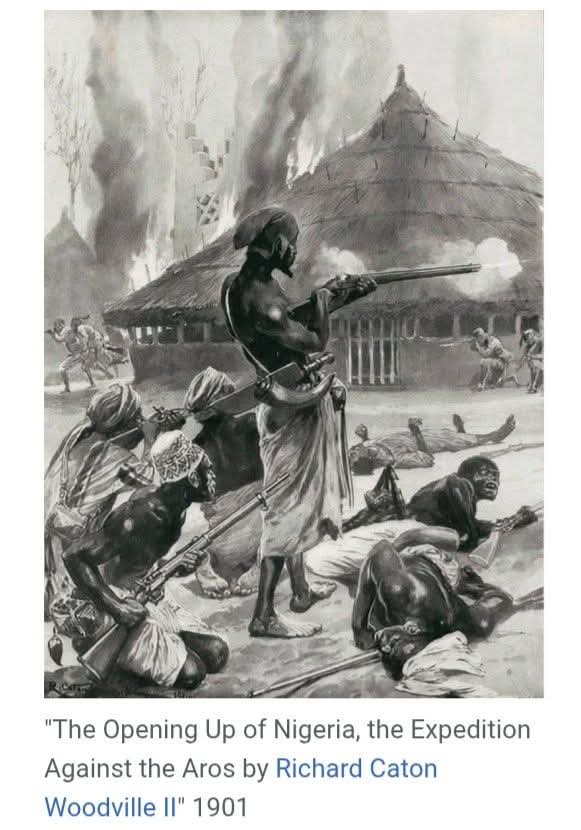
The British campaign, dubbed the “Aro Expedition”, was launched on November 28, 1901, with a four-pronged advance on Arochukwu from Oguta, Akwete, Unwana, and Itu . Key battles included:
-Attack on Obegu: Before the British could launch their expedition, Aro forces led by Okoro Toti preemptively attacked Obegu, a British-allied community, killing approximately 400 people. This accelerated British preparations .
-Battle of Arochukwu: After weeks of fighting through surrounding territories, British forces reached Arochukwu in late December 1901. The capital fell after four days of intense fighting on December 28, 1901. The British subsequently destroyed the Ibini Ukpabi shrine, a major spiritual and political blow to the Aro Confederacy .
-Battle of Bende: The last major engagement occurred at Bende in March 1902, where Aro forces were decisively defeated. This battle effectively ended organized Aro resistance .
4 Aftermath and Consequences of the War
1 Immediate Consequences
The defeat of the Aro Confederacy had several immediate consequences:
-Execution of Aro leaders: Key leaders like Okoro Toti were captured, tried by tribunals, and hanged .
-Destruction of Aro power: The Aro Confederacy was largely dismantled, and its territory incorporated into the British Protectorate of Southern Nigeria.
-Loss of cultural artifacts: Numerous priceless Aro cultural and religious artifacts were destroyed or looted during the conflict .
-Liberation of slaves: The British freed many Ibibio and non-Aro Igbo slaves held by the Aro .
2 Continued Resistance
Despite the official end of the Aro Expedition in March 1902, resistance to British rule continued through guerrilla campaigns in various regions:
-Afikpo (1902-1903): Aro fighters joined resistance efforts in the Afikpo region .
-Ezza (1905): Significant resistance occurred in Ezza with Aro participation .
-Other conflicts: The British faced continued resistance throughout Igboland, including the Ekumeku War (1883-1914), Nri Conflict (1905-1911), and the Igbo Women’s War (1929) .
3 Long-Term Impacts
- Colonial administration: The British established new administrative systems that altered traditional power dynamics and integrated the local economy into the global market, often at the expense of indigenous practices and autonomy .
-Religious transformation: The destruction of the Ibini Ukpabi oracle opened the region to Christian missionary activity, leading to widespread conversion over subsequent decades .
-Economic restructuring: The British introduced currency-based systems and labor markets that replaced previous trade networks and slavery-based economies .
5 Historical Interpretations and Debates
The Anglo-Aro War has been interpreted differently through various historical perspectives:
1 British Colonial Narrative
Official British accounts justified the war as a moral crusade against slavery and barbaric practices. Sir Ralph Moor framed the conflict as necessary to enforce the Slave Dealing Proclamation of 1901, abolish the “Juju hierarchy,” and introduce civilization . This perspective portrayed British actions as benevolent and progressive.
2 Igbo and Aro Perspectives
Many Igbo historians challenge the British narrative, arguing that anti-slavery rhetoric was primarily a pretext for imperial expansion. As noted in the New World Encyclopedia, the official Aro king’s website describes the British attack as “unwarranted” and driven by “the selfish economic interest of the then British Empire” . These perspectives emphasize:
- The Aro Confederacy had already begun transitioning to the palm oil trade by 1901 .
- Reports of cannibalism and extreme practices appeared only from British sources, suggesting possible propaganda .
- The British themselves had been primary participants in the transatlantic slave trade for centuries .
3 Academic Analysis
Scholarly analysis by historians like Jeffrey Ian Ross and Adiele Afigbo acknowledges the complexity of motivations, recognizing that while slavery was indeed a concern, it served alongside geopolitical and economic interests in justifying military action . Robert D. Jackson’s “The Twenty Years’ War” documents that resistance to British expansion in southeastern Nigeria involved over 300 battles and at least 10,000 Nigerian lives over two decades, placing the Anglo-Aro War within a broader context of prolonged African resistance to colonialism .
6 Legacy and Commemoration
The Anglo-Aro War remains a significant historical memory for the Igbo people and particularly for the Aro community:
-Cultural preservation: Today, Arochukwu is the third-largest city in Abia State, and numerous Aro associations work to preserve Aro culture and history .
-Historical reassessment: There is ongoing scholarly and community effort to reassess the war from African perspectives rather than colonial narratives .
-Broader colonial understanding: The war exemplifies how European powers used claims of moral superiority to justify imperial expansion while simultaneously obscuring their own economic motivations .
- Symbol of resistance: The conflict is remembered as part of a broader history of African resistance to colonialism, illustrating the fierce determination of indigenous peoples to maintain their sovereignty despite technological disadvantages .
The Anglo-Aro War represents a critical chapter in the history of colonial resistance in Africa, demonstrating the complexity of colonial encounters and the multifaceted motivations behind imperial expansion. It underscores the importance of examining historical events from multiple perspectives to gain a more nuanced understanding of this transformative period in Nigerian and African history. The war not only reshaped the political landscape of eastern Nigeria but also left a lasting legacy on the cultural and historical consciousness of the Igbo people and their descendants
 Hi welcome to my website
This is an impressively detailed and insightful post on the Anglo-Aro War! 🌍⚔️ I truly appreciate how you’ve contextualized the Aro Confederacy’s political, economic, and religious influence, and how it intersected with British colonial ambitions. Your explanation of the economic and strategic motivations behind the conflict, alongside the nuanced discussion of “moral pretexts” versus imperial interests, makes the post both informative and thought-provoking. It’s a compelling piece that sheds light on a critical episode in Nigerian and colonial history, helping readers understand the complexities of power, trade, and resistance. Excellent work! 📖✨
LikeLiked by 1 person
Thanks
LikeLiked by 1 person