
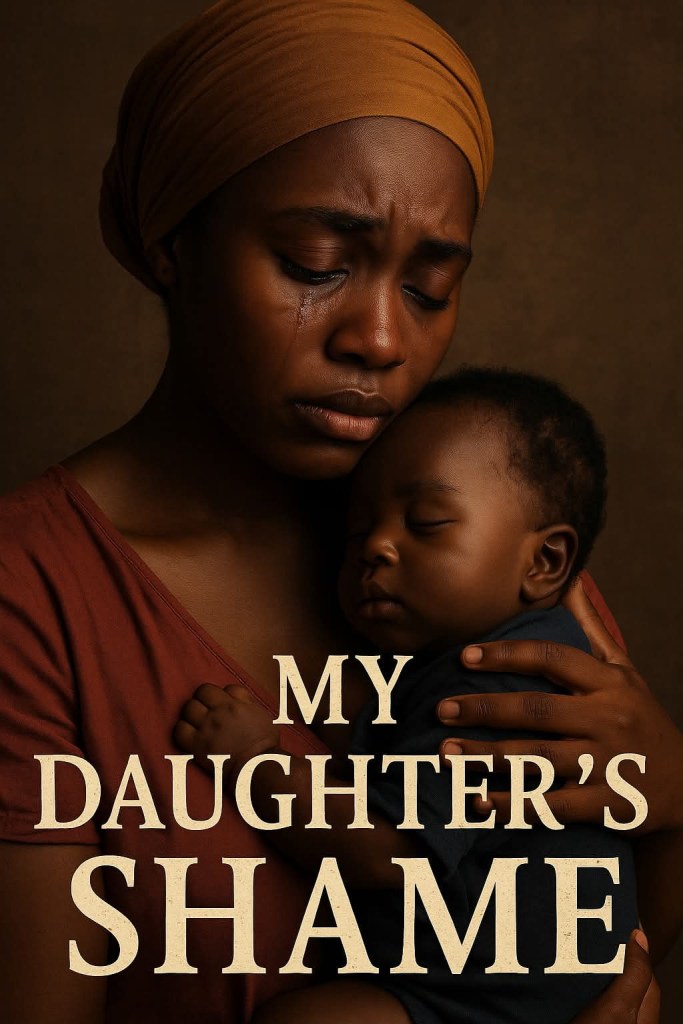
MY DAUGHTER’S SHAME
“What happens when the baby born of shame begins to shine like a blessing—and the whole village is forced to choose between their gossip and the truth?”
MY DAUGHTER’S SHAME
(Episode 10)
The weeks that followed Ada’s testimony in church were heavy yet strangely lighter than the ones before. Something had shifted in the village. Where once there had only been whispers of shame, now there were murmurs of pity, of admiration, even of respect. People still stared when she walked by, still gossiped in corners, but their words no longer had the same sharpness. It was as if by speaking her truth, Ada had stolen back the weapon they once used against her.
Yet inside our home, the battle was far from over. Nights were restless. Mama still cried into her wrapper, her prayers filling the air with desperate pleas for mercy. Papa sat outside most evenings, staring at the stars, his thoughts heavy, his silence louder than words. Ada moved like a shadow in her own skin. Some days she spoke, other days she stayed locked in her room, clutching her stomach as if afraid the world would rip the child from her.
Her belly grew rounder, heavier, announcing life even as she carried memories of death. I often found her by the window, staring out at the road. “Do you think people will ever stop looking at me like I’m cursed?” she asked one afternoon, her voice so soft I almost didn’t hear it.
I touched her hand gently. “Maybe not today. Maybe not tomorrow. But one day, they will look at you and see strength instead of shame. You are more than what happened to you.”
Tears welled in her eyes. “I don’t feel strong. I feel broken every time I remember his hands, his threats, his lies.”
I squeezed her fingers. “But you’re still standing. That is strength.”
Mama overheard us and joined, her eyes swollen from another night without rest. She placed her hands on Ada’s belly. “This child will be a blessing, my daughter. The enemy meant it for evil, but God will turn it into testimony. When you hold your baby, you will see love instead of pain.”
Ada sobbed, pressing her face into Mama’s chest. Papa, listening from the doorway, turned away quickly, but I saw his eyes glisten.
It was not long before Ada went into labor. The night was thick with rain, the roof leaking in small drops, the floor damp beneath our feet. Her screams tore through the house, each one sharper than the last. Mama knelt beside her, guiding her, whispering prayers and encouragement. Papa paced outside, his hands on his head, his body trembling with helplessness.
Hours passed. Sweat drenched Ada’s face, her hair sticking to her skin. She cried out, “Mama, I can’t… I can’t do this.”
Mama’s voice was firm though her own tears flowed. “You can, my child. You must. Push with your strength. Push with your soul. This is not just a baby. This is your freedom.”
I held Ada’s hand, whispering into her ear. “You are stronger than this pain. You have survived worse. Don’t give up now.”
And then, with one final scream, the sound of new life filled the room. A cry—loud, fierce, defiant. Mama lifted the tiny baby, wrapped in a cloth, tears streaming down her face. “A girl,” she whispered. “A beautiful baby girl.”
Ada collapsed into sobs, reaching out trembling hands. When Mama placed the child in her arms, Ada stared as though she could not believe what she saw. The baby’s face was scrunched, her fists clenched, her cries filling the air. And in that moment, something shifted in Ada’s eyes. Pain melted into wonder, shame into love.
“She’s mine,” Ada whispered, her voice breaking. “She’s mine.”
Papa entered then, his face pale with fear and relief. When he saw the baby, his body shook. Slowly, he reached out and touched the child’s tiny hand. Tears fell freely down his cheeks. “She is not shame. She is hope. She is blood. She is ours.”
The room filled with sobs—Mama’s, Ada’s, even Papa’s. I held them all in my heart, the weight of the moment pressing into my soul.
But outside our walls, the village was already waiting. By morning, the news had spread: Ada had given birth. Some muttered that the child was cursed, born of abomination. Others whispered that perhaps the child was the proof of Ada’s innocence, a life blessed to erase the darkness. The church women came with food and clothes, some with genuine kindness, others with curious eyes. The elders debated what this child would mean for the future.
Pastor James visited and prayed over the baby. His voice was firm. “This child is innocent. Let no one call her cursed. What happened was evil, but God has turned it into a testimony. This girl will grow to carry light.”
Ada wept, clutching her baby tighter. “Did you hear that, my child? You are not cursed. You are light.”
But not everyone agreed. One afternoon, as I carried water from the stream, a group of young women whispered loudly. “That baby should never step into the church. She carries abomination in her blood.”
Another spat into the dirt. “Let them keep her hidden. She will grow to bring more shame.”
My heart burned with anger. I wanted to shout, to defend, to curse them with words stronger than theirs. But I remembered Mama’s warning: silence is stronger than gossip. I walked past them, holding my head high, though inside my chest, rage and sorrow fought.
At home, I told Ada what I heard. Her face fell, tears pooling in her eyes. “So it will never end. Even my baby will carry their whispers.”
Papa overheard and slammed his fist against the wall. “Let me hear anyone speak against my grandchild again! I will scatter their teeth on the ground.”
Mama rushed to him, her hands trembling. “Anger will not solve this. We must pray. We must protect her with love, not threats.”
Ada rocked her baby, kissing her forehead. “I will not let their words destroy me anymore. I will raise her with strength, not shame.”
Days turned into weeks, weeks into months. The baby grew, her cries turning into laughter, her tiny hands grabbing at everything around her. Her eyes sparkled like stars, her smile lighting the darkest corners of our home. Ada, though still scarred, began to smile more, began to lift her head when she walked. With every giggle of her child, the weight of her past seemed to lessen.
But not everyone was ready to let go of the past. The family of the uncle—his wife and children—became a new storm. His wife, the one who had testified against him, was thrown out by her in-laws. She came to our home, weeping, carrying her children with her. “They blame me for his death. They say I betrayed him. They have cast me out.”
Mama welcomed her in, giving her food, a mat, and comfort. Papa nodded solemnly. “If they do not want you, we will not turn you away. You spoke the truth when you could have kept silent. You will not suffer alone.”
But others in the village began to whisper again. “First the daughter, now the brother’s wife. That family is cursed. They attract shame like flies to palm wine.”
The whispers grew so loud that one evening, the elders summoned Papa. They told him plainly, “Your house has become a house of scandal. First your daughter, now your brother’s wife. If this continues, your name will rot in the ears of men. You must find a way to cleanse your home.”
Papa returned with fury in his eyes, but Mama calmed him. “We will not let fear drive us. Let them talk. Our house is not cursed. It is blessed with truth, even if it came through fire.”
That night, Ada sat with her baby in her lap, staring at the flames of the lantern. Her voice was soft but steady. “One day, this child will walk into this village, and they will bow their heads. They will see not shame, but glory.”
I watched her, my heart swelling with pride and sorrow. She was no longer just my sister. She was a mother now, a survivor, a woman who had walked through the fire and was still standing.
But deep in my chest, I knew the story was not over. For though the uncle was gone, his shadow lingered. His family still burned with resentment. The village still whispered. And Ada’s child, though innocent, would grow in the midst of suspicion.
The real battle had only just begun.
💬
“If you were Ada, would you raise your child boldly in the village that mocked you—or leave everything behind and start a new life elsewhere?”
 Hi welcome to my website