THE MOTION OF EXIT
THE MOTION OF EXIT
COURT CLERK:
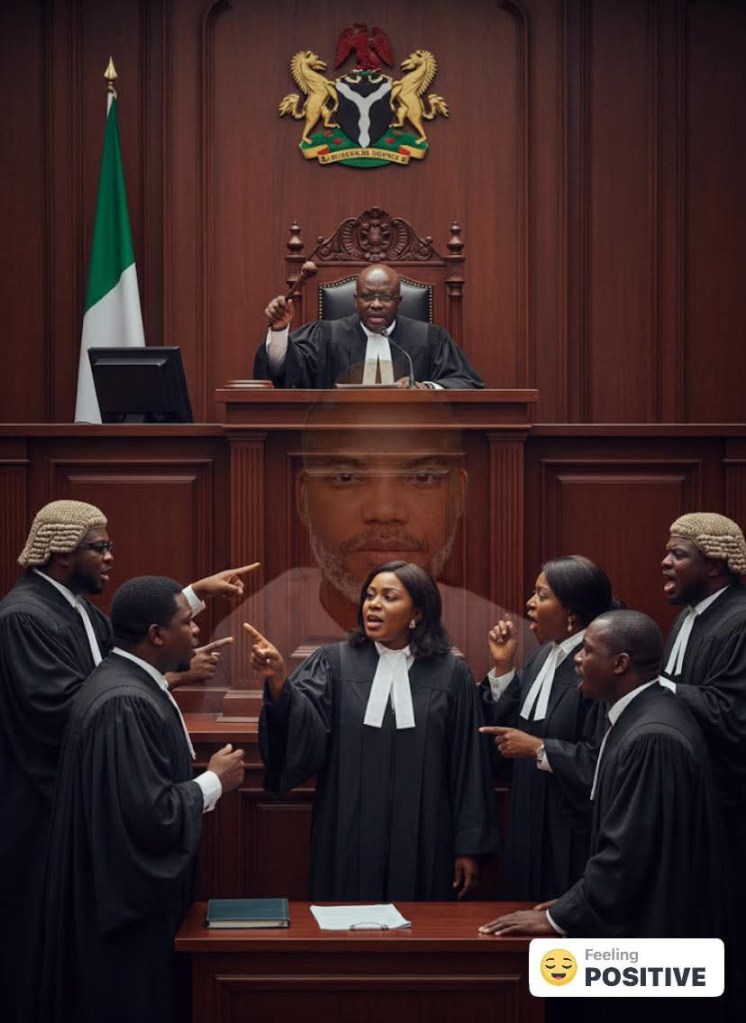
All rise! The Federal High Court, Abuja Division, is now in session. The Honourable Justice Hadiza Abdullahi presiding.
[All rise. Justice Hadiza enters, robed in authority. She takes her seat.]
JUSTICE HADIZA:
Be seated. (Pauses) Court is now in session.
The matter before this honourable court is Suit No. FHC/ABJ/CS/538/2021, between Nastura Ashir Shariff and three others as Plaintiffs, versus the Attorney General of the Federation, the Senate President, the Speaker of the House of Representatives, and the National Assembly.
Today, we also hear an application filed by the Association of Igbo Lawyers seeking to be joined as a party in this historic suit.
Barrister Shariff, you may proceed.
BARRISTER NASTURA SHARIFF:
Much obliged, My Lord.
We appear today in pursuit of justice and peace.
We, the Plaintiffs, have approached this Honourable Court not in hostility, but in hope — hope for a lawful, peaceful, and constitutional path to resolve a matter that has long threatened the unity and sanity of our nation.
JUSTICE HADIZA:
Go on, Counsel.
BARRISTER SHARIFF:
My Lord, the Plaintiffs rely on the provisions of Articles 1, 2, 4, 14, and 20(1) of the African Charter on Human and Peoples’ Rights, domesticated under Nigerian law.
These articles affirm the right of all peoples to self-determination — to freely determine their political status and pursue their economic and cultural development.
Therefore, we seek a declaration that the 2nd and 3rd Defendants — the Senate President and the Speaker — have the constitutional authority to convene a joint session of the National Assembly to deliberate on this matter.
JUSTICE HADIZA:
And your prayer?
BARRISTER SHARIFF:
We pray this Court to direct the National Assembly to provide a framework for a referendum to allow the South-Eastern states to decide their destiny — whether to remain in Nigeria or to peacefully depart.
This, My Lord, is not rebellion. It is recognition. It is democracy at its purest — the will of the people tested by law, not by war.
[Murmurs in the gallery. Reporters scribble.]
JUSTICE HADIZA (firmly):
Order! This is a court of law, not a marketplace. Continue, Counsel.
BARRISTER SHARIFF:
My Lord, our motivation is clear. The continued agitation for secession has bred violence, bloodshed, and destruction.
We believe that if the people of the South East wish to leave, let it be through a peaceful and lawful referendum.
It is time Nigeria faces its truth — not as conqueror and conquered, but as equals in choice.
JUSTICE HADIZA:
Thank you, Counsel. (Turns) Barrister Chukwuemeka Ijeoma, you have filed to be joined. The Court will now hear your argument.
BARRISTER CHUKWUEMEKA IJEOMA:
May it please this Honourable Court.
I appear for the Association of Igbo Lawyers of Nigeria.
Our application, My Lord, is anchored on justice and on the need for balance in a case that concerns the destiny of millions of our people.
If the Plaintiffs — our Northern brothers — can come to Court to ask that we be allowed to go, then it is only proper that we, the people being “released,” have a voice in that conversation.
JUSTICE HADIZA:
You seek to be joined as which party?
BARRISTER IJEOMA:
As co-Plaintiffs, My Lord. We are not opposing the motion. We are embracing it — lawfully, peacefully, and intellectually.
We believe, as the Plaintiffs do, that the right to self-determination is enshrined not only in international law but in moral conscience.
[A wave of silence fills the room.]
BARRISTER IJEOMA:
My Lord, the Plaintiffs have cited the African Charter. Permit me to remind this Court that Nigeria, by domestication of that Charter in 2004, accepted that the right to self-determination is legally binding within her borders.
Article 20(1) states — and I quote:
“All peoples shall have the right to existence. They shall have the unquestionable and inalienable right to self-determination. They shall freely determine their political status and shall pursue their economic and social development according to the policy they have freely chosen.”
JUSTICE HADIZA (leans forward):
And you believe this applies to a region within a sovereign state?
BARRISTER IJEOMA:
Yes, My Lord — particularly when the will of that region has been repeatedly expressed, and the central government continually fails to address their grievances.
We do not seek war. We seek a lawful exit — guided by dialogue, defined by democracy, and delivered through due process.
AGF (rises abruptly):
My Lord, with due respect, this argument is dangerous and unconstitutional.
Nigeria’s sovereignty is not negotiable. No part of the Federation can unilaterally decide to secede.
Section 2 of the 1999 Constitution (as amended) declares that “Nigeria shall be one indivisible and indissoluble sovereign state.”
BARRISTER IJEOMA (calmly):
My Lord, with even greater respect, the word “indivisible” is a political aspiration, not a divine decree.
What binds us is consent — not compulsion.
If a marriage becomes toxic, the law provides for divorce, not detention.
[A gasp runs through the courtroom.]
JUSTICE HADIZA (sternly):
Order in Court!
(After a pause) Counsel, proceed — but be guided by law, not passion.
BARRISTER IJEOMA:
Thank you, My Lord.
We, the Igbo Lawyers, have no desire for chaos. But we refuse to be passengers in a vehicle whose drivers deny us the right to know the destination.
If Nigeria is truly democratic, let her prove it through referendum, not rhetoric.
BARRISTER FATIMA BELLO:
My Lord, I represent the 2nd and 3rd Defendants — the Senate President and the Speaker.
The Plaintiffs’ motion, and this new application by the Association of Igbo Lawyers, are both misplaced.
There is no constitutional provision that empowers the National Assembly to conduct a referendum for secession.
Only the Nigerian people, through constitutional amendment, can decide such a matter — and even then, it must pass through the National Assembly and the State Houses of Assembly.
In essence, My Lord, this Court is being asked to grant what the Constitution forbids.
JUSTICE HADIZA:
And yet, Counsel, Article 1 of the African Charter is clear — Nigeria has undertaken to recognize and give effect to the rights contained therein.
Does that not create a binding obligation?
BARRISTER BELLO:
My Lord, international charters cannot override our domestic Constitution.
To do so would be to place foreign treaties above the sovereignty of Nigeria.
BARRISTER SHARIFF:
My Lord, may I respond?
JUSTICE HADIZA:
You may.
BARRISTER SHARIFF:
With due respect to learned Counsel, the African Charter is not a foreign treaty — it is part of our laws by ratification.
Therefore, its provisions carry the force of law.
If we recognize the right to self-determination in principle, then we must also recognize it in practice.
JUSTICE HADIZA:
A fine argument. (Pauses) But let us test its consequence:
If tomorrow, the South-East leaves, will the South-South not follow? And the Middle Belt next?
Where, then, does this motion end?
BARRISTER IJEOMA:
My Lord, the same question was asked in 1967, and the answer was war.
But today, we seek peace — a referendum supervised by law, not rifles.
Nigeria must stop holding unity hostage.
Unity is beautiful, My Lord — but only when it is voluntary.
JUSTICE HADIZA:
Let me ask a question — not as a Judge, but as a Nigerian.
Do we truly love this country, or do we merely fear what would happen if it breaks?
[None speaks immediately.]
BARRISTER SHARIFF:
My Lord, love and fear are twin emotions.
We love the peace that unity promises, but we fear the blood that disunity might spill.
Hence our prayer: let the law — not the gun — decide the fate of this question.
BARRISTER IJEOMA:
My Lord, I agree.
The South-East is not demanding war. We are demanding a say.
And the Plaintiffs’ motion gives us that chance — to define our relationship with Nigeria through ballot, not bullets.
AGF:
My Lord, if this motion is granted, the government’s authority will be mocked, and our sovereignty fractured.
We will open a floodgate of separatist claims.
Today it is the South-East. Tomorrow it could be the North-East, the Niger Delta, or even the FCT.
Shall we then dissolve Nigeria piece by piece?
BARRISTER IJEOMA (with calm firmness):
No, My Lord. But let us build Nigeria by consent, not by coercion.
When a house leaks, you fix the roof — you do not chain the occupants inside.
JUSTICE HADIZA (leaning back):
I have listened to both sides.
The Plaintiffs argue that the National Assembly has the power to deliberate on the issue of self-determination under the African Charter.
The Defendants say that the Constitution forbids it.
And the Applicants — the Association of Igbo Lawyers — stand between faith and freedom, asking for their voice to be heard.
(Pauses; looks at each Counsel.)
JUSTICE HADIZA:
The question before this Court is not whether the South-East should leave Nigeria — but whether they have the right to ask the question at all.
If democracy means anything, it must include the right to choose, and to ask uncomfortable questions.
BARRISTER SHARIFF:
Indeed, My Lord.
JUSTICE HADIZA:
Nigeria cannot continue to silence the word referendum as though it were treason.
This Court is not an army barracks.
We are the temple of justice, and here, truth must not tremble before power.
BARRISTER BELLO:
My Lord, are you suggesting the Court supports secession?
JUSTICE HADIZA:
No, Counsel.
This Court supports law — and the law, as domesticated, recognises the right of self-determination.
If the people seek it through legal means, it is the duty of the state to provide a constitutional pathway — not to imprison the idea.
AGF:
My Lord, this will shake the foundations of the country.
JUSTICE HADIZA:
Then let the country stand on justice, not fear.
[The courtroom grows quiet as Justice Hadiza picks up her pen. Her voice becomes solemn.]
JUSTICE HADIZA:
This Honourable Court rules as follows:
- That the Association of Igbo Lawyers of Nigeria is hereby granted leave to be joined as a party to this suit, as their interest is directly affected by its outcome.
- That the issue of self-determination, as contained in Article 20(1) of the African Charter on Human and Peoples’ Rights (Ratification and Enforcement) Act, is a justiciable matter within Nigerian law.
- That the National Assembly possesses the moral and legal responsibility to deliberate on any motion or framework that addresses the question of self-determination, provided it is pursued through peaceful and democratic means.
This is not a judgment for disintegration — it is a call for dialogue under law.
Let it be known that peace cannot be forced, and unity without justice is only another form of bondage.
(She looks at both sides.)
JUSTICE HADIZA (firmly):
The motion for joinder is granted.
The Court shall resume in one month for substantive hearing on the originating summons.
COURT CLERK:
All rise!
[As the Judge exits, murmurs erupt. Reporters rush forward. Barrister Ijeoma and Barrister Shariff shake hands.]
BARRISTER IJEOMA:
Brother, perhaps this time, Nigeria will listen before it bleeds.
BARRISTER SHARIFF:
Or bleed until it finally listens.
[Both men exchange a knowing look — one of hope, one of history.]
BARRISTER IJEOMA (softly):
May this be the beginning of understanding, not division.
For if we must remain one nation, let it be a union of hearts, not a cage of fears.
Let love be stronger than suspicion, and peace be deeper than politics.
BARRISTER SHARIFF:
Amen to that, brother. May our unity be born again — not in blood, but in truth.
[Lights fade. The faint sound of the national anthem echoes — soft, trembling, yet filled with hope.]
THE END
Chipangula EnockEze Omaka IsuEzzy AustineKemi Nkechi Ejiro FlashEmmanuel Brown UgoVictoria JUAbuchi DicksonDavid OginniOnyii OzoemenaVictor ChummyEsumai Ifeanyichukwu PepeStephen Uche OkoliEmmanuel NwanegboIgweh GodleadsJanet MikedanChibuzor Godson AnimamMike ‘Dichi UgorjiItz WisdomNelson OkorieJohn GoodnewsBenvincent Mbanasor
 Hi welcome to my website