
IS IT TRUE THAT CHRISTIANS ARE BEING KILLED IN NIGERIA?
IS IT TRUE THAT CHRISTIANS ARE BEING KILLED IN NIGERIA?
Nigeria is a diverse nation composed of numerous ethnic groups and religions, the most prominent being Islam and Christianity. The country was created in 1914 when the British colonial administrator Sir Frederick Lugard united the northern and southern regions. From that colonial “marriage” emerged long-standing tensions rooted in religious and cultural differences.
After independence, Nigeria enjoyed a period of relative stability until the coup of 1966 shattered national unity. Prominent leaders such as Sir Abubakar Tafawa Balewa (Prime Minister), Sir Ahmadu Bello (Premier of the North), and Ladoke Akintola (Premier of the West) were killed. Those events heightened Northern suspicions of targeted violence and precipitated further coups, eventually leading to Yakubu Gowon’s rule and the civil war that threatened to split the country. International involvement in that conflict deepened mutual distrust among Nigerians and hardened perceptions of the crisis as partly religious in character.
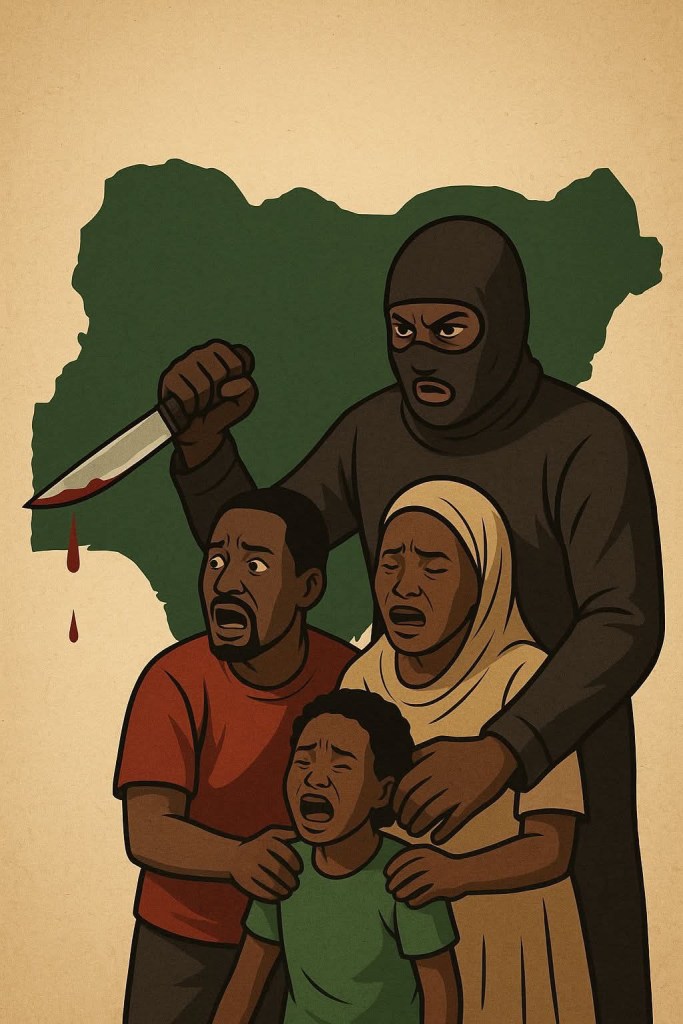
In recent decades, Nigeria has faced serious security challenges, particularly in the North. Since Boko Haram’s emergence in 2009 and through the rise of banditry and kidnappings, violent groups claiming jihad have repeatedly attacked towns especially in the Northeast states of Borno, Yobe, and Adamawa. These assaults have affected everyone, including Christians, but the communities most directly impacted by Boko Haram’s operations are often Muslim.
Banditry and kidnappings are especially prevalent in the Northwest in states such as Katsina, Zamfara, Sokoto, Kaduna, and Kebbi and these criminal networks sometimes extend into central Nigeria. While many perpetrators in those areas are Muslim, Christians have also been victims. Likewise, clashes between farmers and herders driven by competition for land and resources have produced fatalities on both sides and cut across religious lines. In short, Nigeria’s insecurity does not exclusively target Christians; it affects many communities, and in some measures it disproportionately harms Muslims.
Yet the perception that “Christians are being killed” gained prominence after a senior Nigerian Christian presented evidence of attacks on Christians to the U.S. Congress and to then-President Trump. From a human perspective, seeking international attention for mass killings is understandable; victims and advocates may feel compelled to find allies who will press for justice. However, bringing the matter to the United States rather than to multilateral bodies such as the United Nations or the International Criminal Court has geopolitical consequences. Nigeria’s recent foreign-policy shifts efforts to strengthen ties with China, interest in BRICS, and resistance to hosting foreign military bases have strained relations with the U.S., and internationalizing the issue inevitably becomes entangled with those tensions.
Constitutionally and practically, Nigerian Muslims do not forbid Christians from practicing their faith; the Constitution guarantees freedom of religion so long as worship does not disturb public order. Terrorists typically do not check victims’ religious affiliation before committing atrocities, which complicates any simple narrative about targeted religious massacres.
WHAT WOULD HAPPEN IF THE U.S. INTERVENED IN NIGERIA?
An American military intervention framed as protecting Christians would raise serious sovereignty concerns and could intensify the insurgency. Experience from other conflicts Syria, Iraq, parts of Africa shows that foreign military interventions often produce unintended consequences, including proliferating non-state armed groups. Nigeria possesses security forces and police capable in principle of confronting insurgency, but political negligence, corruption, and factionalism have undermined an effective, sustained campaign. The preferable course is for Nigeria to confront and dismantle terrorist networks domestically, hold their sponsors to account, and strengthen institutions so violence cannot be instrumentalized for political ends.
If foreign powers intervene, both Muslims and Christians would suffer; foreign involvement can be exploited to seize natural resources and to further external strategic interests. Nigerians of all faiths must therefore recognize that no foreign power’s interest is superior to the nation’s well-being. When conflict escalates, few are spared so unity and pressure on the government to act impartially against perpetrators, regardless of religion or ethnicity, are essential.
To those in Northern Nigeria who condemn the Christian who sought external redress: consider whether silence is justice. When atrocities occur, raising one’s voice for the victims is not betrayal but an appeal for accountability. Imagine thieves who kill children in two neighboring homes: if one neighbor seeks justice and the other remains silent, who has acted rightly? Speaking up for the persecuted is a moral obligation that transcends parochial loyalties.
Finally, some local actors including compromised religious leaders have, at times, provided cover for criminals. That complicity must be exposed and addressed. Our shared duty is to promote truth, protect civilians, and demand that those responsible for massacres and kidnappings be identified and punished, regardless of their faith or background.
May God grant us health and lasting peace.
 Hi welcome to my website