
On the afternoon of 25 October 1954 security forces on the north-eastern edge
On the afternoon of 25 October 1954 security forces on the north-eastern edge of the city received information that armed terrorists were on a nearby sisal plantation. The informant was a young Luo migrant worker. As dusk fell, a platoon surrounded the spot, in an uncultivated part of the plantation in Dandora, near the swampy junction of two rivers. The gang were camped at the base of a spreading thorn tree. All around was thick papyrus, in which avenues had been cut leading to sleeping places. This was clearly a regular Mau Mau base, a link in the supply chain that connected Nairobi to the forests. Amid the papyrus, the members of a Mau Mau unit could be seen, huddled together in groups of three to four. As darkness fell, the platoon tightened their encirclement. As they did so, those resting in the papyrus became aware of their peril. When the attack began, just after 9p.m., the Mau Mau fighters were ready and returned fire with a ferocity that surprised the European commander. Now realizing that his adversaries were well armed and determined, he pulled his men back to take cover and summoned reinforcements. Later that night officers of the Kenya Regiment arrived with members of the local Kikuyu Home Guard, shortly followed by CID officers and police from Thika. Then came a platoon of the Royal Northumberland Fusiliers, who took positions for an assault on the swamp. Before dawn the Mau Mau fighters were invited to surrender; but none did. The Mau Mau camp was then heavily mortar-bombed for over an hour, this being answered by constant sniping from the guerillas holed up in the papyrus beds.
In the clear light of mid-morning, the Northumberland Fusiliers finally entered the swamp, whilst the other security forces maintained the cordon. The British soldiers moved slowly, cautiously searching amid the papyrus. The skirmishing in the swamp lasted most of the day, as small groups of Mau Mau were flushed out. When discovered, some stood their ground and died with their weapons in their hands — several shotguns, home-made pipe-guns, pistols, bottle-bombs and pangas. In the confusion, part of the gang slipped through the startled and ill-disciplined Home Guard. Others lost their nerve and ran from their hiding places, throwing away their weapons and ammunition as they ran, only to be shot by the Kenya Regiment officers or caught by the Home Guards stationed in the cordon. Some emerged from the papyrus with their hands aloft, and quickly surrendered to the British soldiers. Among them were a few women and young children.
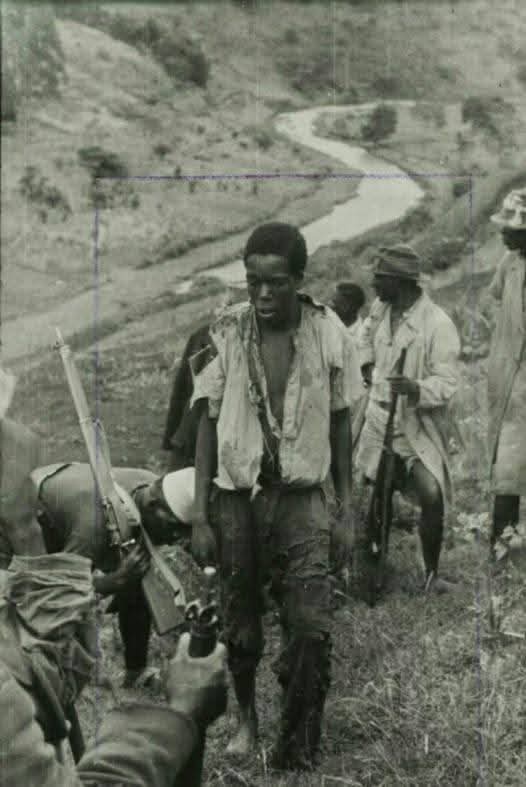
When the final sweep through the swamp was completed that afternoon, around fifty prisoners had been taken, some of them seriously wounded. More than thirty guerillas lay dead, many having perished in the mortar attack before dawn. Among the prisoners was the gang leader, Captain Nyagi Nyaga, who defiantly proclaimed his authority. . .
The interrogations of Captain Nyaga and his followers lasted more than three weeks. When the evidence was gathered, forty-one of those arrested at Dandora came before the Special Emergency Assize Courts in seven trials. The thirty-seven men and four women who stood in the dock can be broadly grouped into three categories. The first comprised seasoned Mau Mau fighters, who had been in the Aberdares forest for many months. There were only five such fighters among the Dandora captives brought before the court: Kaburuki M’amamja, a married man of around twenty-two years of age from Meru; Irungu Mwangi, a former tailor from Ndegwa in Fort Hall, who had been educated to Form II at a Church Mission Society (CMS) primary school; Jacob Maina Gituru, in his early twenties, another CMS affiliate, who had been employed as a clerk in Nairobi prior to the Emergency; Kirongochu Nyaga, a young man of twenty years, from Kirioniri, in Embu, who freely admitted his activities with the forest fighters in the Aberdares; and their leader, Nyagi Nyaga. It is striking that so few of this large gang fell into this category. Several other experienced forest fighters were certainly among those killed at Dandora, and we know that others were among the few who slipped through the cordon on the morning of 26 October; but there had been only around a dozen experienced Mau Mau fighters at Dandora.
The court heard that the ‘talkative’ Nyaga had been cooperative under interrogation. Carrying the insignia of a British army captain on his tattered, improvised military uniform, Nyaga made no effort to conceal his role as a freedom fighter. A married man in his early twenties, from Meru, with a little Anglican education, he had joined General Simba on Mount Kenya at the outbreak of the Emergency in October 1952, later coming under the command of General Kassam. He had come to Nairobi at Kassam’s instigation in September 1954 with a small band of a dozen or so fighters, to secure supplies and to gather new recruits for the movement. . . .
 Hi welcome to my website