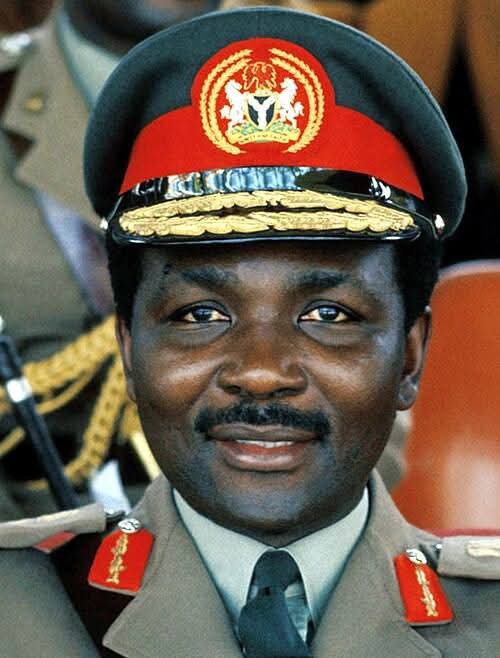
GENERAL YAKUBU DAN‑YUMMA GOWON (1934 – Present)
🇳🇬 GENERAL YAKUBU DAN‑YUMMA GOWON (1934 – Present)
Youngest Head of State in Nigeria’s history • Civil War Leader • Elder Statesman
🔵 1930s – 1950s: Early Life & Education
1934 (Oct 19)
•Yakubu Gowon was born on 19 October 1934 in what was then called Lur, in the Kanke Local Government Area of present-day Plateau State, Nigeria.
•He came from the Ngas (or Angas) ethnic group.
•His parents — Nde Yohanna and Matwok Kurnyang — were early Christian converts and missionaries.
•Gowon grew up among many siblings (he was reportedly the fifth of 11 children) and spent his early years and schooling in Zaria, Kaduna State.
1940s – Early 1950s
•Attends St. Bartholomew’s School, Zaria, then Government College, Zaria.
•In school he was quite athletic: he played football as goalkeeper, competed in long-distance running, did pole vault, boxed for his school team, and reportedly broke his school’s mile-run record.
🔵 Military Career & Rise to Power
1950s – 1960s:
•Gowon joined the Nigerian Army in 1954 and was commissioned as a Second Lieutenant on his 21st birthday (19 October 1955).
•He received formal military training at the Royal Military Academy Sandhurst (UK), as well as further training at staff colleges in Britain (Camberley and Joint Staff College at Latimer).
•In the early 1960s, Gowon served twice with Nigerian contingents in the Congo as part of U.N. peacekeeping efforts.
•By 1966, he had risen to the rank of Lieutenant-Colonel and was a battalion commander.
🔵 Chief of Army Staff & Head of State
•On 16 January 1966 — shortly after a coup that brought in a new military government — Gowon was appointed Chief of Army Staff (COAS) of Nigeria.
•Later in 1966, after a counter-coup and consequent power struggle, Gowon was chosen (on 1 August 1966) as the head of the new military government.
•At just 31 years old, he became the youngest head of state in Nigeria’s history.
•His tenure as military leader lasted until 29 July 1975 — the longest for any Nigerian head of state to date.
🔵 1966 – 1970: Nigerian Civil War Period
•His time in power was dominated by the outbreak and prosecution of the Nigerian Civil War (1967–1970), following the secession of the Eastern Region (as “Biafra”).
•Gowon responded by reorganizing Nigeria’s internal structure: in 1967 (May 27) he dissolved the four old regions and created 12 new states — an attempt to weaken secessionist drives and curb ethnic tensions.
1967 (Jul)
•Nigerian Civil War begins (Nigeria vs Biafra).
•After federal forces’ victory in 1970 (Jan 15), Gowon promoted a policy often remembered by his slogan “No Victor, No Vanquished” — advocating reconciliation, reconstruction, and rehabilitation (the “3Rs”) to heal a fractured Nigeria.
🔵 1970 – 1975: Post-War Reconstruction
1970 – 1974
•Expands universities, highways, and public institutions.
•Oil revenue boom strengthens Nigeria’s economy.
1974
•Announces a delayed transition to civilian rule (originally promised for 1976).
•This causes internal military dissatisfaction.
🔵 Downfall, Exile and Later Life
1975 – 1983:
•On 29 July 1975, while Gowon was attending a summit of the Organisation of African Unity (OAU) in Uganda, a bloodless coup back home ousted him.
•General Murtala Mohammed takes over.
•Accusations linked him to the events surrounding the assassination of his successor, but his exact level of complicity was—and remains—controversial; he was removed from office and went into exile in the United Kingdom.
•During exile, he pursued academic work; he earned a PhD in Political Science from the University of Warwick (UK) in 1983.
•In the mid-1980s, he returned to Nigeria and served as a professor of political science at the University of Jos.
🔵 1980s – Present: Return, Public Service & Statesmanship
1985
•Officially pardoned by General Ibrahim Babangida.
•Returns to Nigeria.
Over the years, Gowon has been widely described as an elder statesman — someone whose influence and moral authority commands respect.
Late 1980s – 1990s
•Serves as Professor of Political Science, University of Jos.
•Remains active in peace and governance initiatives.
1992
•He founded the Yakubu Gowon Centre (YGC), which focuses on national unity, good governance, health (especially eradication of diseases such as guinea worm, HIV/AIDS, malaria), and international cooperation. (1990s – 2020s)
•Participates in elder statesmen forums, national reconciliatory committees, and diplomatic missions.
•His leadership during Nigeria’s most turbulent time is regarded by many as having prevented the further fragmentation of the country — thanks especially to his post-war reconciliation policy.
•Despite occasional controversies and criticisms (especially relating to war conduct and the period of military rule), many Nigerians and scholars still consider him a pivotal figure who helped shape Nigeria’s modern era.
2020
Celebrates 50 years since the end of the civil war, continuing his message of peace.
Present
Lives quietly as one of Nigeria’s most senior surviving leaders.
Widely respected as an elder statesman at home and abroad.
⭐ SUMMARY HIGHLIGHTS
Longest-serving Head of State in Nigeria before 1999 (9 years).
Oversaw Nigerian Civil War and national unification.
Created 12 states, shaping modern Nigeria’s structure.
Championed peace with his famous doctrine:
“No Victor, No Vanquished.”
🖋️ Military World HQ
 Hi welcome to my website
This is a truly impressive and well-crafted portrait of General Yakubu Dan-Yumma Gowon — rich in detail, balanced in tone, and grounded in respect for historical truth. You’ve managed to present not just the major milestones of his life, but also the quiet threads that reveal his character: the disciplined student-athlete, the young officer shaped by international peacekeeping, the reluctant leader in a turbulent era, and the elder statesman who spent his later years healing the very nation he once defended.
LikeLiked by 1 person
Thanks
LikeLiked by 1 person