
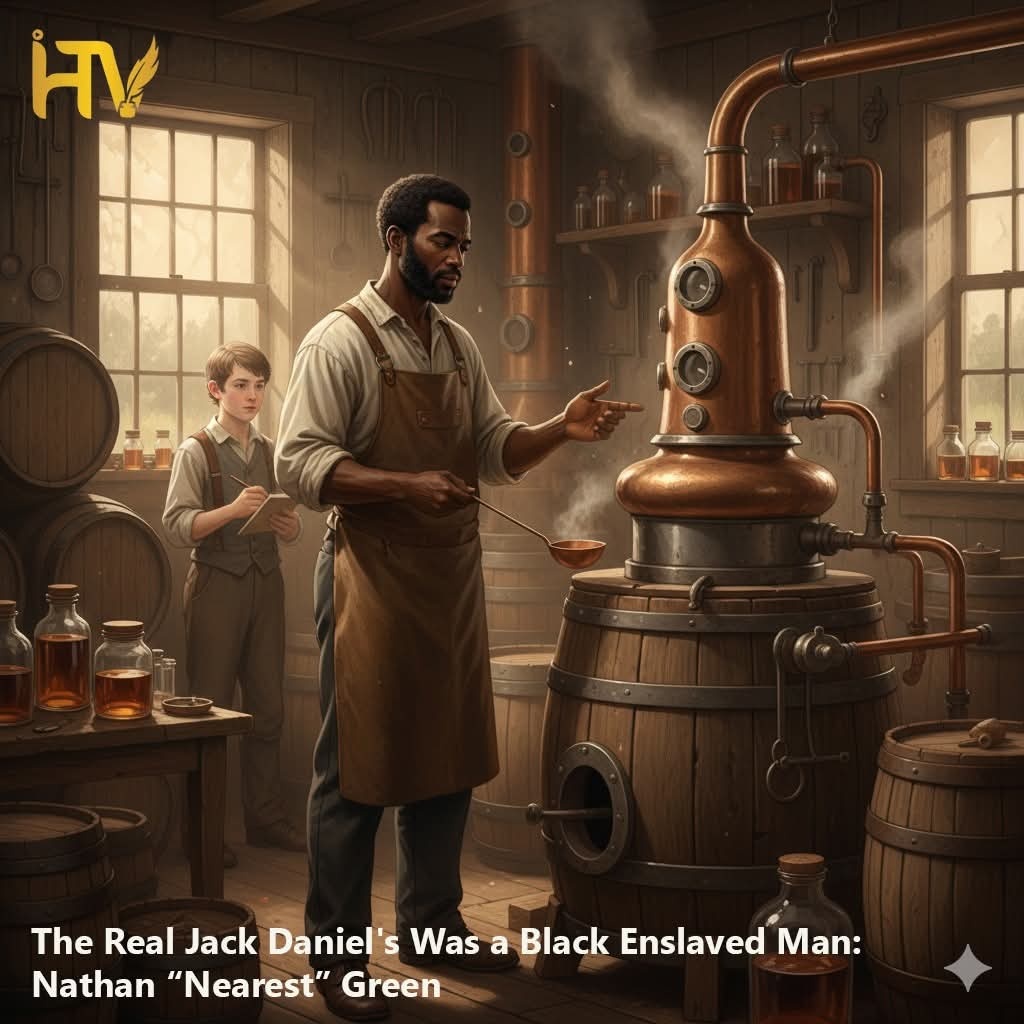
The Real Jack Daniel’s Was a Black Enslaved Man: Nathan “Nearest” Green
The Real Jack Daniel’s Was a Black Enslaved Man: Nathan “Nearest” Green
When the name Jack Daniel’s comes up, most people imagine a white man with a whiskey still in Lynchburg, Tennessee. But the true story behind the world-famous Tennessee whiskey has a deeper, often overlooked chapter: the life of Nathan “Nearest” Green, an enslaved African American whose expertise and innovation shaped the spirit that became a global icon.
From Slavery to Master Distiller
Nathan Green was born in 1820, enslaved in Tennessee, and became a distiller of high repute even before teaching Jack Daniel. Green mastered a technique that would later be known as the Lincoln County Process, a sugar maple charcoal filtering method that gives Tennessee whiskey its signature smooth taste. Remarkably, this technique has roots in West African water purification methods, highlighting the enduring influence of African knowledge in American craft.
At just seven years old, Jack Daniel came to work for the distillery where Green served. It was Nearest Green who mentored the young boy, teaching him the science of mashing, fermentation, distillation, and fire management. After the Civil War and Emancipation, Jack Daniel hired Green as his first Master Distiller, formalizing what had already been a master-apprentice relationship. Despite this critical contribution, Green’s role was omitted from the corporate history of the distillery for over 150 years, only officially recognized in 2016.
Key Highlights of Nathan Green’s Legacy:
African Roots: The charcoal filtering method that defines Tennessee whiskey was adapted from traditional West African techniques.
First Black Master Distiller: Nathan Green is the earliest documented African American Master Distiller in the U.S.
150 Years of Silence: Green’s name was absent from the official story of Jack Daniel’s for more than a century.
Family Tradition: Seven generations of Green’s descendants have continued working at the distillery, preserving the craft and the legacy.
Nathan Green’s story is more than just a tale of whiskey—it’s a testament to resilience, innovation, and the often-overlooked contributions of Black Americans in building iconic industries. Recognizing Green’s influence corrects a historical oversight and celebrates the African American ingenuity that helped shape America’s cultural and industrial landscape.
 Hi welcome to my website