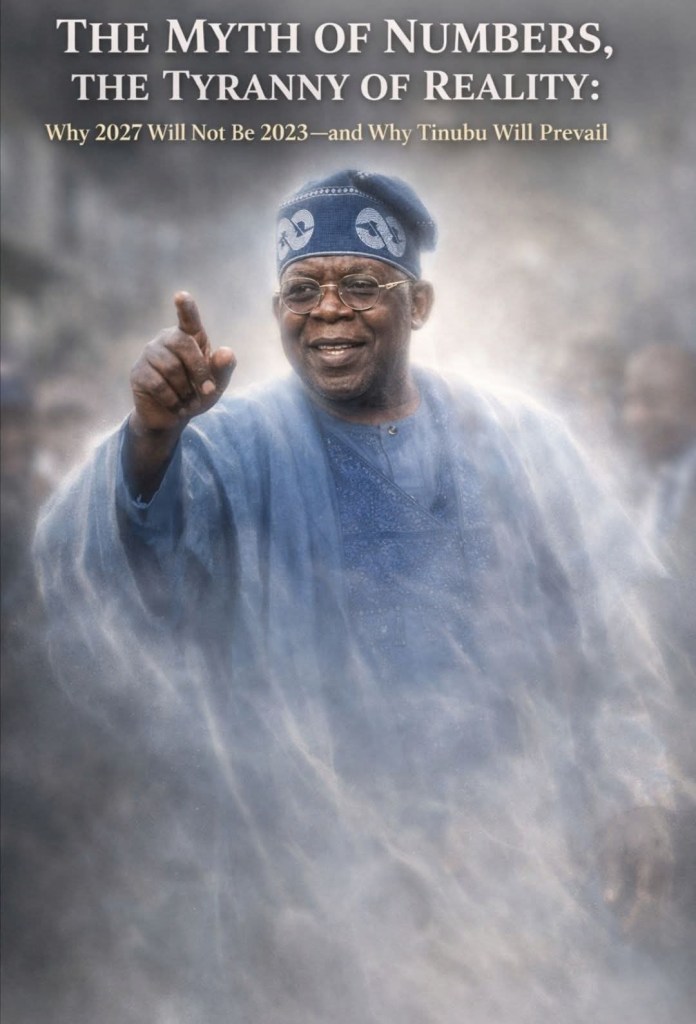
THE MYTH OF NUMBERS, THE TYRANNY OF REALITY: Why 2027 Will Not Be 2023—and Why Tinubu Will Prevail
THE MYTH OF NUMBERS, THE TYRANNY OF REALITY: Why 2027 Will Not Be 2023—and Why Tinubu Will Prevail
There comes a moment in every political epoch when illusion collapses under the sheer weight of arithmetic, geography, and raw political machinery. Nigeria is fast approaching such a moment.
The 2027 elections will not be a referendum on sentiment, social media enthusiasm, or the nostalgic fantasies of perpetual opposition. They will be a cold reckoning—one that exposes the fatal miscalculations of those who still believe elections are won on hashtags rather than hard structures.
The truth, inconvenient to many, is that President Bola Ahmed Tinubu enters the 2027 contest not as a mere incumbent, but God willing, as the undisputed political colossus bestriding the Nigerian landscape.
Let us speak plainly.
The APC already controls 30 of Nigeria’s 36 states. Not in theory. In fact. Not in wishful polling. In raw, institutional power. Governors matter. Structures matter. Ground game matters. And in Nigerian politics, nothing matters more than the ability to mobilize, protect, and deliver votes across terrain, tribe, and temperament.
Even among the so-called “opposition governors,” the ground is shifting beneath their feet.
Soludo of Anambra and Otti of Abia—though flying the banners of APGA and LP—have already signaled where history is headed. Their political instincts, sharpened by survival, point unmistakably toward Tinubu. These are not ideological men; they are realists. They see the center of gravity moving, and they are adjusting accordingly.
That leaves a shrinking map of resistance.
Osun and Oyo?
Governed by the PDP, yes—but politically inseparable from Tinubu’s South-West architecture. These states are Yoruba heartland territory, bound by identity, memory, and political alignment. The idea that they will defy the gravitational pull of a sitting Yoruba president with deep-rooted structures in every ward is wishful fantasy. Tinubu does not need their governors; he owns the soil beneath their feet.
The South-South? Locked.
The South-West? Sealed.
The North-Central? Consolidated.
The North-West? Firmly aligned.
The FCT? Already tilting decisively.
In the North-East, the picture is equally clear. Borno, Gombe, and Taraba fall comfortably into Tinubu’s column, leaving Atiku to cling to Yobe, Bauchi, and Adamawa—his ancestral and emotional redoubts.
And then comes the final miscalculation of the opposition: the belief that Peter Obi’s political essence can be transferred like a talisman.
If Obi runs on the ADC platform, his votes do not multiply—they dissolve. Detached from the emotional insurgency of 2023 and absorbed into Atiku’s perennial ambition, the so-called “Obidient” surge loses its moral electricity. What remains is a regional echo, not a national force.
Thus, Tinubu walks away with 28 states, effortlessly crossing the constitutional threshold of 25% in at least 24 states—not by miracle, but by mathematics.
This is the fundamental error of those still adding 2023 numbers on paper, as though politics were algebra and not warfare. Coalitions are not arithmetic; they are chemistry. Some elements combine explosively. Others neutralize each other on contact.
2027 will not be a rerun of 2023. It will be a reckoning.
Those still clinging to the arithmetic of outrage will wake up on election morning to discover that the map has already been colored in—long before the first ballot is cast.
And when the dust settles, it will become painfully clear:
Nigeria did not choose sentiment.
Nigeria chose structure.
Nigeria chose inevitability.
Asiwaju Bola Ahmed Tinubu Femi Gbajabiamila Bayo Onanuga
 Hi welcome to my website