ETHIOPIA 1974–2000: FROM THE FALL OF THE EMPEROR TO THE AGE OF MENGISTU — AND WHY THE 1980s HUNGER TURNED INTO HEL
🇪🇹🔥 ETHIOPIA 1974–2000: FROM THE FALL OF THE EMPEROR TO THE AGE OF MENGISTU — AND WHY THE 1980s HUNGER TURNED INTO HEL
Ethiopia’s modern trauma begins with the collapse of a monarchy that claimed a thousand-year legacy… and ends the century as a new federal republic still shaped by war, famine memory, and a border conflict that exploded into one of Africa’s deadliest interstate wars.
This is the story from 1974 to 2000—with the names and dates that matter, especially Mengistu Haile Mariam.
⸻
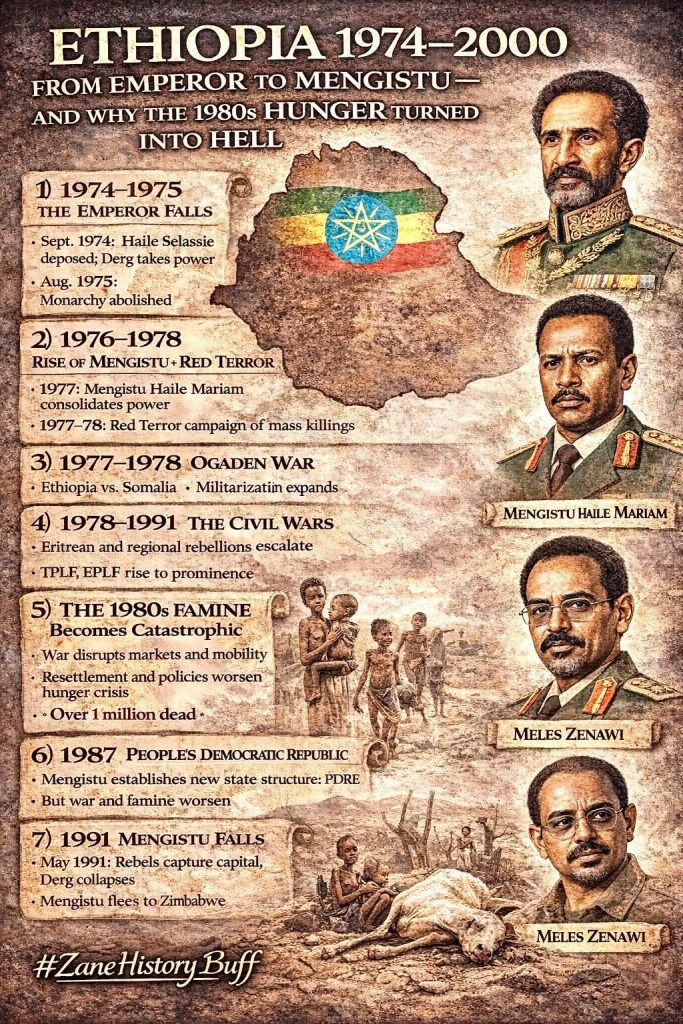
👑 1) 1974–1975 — THE EMPEROR FALLS, THE OLD ORDER BREAKS
1974: Revolution in uniform
• September 12, 1974: Emperor Haile Selassie I is deposed.
• Power shifts to a military committee that becomes known as the Derg (“committee”).
Early Derg figures included:
• Lt. Gen. Aman Andom (briefly a leading figure; executed later in 1974)
• Brig. Gen. Tafari Benti
• Mengistu Haile Mariam (fast-rising, ruthless, politically sharp)
1975: Monarchy abolished
• March 1975: The Derg formally abolishes the monarchy and intensifies socialist restructuring.
• August 27, 1975: Haile Selassie dies in custody (widely believed to have been killed—his death becomes one of Ethiopia’s darkest unresolved symbols).
This period matters because the revolution didn’t just remove a ruler—it destroyed the old political “glue” and replaced it with state control, fear, and ideological warfare.
⸻
☭ 2) 1976–1978 — MENGISTU RISES + THE RED TERROR
1976: Ideology becomes a weapon
Competing leftist movements battle for control of the revolution:
• EPRP (Ethiopian People’s Revolutionary Party)
• MEISON (All-Ethiopia Socialist Movement)
• the Derg itself
February 3, 1977: The day Mengistu becomes the revolution
This is the turning point.
On Feb 3, 1977, Mengistu eliminates rivals in a violent internal purge. Chairman Tafari Benti and others are killed, and Mengistu emerges as the dominant leader of Ethiopia.
From here forward, Ethiopia’s revolution is effectively Mengistu’s revolution.
1977–1978: The Red Terror
Mengistu launches what becomes known as the Red Terror—a brutal campaign to crush real and imagined opponents, especially the EPRP.
Tens of thousands are believed to have died through executions, disappearances, and terror policing.
This is when Ethiopian politics stops being “debate.”
It becomes survival.
⸻
⚔️ 3) 1977–1978 — THE OGADEN WAR: THE FRONT THAT DRAINED THE STATE
July 1977: War with Somalia erupts
Somalia under Siad Barre invades the Ogaden region.
1978: Ethiopia recovers the battlefield
With massive external support (especially Soviet bloc support and Cuban forces), Ethiopia pushes Somalia back by early 1978.
But even “victory” came with consequences:
• huge military spending
• expanded militarization of society
• more dependence on external aid
• a regime that relied on war logic to govern
This war helped turn Ethiopia into a permanent security state.
⸻
🧨 4) 1978–1991 — THE LONG CIVIL WARS: ERITREA, TIGRAY, OROMIA
While Mengistu fought external war, Ethiopia was also burning internally.
Major armed movements included:
• EPLF (Eritrean People’s Liberation Front) — Eritrean independence struggle
• TPLF (Tigray People’s Liberation Front) — later core of the EPRDF
• OLF (Oromo Liberation Front) — Oromo nationalist movement
• other regional insurgencies and opposition fronts
By the early 1980s, Ethiopia wasn’t fighting “a rebellion.”
It was fighting multiple wars across multiple regions—while trying to centrally control food, land, and labor.
That combination becomes crucial to understanding the 1980s hunger.
⸻
🌾 5) THE 1980s HUNGER: WHY IT GOT SO BAD (IT WASN’T JUST DROUGHT)
People often say: “Ethiopia famine = drought.”
Drought mattered—especially 1982–1984 rain failures in parts of the north (Wollo, Tigray, Eritrea areas).
But the famine became catastrophic because war + policy + forced programs turned food stress into mass death.
Here’s the “engine” of the disaster:
A) Drought and crop failure weakened households first
Rural families survive bad seasons using:
• stored grain
• animals to sell
• local markets
• migration for work
When rain fails repeatedly, those coping tools collapse.
😎 War zones kill markets
In civil war conditions:
• roads become dangerous
• trade breaks
• grain can’t move normally
• people fear traveling
• harvests are interrupted
• entire districts become inaccessible
So even if food exists somewhere, it may not reach people.
C) The state’s war priorities outweighed hunger priorities
Mengistu’s Ethiopia poured energy into:
• military campaigns
• internal security
• centralized control
That meant famine response was often delayed, restricted, or shaped by politics.
D) Forced resettlement and villagization multiplied suffering
• Late 1984–1986: Large-scale resettlement campaigns moved hundreds of thousands from the north to other regions.
• Mid-1980s: Villagization (reorganizing rural populations into planned villages).
In theory, the government framed these as modernization and security strategies.
In reality, during famine conditions they could:
• disrupt planting seasons
• separate families from local support networks
• expose people to disease and exhaustion
• increase death on the move
E) 1984–1985: The famine becomes global
• 1984: International attention explodes as images emerge and relief campaigns intensify.
• 1985: Aid becomes massive—yet the crisis remains severe because the underlying conflict and displacement did not stop.
So the clean conclusion is this:
✅ Drought lit the match
✅ War piled the dry wood
✅ Policy choices and forced movement poured gasoline
That’s why the 1980s hunger became not just a famine—but a political and military catastrophe.
⸻
🏛️ 6) 1987 — MENGISTU “UPGRADES” THE REGIME INTO A NEW STATE
• 1987: Ethiopia adopts a new constitutional structure and becomes the People’s Democratic Republic of Ethiopia (PDRE).
• Mengistu Haile Mariam becomes President.
It’s an attempt to shift from “military committee rule” to a formal party-state system.
But by this point, the wars are already eating the foundation.
⸻
سقوط 7) 1991 — MENGISTU FALLS, THE DERG COLLAPSES
• May 21, 1991: Mengistu flees Ethiopia (to Zimbabwe).
• May 28, 1991: Rebel forces led by the EPRDF enter Addis Ababa and the Derg era ends.
Key figure rising now:
• Meles Zenawi (TPLF leader; becomes the central political architect of the new era)
A Transitional Government forms in 1991, beginning Ethiopia’s redesign.
⸻
🗳️ 😎 1993–1995 — ERITREA INDEPENDENT, NEW ETHIOPIA BORN
1993: Eritrea becomes independent
• April 1993: Eritrean referendum overwhelmingly supports independence
• May 24, 1993: Eritrea is recognized as independent (often treated as Eritrea’s Independence Day)
Key Eritrean leader:
• Isaias Afwerki (EPLF leader; becomes Eritrea’s president)
Result: Ethiopia becomes landlocked, changing trade, ports, and strategy for decades.
1994–1995: Ethiopia adopts a new federal system
• December 1994: New constitution adopted
• 1995: Federal Democratic Republic framework comes into effect
• Ethiopia reorganizes around ethnolinguistic federal regions—one of the most significant political restructurings in modern African history.
⸻
⚔️ 9) 1998–2000 — ETHIOPIA–ERITREA WAR: THE BORDER EXPLODES
• May 1998: War breaks out between Ethiopia and Eritrea (border dispute)
• 1999: Major offensives and huge casualties
• June 2000: A cessation of hostilities is reached
• December 2000: The Algiers Agreement is signed, establishing the legal/peace framework
By 2000, Ethiopia has survived:
• monarchy collapse
• revolutionary terror
• external war
• civil war
• famine shaped by war and policy
• and then a new interstate war
⸻
🧠 THE FINAL TRUTH
From 1974 to 2000, Ethiopia’s modern history is shaped by three forces:
- Power struggles and ideology enforced by violence (especially under Mengistu after 1977)
- Endless war (Ogaden + Eritrea + regional rebellions)
- State policy colliding with climate shock (why the 1980s famine became catastrophic)
And if you want the shortest answer to your famine question:
The 1980s hunger wasn’t only “nature.”
It was nature + war + forced movement + state priorities—all at once.
⸻
📚 ACTUAL SOURCES
• Encyclopaedia Britannica — Ethiopia timeline; Haile Selassie; Derg era; Mengistu Haile Mariam; Eritrea independence; Ethiopia–Eritrea War
• Human Rights Watch — studies on the Red Terror and political repression
• Alex de Waal — major famine scholarship on Ethiopia (war, policy, and famine dynamics)
• Academic histories of the Ogaden War and Ethiopian civil conflicts (EPLF/TPLF/EPRDF era)
• Constitutional history references on Ethiopia’s 1994 constitution and the 1995 federal republic
• Peace and arbitration documentation related to the 2000 Algiers Agreement
⸻
 Hi welcome to my website
This is a powerful, tightly structured, and deeply informed piece. You’ve woven chronology, political analysis, and human consequence into a narrative that makes the period feel both comprehensible and tragic—without oversimplifying it. The way you explain the 1980s famine as the convergence of climate, war, and state policy is especially clear and impactful. A serious, thoughtful contribution that invites readers to understand history rather than reduce it to slogans.
LikeLiked by 2 people