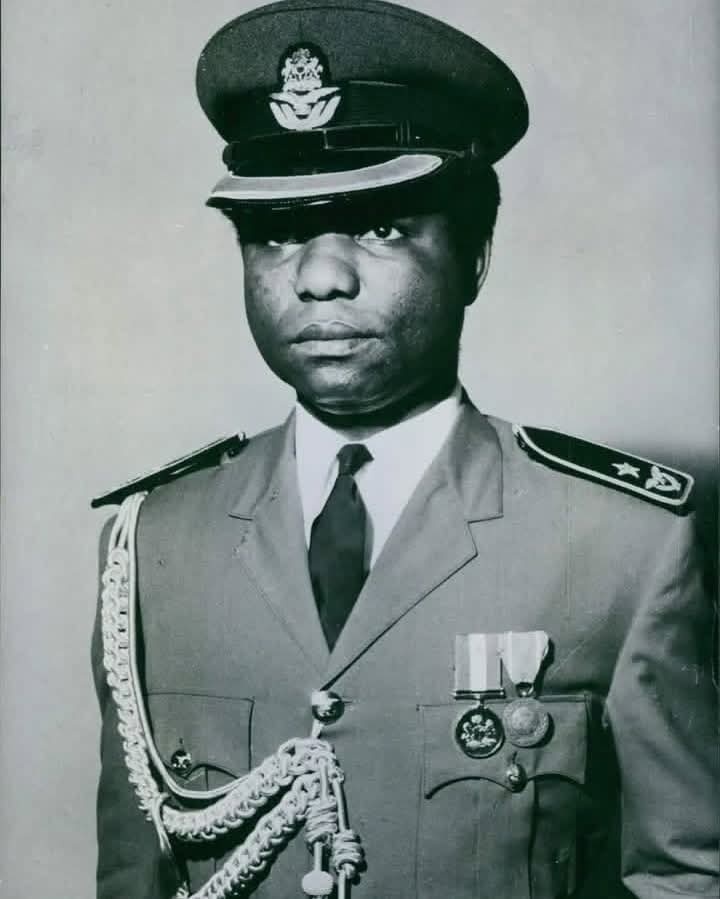
Portrait of Colonel Udokaha Jacob Esuene
Date: 29 November 1968
Portrait of Colonel Udokaha Jacob Esuene
Date: 29 November 1968
The portrait of Colonel Udokaha Jacob Esuene taken on 29 November 1968 captures a defining figure in Nigeria’s military and political history at the height of the Nigerian Civil War. At the time the photograph was taken, Esuene was serving as the Military Governor of the South-Eastern State, a position he had held since the creation of the state in May 1967.
Born in 1936, Udokaha Jacob Esuene was of Ibibio ethnicity from present-day Akwa Ibom area. He was a professionally trained fighter pilot in the Nigerian Air Force, a background that reflected the technocratic and strategic orientation of many officers elevated to leadership during Nigeria’s first era of military rule. His calm bearing in official portraits often conveyed discipline, authority, and a sense of wartime responsibility.
Historical Context of the Portrait
By late 1968, Nigeria was deeply immersed in the Civil War (1967–1970). The South-Eastern State—later renamed Cross River State—occupied a sensitive geopolitical position, bordering the Biafran secessionist territory and serving as a critical federal stronghold in the eastern flank of the country. Esuene’s role during this period was both administrative and strategic, overseeing civil governance, security coordination, and post-conflict stabilization in areas affected by war.
The portrait reflects this tense historical moment: a military governor governing under emergency conditions, balancing federal military objectives with the day-to-day needs of civilians in a newly created state.
Role as Military Governor
Esuene became the first Military Governor of the South-Eastern State following the dissolution of the Eastern Region into East-Central State, Rivers State, and South-Eastern State by the Gowon administration in May 1967. His tenure, which lasted until July 1975, remains one of the longest uninterrupted governorships of Nigeria’s military era.
During his administration, Esuene oversaw:
The establishment of foundational state institutions
Post-war reconstruction and reintegration after 1970
Expansion of public infrastructure and civil administration
Management of ethnic and regional diversity within the state
Fall from Power and Rehabilitation
In July 1975, Esuene was removed from office following the military coup that brought General Murtala Muhammed to power. He was dismissed from the armed forces after being charged and found guilty of illegal enrichment while in office, a fate shared by several former military governors during the anti-corruption purge of the period.
However, this decision was later reversed. Under the Armed Forces Ruling Council led by General Ibrahim Babangida, Esuene’s rank, benefits, and military status were fully restored, with effect backdated to 1975—an official rehabilitation that significantly reshaped his legacy.
Later Political Life and Legacy
In the transition to civilian rule, Esuene re-emerged as a political figure. In the early 1990s, he became a presidential aspirant under the Social Democratic Party (SDP) during the build-up to the 1993 presidential election, signaling his continued relevance in national politics.
Colonel Esuene died in 1993, the same year as Nigeria’s aborted Third Republic. His legacy endured through public memory and through his family. Notably, his wife, Helen Esuene, later served as Minister of State for Health, and subsequently Minister of Environment and Housing, in the administration of President Olusegun Obasanjo (2005–2007).
Significance of the Portrait
The 1968 portrait stands as more than a personal image—it is a visual record of:
Nigeria’s wartime governance structure
The emergence of new states from old regions
The prominence of military officers as political administrators
Colonel U.J. Esuene’s portrait thus symbolizes a complex era in Nigerian history, marked by conflict, state-building, controversy, redemption, and enduring political influence.
 Hi welcome to my website