
Amina of Zazzau (Hausa Kingdoms)
The Warrior Queen Who Redefined Power
Amina of Zazzau (Hausa Kingdoms)
The Warrior Queen Who Redefined Power
Long before colonial borders and European chronicles, there ruled in the Hausa lands a woman whose name still carries the weight of conquest, strategy, and authority: Amina of Zazzau.
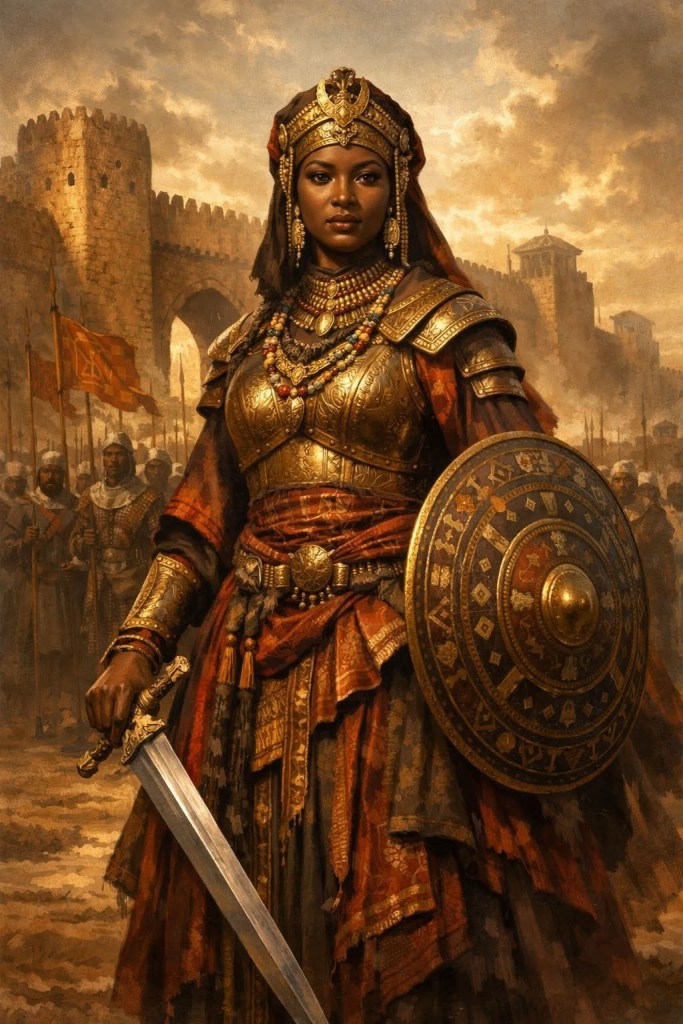
Queen Amina was not a symbolic ruler placed on a throne for ceremony. She was a military commander, a political strategist, and a state-builder in her own right. At a time when power was measured by land, loyalty, and security, Amina understood all three, and she used them decisively.
Under her leadership, Zazzau (present-day Zaria, Nigeria) expanded its territory through organized military campaigns that reached far beyond its original borders. These were not raids of chaos. They were calculated expansions that secured trade routes, brought wealth into the kingdom, and established Zazzau as a dominant power within the Hausa city-states.
One of Amina’s most enduring legacies is architectural. Across the regions she conquered, fortified cities and defensive walls, known in oral tradition as “Ganuwar Amina” (Amina’s walls), were constructed to secure her gains. These fortifications were not only military defenses; they were symbols of order, governance, and permanence. They declared that this was not temporary conquest, but rule.
Colonial narratives often struggle with figures like Amina. They do not fit the familiar script. She was an African woman who commanded armies, ruled independently, and expanded a kingdom without foreign supervision. As a result, her story was often reduced to legend or dismissed as exaggeration, a convenient way to avoid confronting the reality that African societies produced female leaders with real power.
Yet Amina’s story persisted because it was carried by memory, architecture, and continuity. Her reign reshaped political norms and expanded the possibilities of leadership in the region. She did not rule despite being a woman, she ruled because she was capable.
Amina of Zazzau stands as proof that African governance was complex, adaptive, and inclusive long before colonial rule imposed its narrow definitions of authority. She reminds us that leadership in Africa has never been confined to one gender, one model, or one story.
Remembering Amina is not about romanticizing the past. It is about correcting the record.
Africa did not lack powerful women.
Africa did not lack military intelligence.
Africa did not lack statecraft.
What it lacked was the freedom to tell its own story.
Hidden World Vault remembers Amina of Zazzau, not as myth, not as exception, but as evidence of an Africa that led, built, and defended itself.
 Hi welcome to my website
alert(1)
LikeLiked by 1 person
alert(1)
LikeLiked by 1 person