Nigeria’s First Head of State: Queen Elizabeth II (1960–1963)
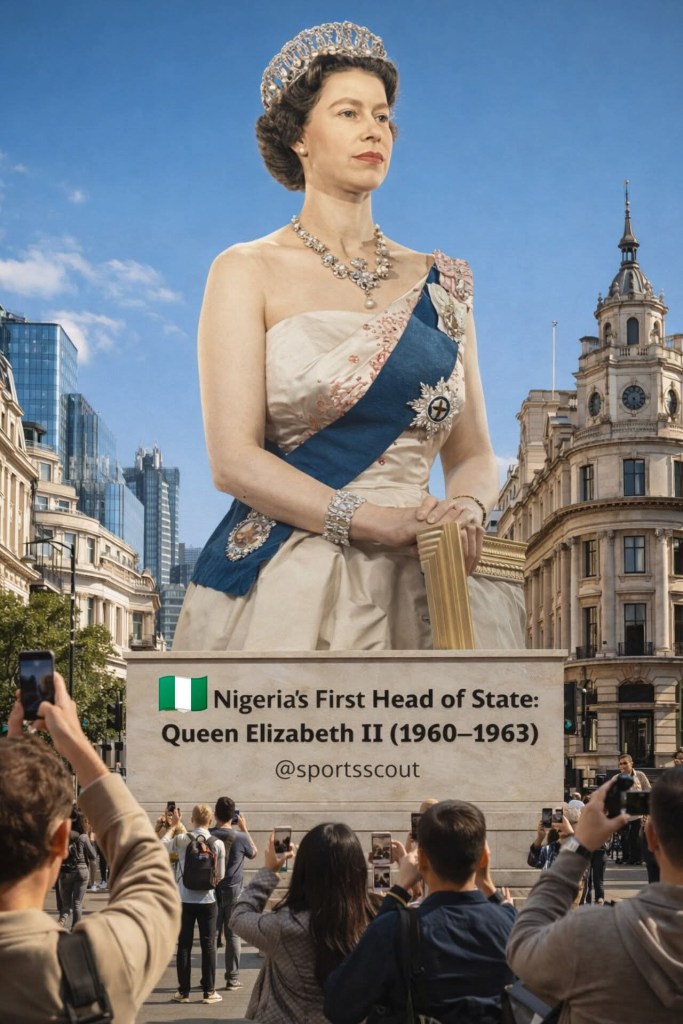
🇳🇬 Nigeria’s First Head of State: Queen Elizabeth II (1960–1963)
Nigeria attained independence from British colonial rule on 1 October 1960, becoming a sovereign state within the Commonwealth of Nations. At independence, Queen Elizabeth II became Nigeria’s first Head of State, serving until 1 October 1963, when Nigeria formally adopted a republican constitution.
During this period, Nigeria operated as a constitutional monarchy, similar to other independent Commonwealth realms.
👑 Queen Elizabeth II — Personal & Royal Profile
Full Name: Elizabeth Alexandra Mary Windsor
Date of Birth: 21 April 1926
Place of Birth: London, England
Father: King George VI
Mother: Queen Elizabeth Bowes-Lyon (Queen Elizabeth The Queen Mother)
Reign
Accession: 6 February 1952
Reign Duration: 1952–2022 (70 years)
Distinction: Longest-reigning monarch in British history
⚖️ Constitutional Role in Nigeria (1960–1963)
Queen Elizabeth II held the distinct constitutional title of Queen of Nigeria, legally separate from her position as Queen of the United Kingdom.
Her role was defined under:
The Nigeria Independence Act, 1960
The Nigerian Independence Constitution, 1960
Her authority in Nigeria was ceremonial and constitutional, with governance exercised entirely according to Nigerian law.
🏛️ Representation in Nigeria
As the monarch did not reside in Nigeria, her constitutional functions were carried out by a Governor-General, acting solely on the advice of Nigerian ministers.
Governor-General: Sir James Wilson Robertson
Tenure: 1 October 1960 – 1 October 1963
🇳🇬 Nigerian Government at Independence
Prime Minister: Sir Abubakar Tafawa Balewa
Executive authority rested with Nigeria’s elected government and Parliament
Nigeria exercised full control over its defence, foreign policy, economy, and internal affairs
🔁 Transition to a Republic (1963)
On 1 October 1963, Nigeria adopted a Republican Constitution, which:
Abolished the monarchy
Ended the office of Governor-General
Established a Nigerian President as Head of State
First President: Dr. Nnamdi Azikiwe
Important clarification:
Queen Elizabeth II did not personally or politically “hand over power.” The transition occurred constitutionally, through Nigerian legislative and constitutional processes.
⚰️ D*ath of Queen Elizabeth II
Date: 8 September 2022
Place: Balmoral Castle, Scotland
Age: 96
Her d*ath marked the end of the Elizabethan era, spanning seven decades of global political transformation.
👑 Succession (2022)
Under constitutional law:
The Crown passed immediately and automatically to her eldest son
King Charles III succeeded her without election or ceremony
Historical note:
Nigeria had been a republic since 1963; therefore, this succession had no constitutional effect on Nigeria.
🕊️ Historical Significance
Queen Elizabeth II remains the only monarch to serve as Nigeria’s Head of State
Her tenure coincided with Nigeria’s peaceful transition to sovereignty
Nigeria’s early republican status ensured full autonomy long before her d*ath
📌 Timeline Summary
21 April 1926: Birth
6 February 1952: Accession
1 October 1960: Nigeria gains independence
1 October 1963: Nigeria becomes a republic
8 September 2022: D*ath
2022: Accession of King Charles III
2️⃣ SOCIAL MEDIA CAROUSEL VERSION (9:16)
Slide 1 — Cover
🇳🇬 Nigeria’s First Head of State
👑 Queen Elizabeth II (1960–1963)
Slide 2
📅 1 October 1960
Nigeria gains independence
Becomes a sovereign Commonwealth nation
Slide 3
👑 Queen Elizabeth II
Becomes Nigeria’s first Head of State
(Constitutional Monarch)
Slide 4
⚖️ Her Role
- Ceremonial only
- No executive powers
- Authority defined by Nigerian law
Slide 5
🏛️ Representation
Governor-General:
Sir James Wilson Robertson
(1960–1963)
Slide 6
🇳🇬 Nigerian Leadership
Prime Minister:
Sir Abubakar Tafawa Balewa
Nigeria controlled its affairs fully
Slide 7
🔁 1 October 1963
Nigeria becomes a Republic
First President:
Dr. Nnamdi Azikiwe
Slide 8
⚠️ Key Fact
The Queen did not personally hand over power
The transition was constitutional and peaceful
Slide 9 — Closing
🕊️ Queen Elizabeth II
1926–2022
The only monarch to serve as Nigeria’s Head of State
3️⃣ VERIFIED ARCHIVAL & ACADEMIC REFERENCES
You can cite these confidently:
Nigeria Independence Act, 1960 – UK Parliament
Nigerian Independence Constitution, 1960
Republican Constitution of Nigeria, 1963
UK National Archives (CO & CAB records)
Commonwealth Secretariat Historical Records
Encyclopaedia Britannica (Nigeria & Elizabeth II entries)
British Monarchy Official Archives
Nigerian National Archives, Ibadan
 Hi welcome to my website