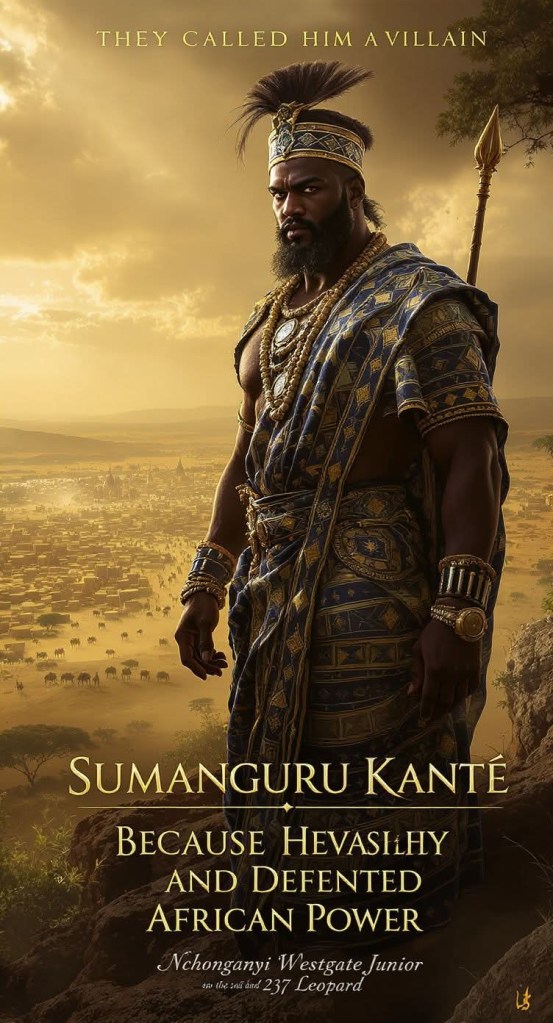
SUMANGURU KANTÉ: THE SHADOW KING THEY TURNED INTO A VILLAIN, BUT HE STOOD FOR AFRICAN SOVEREIGN POWER.
🔥 SUMANGURU KANTÉ: THE SHADOW KING THEY TURNED INTO A VILLAIN, BUT HE STOOD FOR AFRICAN SOVEREIGN POWER.🔥
Before Sundiata Keita unified the Mandé.
Before the Mali Empire dominated West Africa.
There already existed a strong African state, the Sosso Empire, ruled by a man whose authority shook the entire savanna belt from present-day Guinea through Mali to parts of Burkina Faso.
That man was Sumanguru Kanté.
African history did not begin with Mali.
It did not begin with European contact.
It did not begin with written Arab records.
Long before that, African systems of governance, warfare, spirituality, and trade were already fully developed.
Sumanguru Kanté rose from the political vacuum left after the decline of the Ghana Empire, one of Africa’s earliest superpowers.
Rather than allowing foreign merchants or rival clans to dominate the gold routes, he rebuilt centralized African control over trade, taxation, and military defense.
Gold, salt, iron, and kola moved under African command, not foreign supervision.
What griots later called magic was most likely African military science, metallurgy, spiritual warfare traditions, coded communication, and battlefield psychology.
When Africans master strategy, enemies call it witchcraft.
When Europeans do the same, they call it innovation.
The Epic of Sundiata portrays Sumanguru as cruel and demonic because epics are political tools.
Every empire needs a monster to justify replacing another empire.
Mali did not defeat evil.
Mali defeated competition.
This pattern repeats across African history.
The Zulu were called violent for resisting colonial expansion.
Samori Touré was labeled brutal for blocking French invasion.
Shaka was called insane for building military discipline.
Today, African leaders who reject Western economic control are instantly called dictators.
The script never changes.
Sumanguru Kanté represented African resistance to Mandé political domination just as much as Mandé resistance to Sosso authority.
This was not good versus evil.
It was African power versus African power, competing visions of sovereignty over land, labor, and trade.
When Sumanguru fell at Kirina, it was not the triumph of righteousness.
It was the transfer of imperial control from Sosso hands to Mandé hands.
Empires do not disappear because they are immoral.
They fall because another power becomes stronger.
Pan-African consciousness requires that we stop worshipping only the winners.
It demands that we honor every African force that resisted erasure, domination, and foreign manipulation, even when they lost.
You cannot build true African pride while repeating the propaganda of ancient court poets and colonial historians.
Liberation begins when Africans tell their own stories without heroes needing villains to exist.
Sumanguru Kanté was not a footnote to Sundiata.
He was a central pillar of West African political history, a defender of indigenous power at a moment when Africa’s destiny was being decided by African hands, not European guns.
And that is the Africa they never teach.
References
Epic of Sundiata as recorded by Djibril Tamsir Niane
UNESCO General History of Africa, Volume IV: Africa from the Twelfth to the Sixteenth Century
Nehemia Levtzion and J.F.P. Hopkins, Corpus of Early Arabic Sources for West African History
Basil Davidson, African Kingdoms and African Civilization Revisited
If you want to understand how African resistance leaders are turned into villains while collaborators are crowned as heroes, then you must study history with Pan-African eyes.
Read the book “The Lost Yeshua” to understand how revolutionary figures are later stripped of political meaning and turned into harmless religious symbols.
Follow 👉 Nchonganyi Westgate Junior for more…..
Written by Westgate Junior
 Hi welcome to my website