
RESOURCE CONTROL AND THE QUESTION NIGERIA REFUSES TO ANSWER
RESOURCE CONTROL AND THE QUESTION NIGERIA REFUSES TO ANSWER
Nigeria often speaks the language of unity, but unity that survives only on convenience is not unity, it is negotiation postponed.
For decades, Nigeria operated an economic arrangement anchored on resources largely found in the South, especially crude oil from the Niger Delta. These resources sustained the federation, funded national infrastructure, and powered a central government that, since independence, has been largely controlled by Northern political elites. No serious objection was raised then about “regional ownership” of resources. The rhetoric of oneness was loud, proud, and convenient.
Today, that rhetoric is changing.
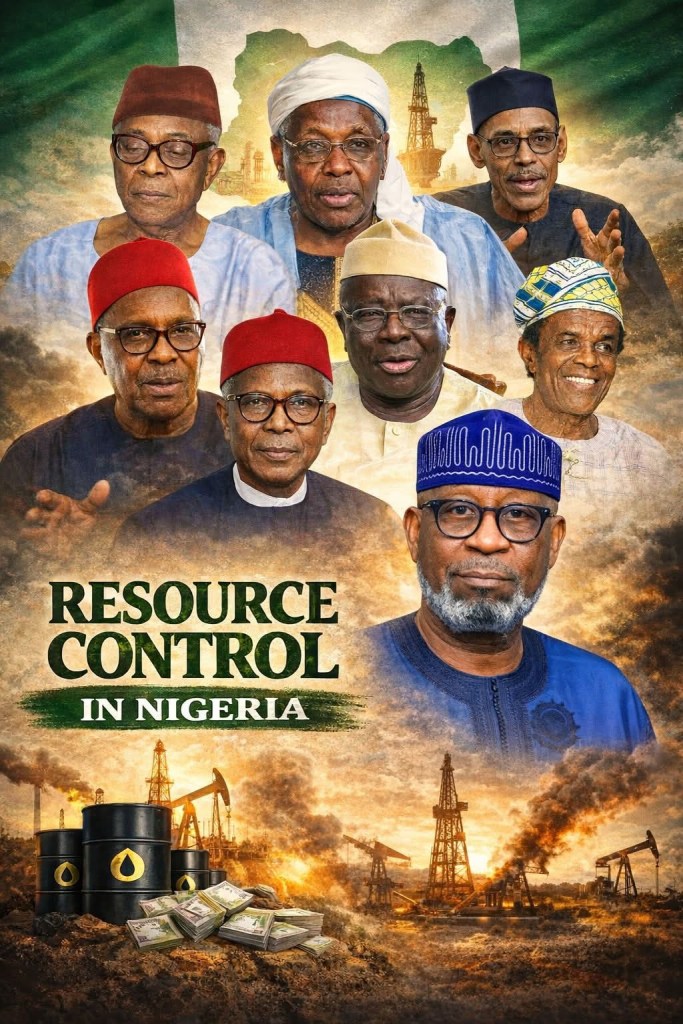
There have been public statements and positions by groups and individuals commonly referred to as Northern elders—most notably figures associated with the Northern Elders Forum—asserting that natural resources located in Northern Nigeria should be used primarily for the development of the North. These assertions have gained volume at the same time solid minerals are being discovered across Northern states and global reliance on oil continues to decline.
This shift raises an uncomfortable but necessary question: Was Nigeria ever truly one, or was it merely profitable to pretend so?
When Southern voices demanded resource control in the past, they were branded as selfish, divisive, or even treasonous. Calls for restructuring were framed as threats to national unity. The argument was simple: Nigeria is one, and all resources belong to all.
But unity, it appears, has an expiry date.
Now that the economic future is tilting away from oil and toward solid minerals, agriculture, and internal production, much of which lies in the North, the tune has changed. The same principle once condemned as dangerous is now being embraced as logical. What was once labeled anti-Nigeria is suddenly described as regional development.
This is not an argument against the North developing itself. No region should apologize for seeking prosperity. The issue is moral consistency. A federation cannot survive on double standards, where one region is asked to sacrifice perpetually while another reserves the right to renegotiate only when circumstances change.
Nigeria’s problem is not resource control; it is selective federalism.
If every region is to develop from its God-given resources, then that principle must apply equally and honestly, not selectively, not opportunistically. Otherwise, what we have is not a nation, but a contract that some parties reserve the right to rewrite unilaterally.
Unity must be founded on fairness, not fear. On justice, not convenience. On shared sacrifice, not selective memory.
Until Nigeria confronts this truth honestly, the question of oneness will not disappear. It will only grow louder, echoing from regions tired of carrying a burden they never consented to bear alone.
 Hi welcome to my website