
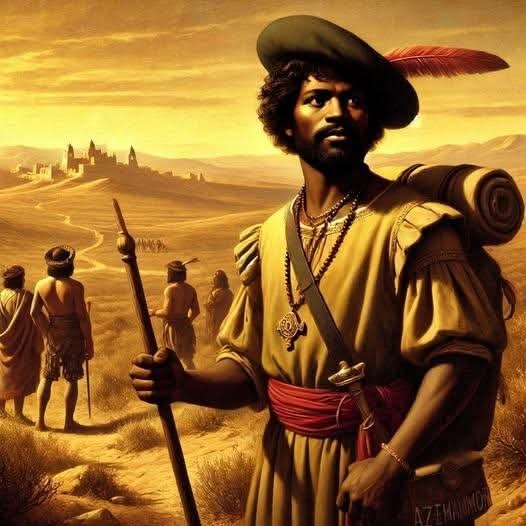
Estevanico – African Explorer (1527)
Estevanico – African Explorer (1527)
Also known as Esteban de Dorantes, Esteban the Moor, or Mustafa Azemmouri—was an enslaved man of Moroccan origin who became one of the first people of African descent to explore what is now the southwestern United States. His life story is closely tied to several early Spanish expeditions in North America, especially the ill-fated Narváez expedition (1527–1536).
Here are some key points about Estevanico:
- Early Life and Enslavement
- Born around the early 16th century in Morocco (some accounts cite Azemmour, a coastal city under Portuguese control at the time).
- At some point, Estevanico was captured or sold into slavery and taken to Spain. There, he was purchased by the Spanish nobleman Andrés Dorantes de Carranza, hence the name “Esteban de Dorantes.”
- The Narváez Expedition
- In 1527, Pánfilo de Narváez led an expedition intending to colonize Florida. Estevanico traveled as Dorantes’s enslaved servant.
- The expedition was struck by storms, hostile encounters, and disease, leading to disastrous losses. Eventually, only four survivors remained: Álvar Núñez Cabeza de Vaca, Andrés Dorantes, Alonso del Castillo Maldonado, and Estevanico.
- Survival and Journey Through the Southwest
- The four survivors spent years wandering through the region that includes present-day Texas and northern Mexico, living intermittently with Indigenous communities.
- Estevanico demonstrated language skills and cultural adaptability, often acting as a translator and mediator.
- In 1536, the group was finally able to reconnect with Spanish colonial forces in present-day Mexico.
- Further Expeditions
- Estevanico’s fluency in Indigenous languages and familiarity with the land made him valuable to further Spanish exploratory efforts, particularly in the so-called “Seven Cities of Gold” legend.
- He set out with Fray Marcos de Niza’s expedition in 1539 to explore what is now the southwestern United States (Arizona and New Mexico). Estevanico was sent ahead as a scout and interpreter.
- Death and Legacy
- Historical accounts differ on the exact circumstances of Estevanico’s death. Many sources say he was killed by the Zuni people, who either mistook him for an invader or became suspicious of his signals for gold and wealth. This happened likely in the area of Hawikuh, a Zuni pueblo, in present-day New Mexico.
- Estevanico’s life demonstrates the early, often overlooked role of Africans and people of African descent in the exploration of the Americas. Despite enduring enslavement, he contributed significantly as a guide, translator, and mediator, shaping the course of Spanish exploration.
Because many of the details about Estevanico’s life come from other explorers’ narratives—especially Álvar Núñez Cabeza de Vaca’s writings—historical records can be fragmentary or biased. Still, his story remains a testament to the diverse backgrounds of those who explored and influenced the course of history in North America.
 Hi welcome to my website