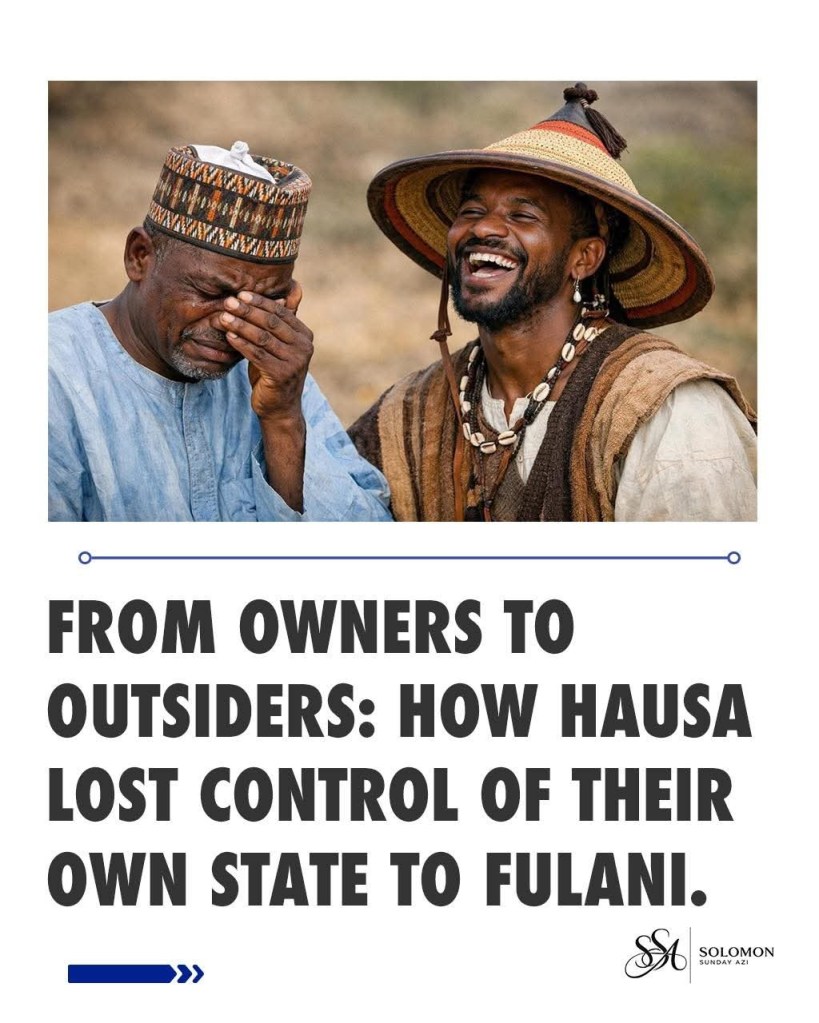
How can the largest tribe in Nigeria be missing where power truly matters?
How can the largest tribe in Nigeria be missing where power truly matters? 🇳🇬
The Hausa people, widely regarded as the most populous ethnic group in Nigeria, currently have zero governors even though they are indigenous to and numerically dominant in many northern states. This reality becomes more troubling when you look at the current ethnic spread of Nigerian governors and see who holds power and who does not.
Number of Nigerian governors by ethnic group 🇳🇬
• Fulani – 9
• Yoruba – 6
• Igbo – 5
• Kanuri – 2
• Ikwerre – 1 (+ FCT minister)
• Half-Fulani/Half-Yoruba – 1
• Urhobo – 1
• Ibibio – 1
• Ijaw – 1
• Efik – 1
• Esan – 1
• Nupe – 1
• Ebira – 1
• Jukun – 1
• Tiv – 1
• Marghi – 1
• Mwaghavul – 1
• Mada – 1
Hausa – ZERO.
This is shocking when you remember that states like Kano, Katsina, Jigawa, Sokoto, Zamfara, Kebbi, and Kaduna are globally recognised as Hausa homeland.
These places were built on Hausa civilisation trade routes, farming systems, city-states, language, and governance structures that existed long before colonial Nigeria. Yet today, Hausa people do not occupy the highest executive office in any of these states.
This political absence has real consequences. Across these states, Hausa farming communities are losing ancestral lands, facing displacement from insecurity, and suffering unresolved conflicts.
With no governors emerging from Hausa political consciousness, many communities feel abandoned, poorly protected, and sidelined in decisions about land, security, and development. Over time, this vacuum has allowed others to consolidate political and territorial control, while indigenous Hausa communities are reduced to voters without power.
This is not about hatred. It is about representation, history, and justice. No ethnic group especially one with such population strength and historical legitimacy should be politically invisible in its own homeland.
There is also a hard truth Hausa leaders and youths must confront: the Hausa political identity has been submerged under Fulani dominance. Hausa interests are often spoken for by others, while Hausa communities bear the brunt of kidnapping, killings, and banditry.
Hausa people must organise independently, reclaim their political voice, and separate civic representation from any group whose actions are destroying their communities. Liberation here means political clarity, self-representation, and accountability not violence.
The hard questions remain:
• How did the Hausa become absent in Kano, Katsina, Jigawa, Sokoto, Zamfara, Kebbi, and Kaduna?
• How long will the largest tribe in Nigeria watch others rule their land?
Representation matters. History matters.
Hausa political visibility must be restored peacefully, lawfully, and deliberately.
 Hi welcome to my website
This made me stop and actually wonder how something so big could be left out where it matters most.
LikeLiked by 1 person