This is what revolution looks like when it refuses to compromise.
This is what revolution looks like when it refuses to compromise.
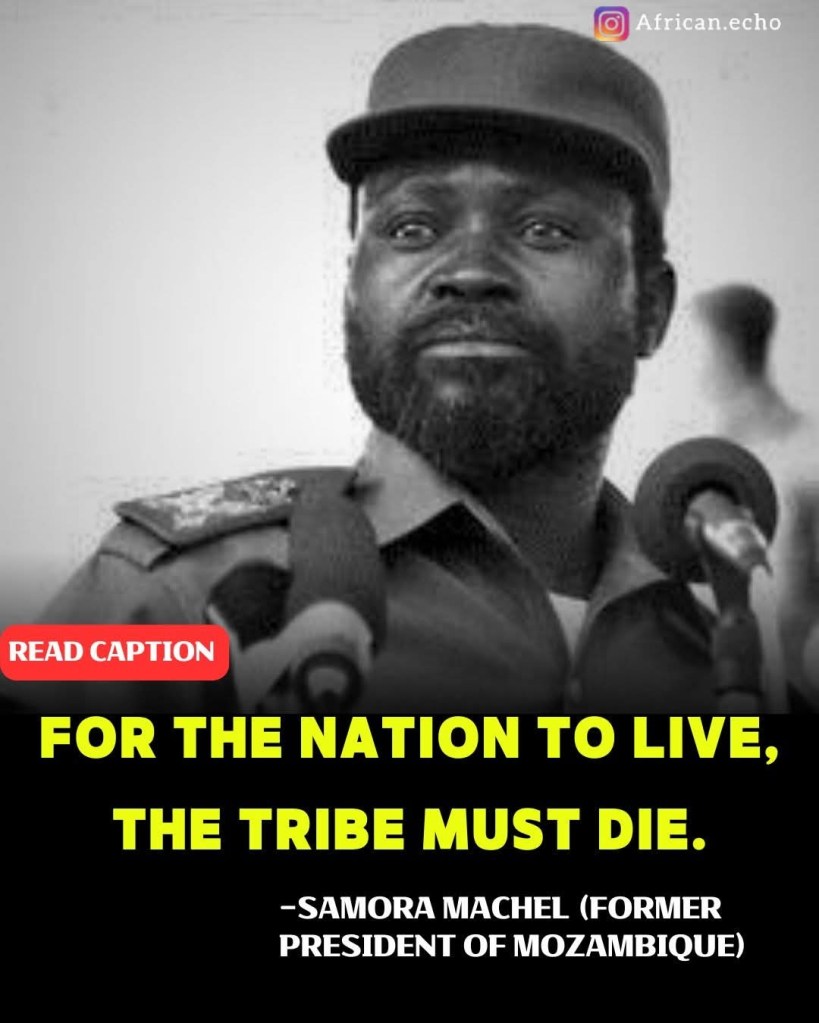
Samora Machel didn’t speak in metaphors. He spoke in stakes. “For the nation to live, the tribe must die.” Not a call to erase culture, but to dismantle the colonial trap that keeps nations at war with themselves.
When Mozambique won independence in 1975, Machel inherited a country carved up by Portuguese brutality and internal division. Tribalism wasn’t tradition. It was a weapon. The colonizers had spent centuries rewarding certain groups, pitting communities against each other, ensuring that unity would be impossible after they left. Machel understood this. He knew that a free Mozambique could not survive if people saw themselves as Makonde first, Shangaan second, and Mozambican last.
So he made a choice most leaders avoid: he named the enemy within. Not ethnicity itself, but the political tribalism that turns difference into division, that makes power a zero-sum game, that keeps nations weak and leaders corrupt. He built a one-party state, yes, with all its flaws. But his vision was integration, not domination. Education for all. Healthcare for all. Land for those who worked it.
The West called him a communist. South Africa’s apartheid regime called him a terrorist. They funded a civil war that killed a million people and destroyed the infrastructure he built. Machel died in a plane crash in 1986, under circumstances many still call suspicious.
But the quote endures because the question endures: Can African nations be truly sovereign if citizens are loyal to clan before country? Can democracy function when elections are ethnic headcounts? Machel’s answer was unforgiving, but it forces us to ask: what are we willing to sacrifice for the nation to live?
Was Machel right, or did his approach ignore the complexity of identity?
Follow @african.echo for more African and global stories they don’t teach you.
Sources:
- Samora Machel: An African Revolutionary by Allen and Barbara Isaacman (Ohio University Press)
- BBC World Service archives on Mozambique’s independence and civil war
 Hi welcome to my website