
March 6, 1957, was history in the making.
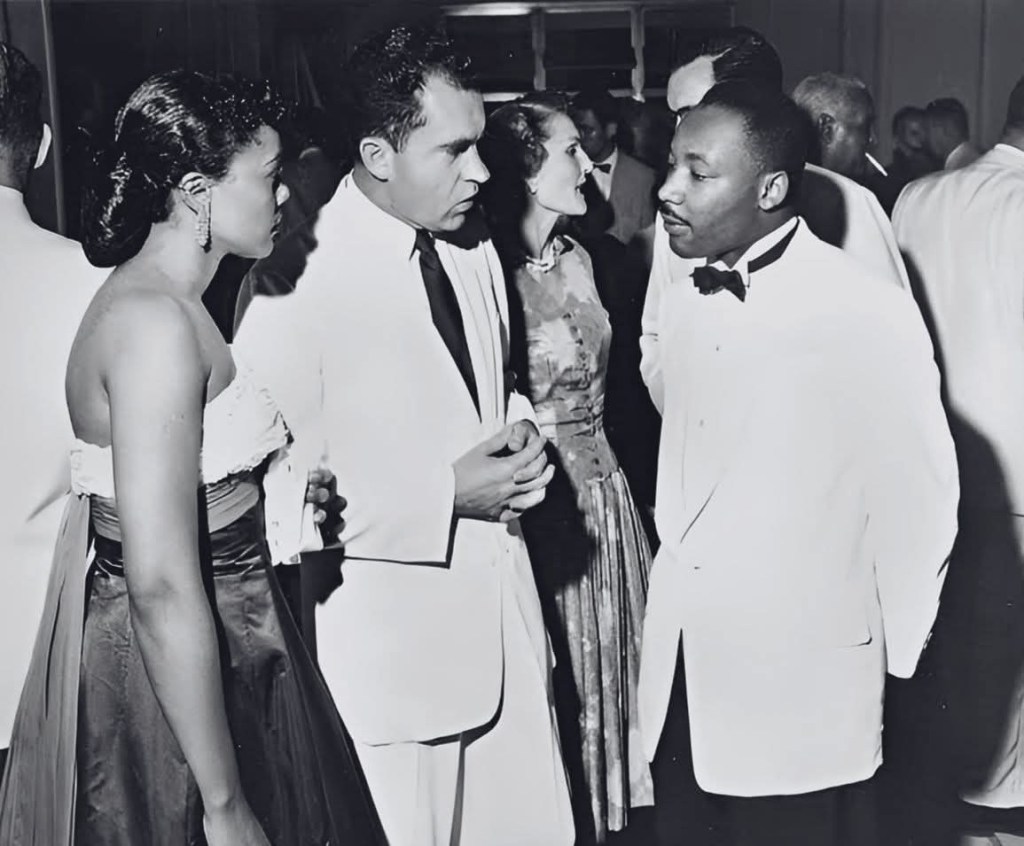
March 6, 1957, was history in the making. After nearly a century of British colonial rule, the Gold Coast had emerged as Ghana, the first sub-Saharan African nation of the modern era to win independence, under the leadership of Kwame Nkrumah. Delegations from across the globe arrived to witness the celebrations, but few pairings captured the contradictions of the era quite like this: the Vice President of the United States, Richard Nixon, rubbing shoulders with a young Baptist minister already rising to global prominence, Martin Luther King Jr..
President Dwight Eisenhower had sent Nixon to represent the United States, aware that Africa’s post-colonial moment was a new arena in the Cold War. Nixon arrived with his wife Pat and a delegation of American officials, including prominent African-American figures. King, who had recently led the Montgomery Bus Boycott, attended independently with his wife Coretta, seeing Ghana’s independence as a historic affirmation of freedom for Black people worldwide.
For African Americans, the event was electric. Here was a Black-led nation throwing off colonial chains at a moment when millions of African Americans were still fighting for basic civil rights under Jim Crow. King described the ceremonies as profoundly moving, calling them a symbolic “birth of a new nation” and a promise that dignity and justice could one day be universal. The independence celebrations culminated in a grand ball filled with political leaders, diplomats, and international luminaries.
At some point during the festivities, Nixon reportedly sidled up to a Black guest, probably expecting a moment of diplomatic small talk, and asked, “How does it feel to be free now that Ghana is independent?” The guest paused, thought for a second, and delivered a line for the ages: “I wouldn’t know, sir. I’m from Alabama.” Cue the awkward silence. The story became legendary because of how it perfectly encapsulated the era’s absurd contradictions: while Ghana celebrated liberation, millions of African Americans were still trapped in the literal chains of segregation. One can almost picture Nixon internally wince, trying to decide whether to chuckle, apologize, or just move along: a classic case of political foot-in-mouth.
In the years that followed, the Nixon-King relationship remained complicated. Early on, Nixon supported some civil rights measures and maintained cordial ties with King. But as the civil rights struggle became increasingly polarizing, especially in the South, Nixon grew cautious. By the 1960 presidential election, when he ran against John F. Kennedy, King had been arrested during a Georgia protest. Kennedy called Coretta Scott King to express sympathy, while Nixon, wary of alienating white Southern voters, stayed publicly silent. Historians suggest this hesitation cost him critical African-American support, contributing to his narrow defeat.
More than a decade later, tragedy struck when Martin Luther King Jr. was assassinated in Memphis on April 4, 1968. Nixon, once again running for president, attended King’s funeral in Atlanta. The two men who had shared a ballroom in Accra, one representing American power, the other America’s struggle for justice, were now bound by a very different moment in history.
 Hi welcome to my website