In the spring of 1960,
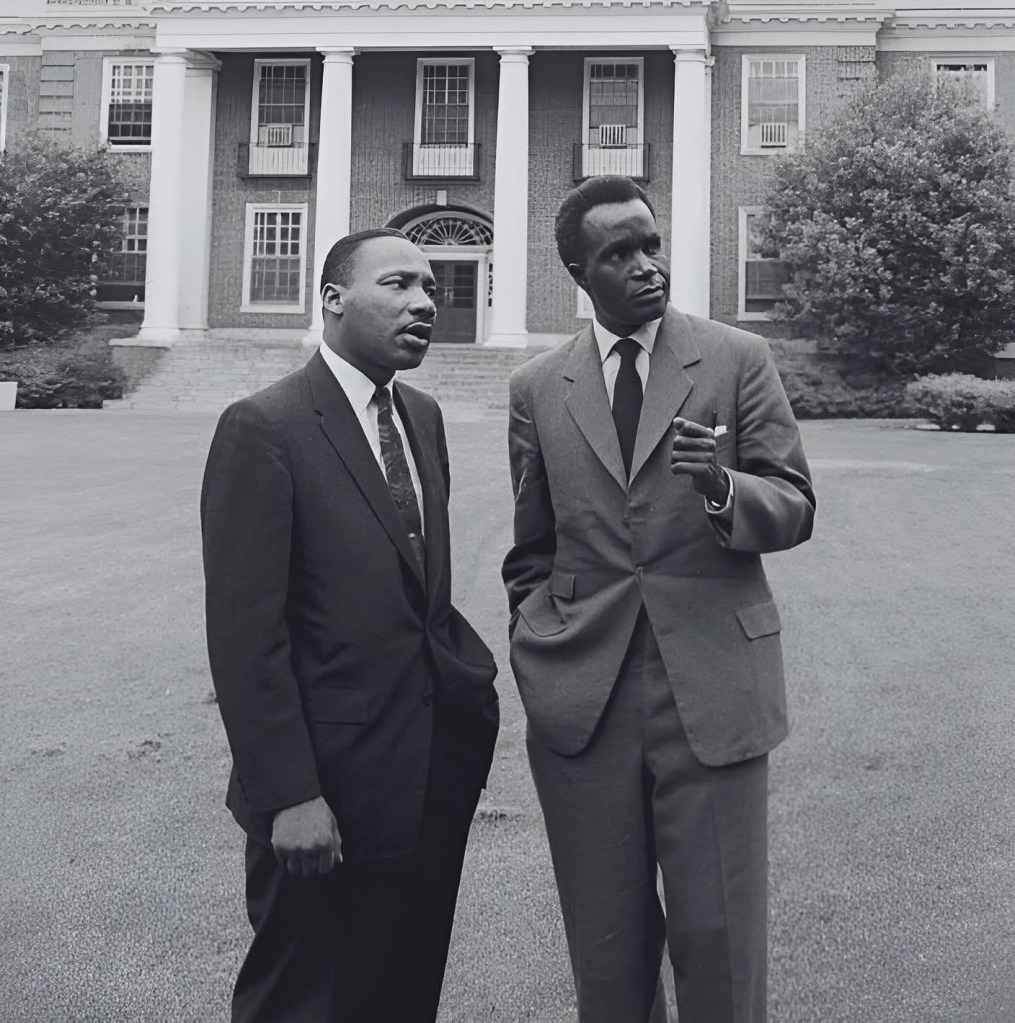
In the spring of 1960, two men leading struggles for Black freedom on opposite sides of the Atlantic met in Atlanta. One was Kenneth Kaunda, a nationalist recently released from colonial prison and now at the forefront of the independence movement in Northern Rhodesia (today’s Zambia). The other was Martin Luther King Jr., the young Baptist minister whose campaign of nonviolent protest was challenging segregation across the American South.
At the time, Northern Rhodesia was part of the Federation of Rhodesia and Nyasaland, a British colonial structure dominated politically and economically by white settlers. African nationalists like Kaunda saw the federation as a tool to entrench white minority rule in Central Africa. Kaunda’s strategy increasingly centered on mobilizing mass political support while adhering to nonviolent resistance, influenced in part by the teachings of Mahatma Gandhi.
As the independence struggle gained momentum, Kaunda sought both international allies and intellectual guidance. This led him to visit the United States in 1960, a trip organized in part by the American Committee on Africa, a civil rights aligned organization that connected African nationalists with U.S. activists and policymakers. During the tour, Kaunda visited cities including Washington, D.C. and Atlanta, where he met with King.
In Atlanta, the two leaders appeared together at Ebenezer Baptist Church, King’s home congregation, where they held a press conference exploring the connections between African liberation movements and the struggle of African Americans. Both men represented movements rooted in the same moral philosophy: Gandhian nonviolent resistance. Scholars have noted that Kaunda was among the most vocal African leaders advocating Gandhi’s principles during the continent’s wave of independence. For King, the encounter underscored that the Civil Rights movement in the United States was part of a broader global fight against racial oppression. As he had stated in earlier speeches on African independence, the freedom of colonized Africans and the emancipation of African Americans were intertwined battles in a global “network of mutuality.”
The discussions between Kaunda and King focused on practical strategies for dismantling systems of racial domination. In the U.S., King was honing tactics such as boycotts, mass protests, and civil disobedience to challenge segregation laws. For African nationalists like Kaunda, the struggle was different: colonial rule offered no legal protections or recourse, and resistance had to confront both social and political structures denying Africans representation.
Still, Kaunda saw disciplined, organized nonviolence as a way to delegitimize colonial authority and attract international support. King’s experiences in Montgomery and across the American South offered lessons in how moral protest could disrupt unjust systems while maintaining credibility on the world stage. In turn, Kaunda shared the realities of colonial Africa, where racial discrimination was embedded not only socially but also structurally. Their meeting became part of a broader transatlantic dialogue connecting civil rights activists with African nationalists, alongside figures such as Kwame Nkrumah, Tom Mboya, and W. E. B. Du Bois.
The influence of the American civil rights movement became evident in Kaunda’s actions after returning to Northern Rhodesia. In July 1961, he launched the “Cha-cha-cha” campaign, a nationwide civil disobedience movement aimed at paralyzing the colonial administration through strikes, boycotts, protests, and limited acts of sabotage. While some elements were militant, the campaign’s main goal was to demonstrate the impossibility of maintaining colonial control in the face of widespread African resistance.
This pressure helped bring about constitutional negotiations that eventually dismantled the federation and paved the way for independence. On October 24, 1964, Northern Rhodesia officially became Zambia, with Kenneth Kaunda as its first president. The 1960 meeting between Kaunda and King thus stands as a historic illustration of the global dimension of the mid-twentieth-century struggle for Black freedom. African leaders drew inspiration from the moral authority and strategic innovations of the American Civil Rights movement, while African American activists saw the rapid decolonization of Africa as proof that racial oppression could be successfully challenged.
 Hi welcome to my website