
THE AFRICAN ORIGIN OF ART
THE AFRICAN ORIGIN OF ART
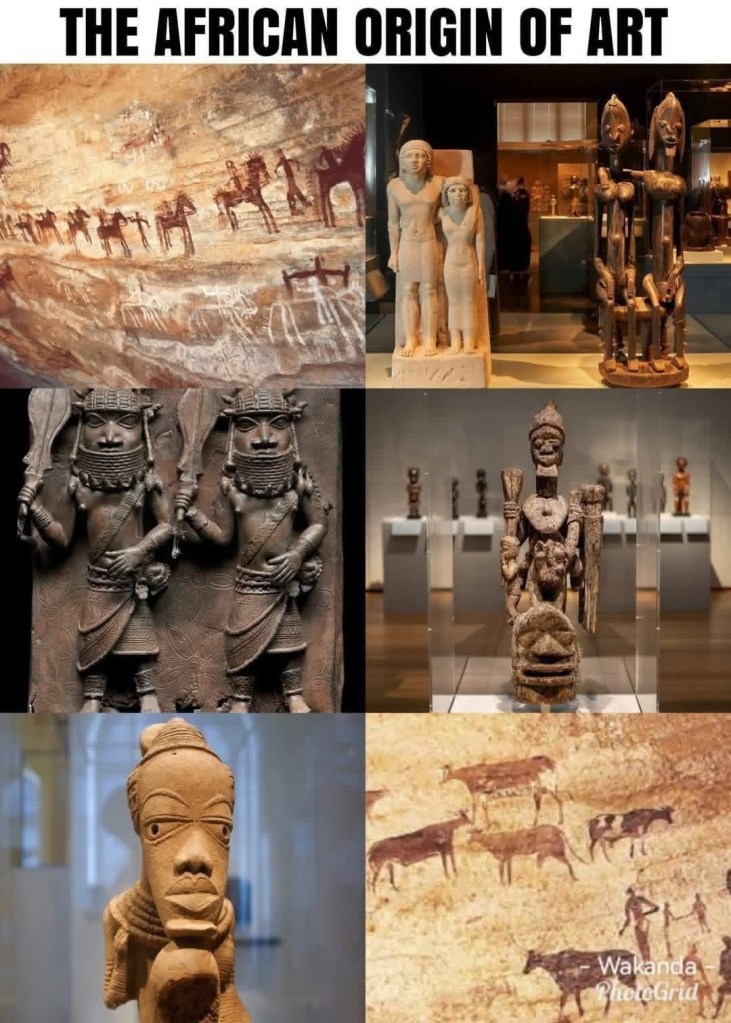
African art history offers a profound insight into the continent’s early human expressions, which significantly influenced global culture. One of the oldest art forms, rock art, serves as a vital window into ancient African societies. For example, rock art found in Namibia’s Apollo 11 caves is estimated to date back 24,000 to 27,000 years, with some researchers suggesting these artworks could be over 50,000 years old (Ngugi, 2022). In Malawi, Late Stone Age rock art illustrates human figures and animal motifs of the Natron culture, reflecting daily life and spirituality. The Kondoa Rock-Art Sites in Tanzania, further highlight the experiences and rituals of early hunter-gatherers (Vogt, 2015). Additionally, South Africa’s San people created rock art approximately 20,000 years ago, depicting animals and ritual practices, while Algeria’s Tassili n’Ajjer features prehistoric paintings that reveal complex societal structures through representations of animals and human figures (Bennoune, 2020; Salima, 2019).
The Nok culture of Nigeria produced some of the earliest known sculptures, particularly terracotta pottery heads that date from around 500 BC to 200 AD, revealing strong abstract figural representation that has persisted for over 2500 years (Okeke, 2019). The Igbo-Ukwu tribe’s bronze casting tradition from the 9th century CE exemplifies the enduring practice of cast metal art in Africa (Uche, 2025). Furthermore, the Yoruba people of Nigeria initiated fine brass and bronze castings in the 12th century CE, culminating in the creation of the renowned Benin bronzes, primarily brass heads constructed from the 15th century CE onward (Sowande, 2021). The earliest textile artifacts, also from Igbo-Ukwu, date to the 9th century CE, while the Tellam caves in Mali have yielded well-preserved cotton and woolen cloths dating back to the 11th century CE (Mensah, 2024).
In addition to bronze and terracotta, the Akan of Ghana are recognized for their small cast copper and bronze gold weights made since the 18th century CE, showcasing various forms including animals and geometric shapes (Ababio, 2017). The Kuba people of Central Zaire created the earliest surviving wooden sculptures from the 17th century CE, with a notable zoomorphic head unearthed in Angola being one of the oldest sculptures found south of the Sahara (Moko, 2023). Surviving examples of wood carving gained prominence around 1920, offering insights into tribal artistry prior to extensive collections made before 1945 (Faji, 2025). In Sudan, the Kingdom of Kush contributed significant pyramids and intricate funerary sculptures, paralleling Egyptian artistry and underscoring its cultural importance (Salima, 2019). Egypt itself, renowned for monumental architecture and elaborate tomb art, represents one of the most studied artistic traditions, reflecting complex societal beliefs and hieroglyphic narratives (Petrie, 2022).
References
Mensah, J. (2024). Textile Traditions in West Africa: An Overview. Journal of African Crafts, 18(4), 257-273.
Ngugi, W. (2022). The Past in Performance: Rock Art and Memory in Africa. African Studies Review, 65(2), 89-104.
Obi, S. (2021). Africa as a Cultural Hub: Artistic Expressions and Historical Narratives. African Review of Culture, 8(3), 187-205.
Jones, Q. (2020). Rock Art and the Symbolic World of Ancient African Societies. Journal of African Archaeology, 15(2), 155-168.
Bennoune, K. (2020). Cultural Heritage and Globalization: The Role of African Art. International Journal of African Studies, 15(1), 112-128.
Ababio, P. (2017). Art and Identity in Contemporary African Practices. African Art Journal, 22(3), 43-60.
 Hi welcome to my website